All Blog Posts

Creative Writing Projects That Spark Student Voice

When students write, they do more than put words on paper. They open doors to imagination, reflect on experiences, and learn how to communicate clearly. Creative writing projects give students the chance to explore perspectives, experiment with ideas, and strengthen critical thinking skills. Whether you are teaching English, history, science, or even math, incorporating creative writing activities for students helps them find a stronger sense of voice while connecting more deeply to your content.

In this post, we will look at why creative writing is important across subjects, share writing prompt ideas you can use right away, and explore how to make peer review and feedback a positive, manageable experience.

Why Creative Writing Matters Across Subjects

Creative writing often gets associated only with English class, but its benefits go much further. Encouraging students to write creatively builds essential skills they will use in every subject and long after graduation.

  • Communication skills: Writing prompts for classroom use give students practice in expressing themselves with clarity, structure, and purpose. Whether they are writing a science reflection or a historical narrative, they are strengthening skills they will need in presentations, emails, and professional writing later in life.
  • Empathy: When students write from perspectives different from their own, such as imagining life in another time period or telling a story through the eyes of a fictional character, they develop empathy and appreciation for diverse experiences.
  • Problem-solving: Creative writing often involves choices. Which character’s perspective should they use? How should a conflict be resolved? These decisions sharpen critical thinking and help students learn to approach problems in new ways.


When students see creative writing as more than “just an English activity,” they begin to view it as a tool for understanding the world.

Writing Prompt Ideas That Inspire

The right writing prompt can spark curiosity and motivate even reluctant writers to take risks. By mixing up the types of prompts you offer, you can make writing lessons more engaging and meaningful for every student.

Imaginative Prompts

These activities encourage students to dream big and explore new possibilities:

  • “What if gravity stopped working for one day? Describe how life would change.”
  • “You wake up with the ability to speak to animals. Write about your first conversation.”
  • “Create a diary entry from a time traveler who accidentally landed in your school today.”


Reflective Prompts

Personal writing helps students process their own growth and experiences:

  • “Describe a time you solved a problem you did not think you could.”
  • “What place makes you feel most at peace, and why?”
  • “Write a letter of gratitude to someone who has made a difference in your life.”


Cross-Curricular Prompts

Creative writing supports learning in science, history, and even math:

  • Science: Write an observation journal about a growing plant or describe a storm from the perspective of a raindrop.
  • History: Create a first-person account of a major event such as the Boston Tea Party or the March on Washington.
  • Math: Imagine you are a fraction trying to explain yourself to decimals. What would you say?

With Brisk, you can generate customized writing prompts in minutes that are tailored to both subject and grade level. This makes it easy to integrate creative writing into any lesson plan without needing to start from scratch.

Making Peer Review a Positive Experience

Peer review can be intimidating for students if they do not know how to give feedback effectively. Without support, comments often end up being vague (“It was good”) or overly critical. The goal is to help students see peer review as collaboration instead of judgment.

Here are a few strategies that work:

  • Model feedback language: Teach students to frame comments in a way that encourages revision. For example, instead of “This part is confusing,” they might say, “I was not sure what you meant here. Can you explain it more?”
  • Set clear expectations: Provide sentence starters or feedback stems, such as “One part I really liked was…” or “One thing you could add is…”
  • Keep it balanced: Encourage students to share at least one positive observation and one suggestion for improvement with each piece they review.


Brisk helps teachers and students practice this balance by generating “Glow and Grow” feedback prompts. Teachers can use these to model effective review, or students can use them as guides when offering feedback to classmates. With clear scaffolds in place, peer review becomes a process that builds confidence instead of discouragement.

Lightening the Teacher Workload in Writing-Heavy Units

Creative writing projects can be deeply rewarding, but the workload of reading and responding to student writing quickly adds up. Teachers often face the challenge of wanting to encourage frequent writing without being buried in stacks of essays and journals.

A few strategies can make this more manageable:

  • Quick writes and reflections: Not every assignment needs a detailed grade. Use short prompts for practice and focus detailed feedback on larger projects.
  • Batch feedback: Look for common patterns across submissions and address them in one message before tailoring comments for individual students. This saves time and ensures consistency.
  • Rubrics and clear criteria: Share expectations upfront so students understand what strong writing looks like and what they are being assessed on.


Brisk supports teachers with flexible feedback tools designed to lighten the load without losing personalization. You can provide feedback using Glows and Grows, targeted notes, rubric criteria, or next steps. If you are short on time, Batch Feedback allows you to respond to multiple assignments at once while still keeping comments meaningful. Since all feedback is fully customizable, you can edit what Brisk generates so it matches your own style and classroom needs.

Creative writing is not just an English activity. It is a way to amplify student voice, spark imagination, and strengthen critical thinking across subjects. With the right prompts, peer review systems, and teacher-friendly feedback strategies, you can create writing lessons that students actually look forward to.

By weaving creative writing activities for students into your classroom throughout the year, you will nurture curiosity, empathy, and confidence in every learner. And with Brisk as your partner, you can focus on what matters most: helping students find their voice while keeping your own workload balanced. Get started using Brisk today.

Latest Posts

Latest from the Brisk Blog

Explore practical articles for K–12 educators, from classroom-ready strategies to thoughtful guidance on using AI in ways that support real teaching.

Library shelves filled with books
September 14, 2026
Brisk Features

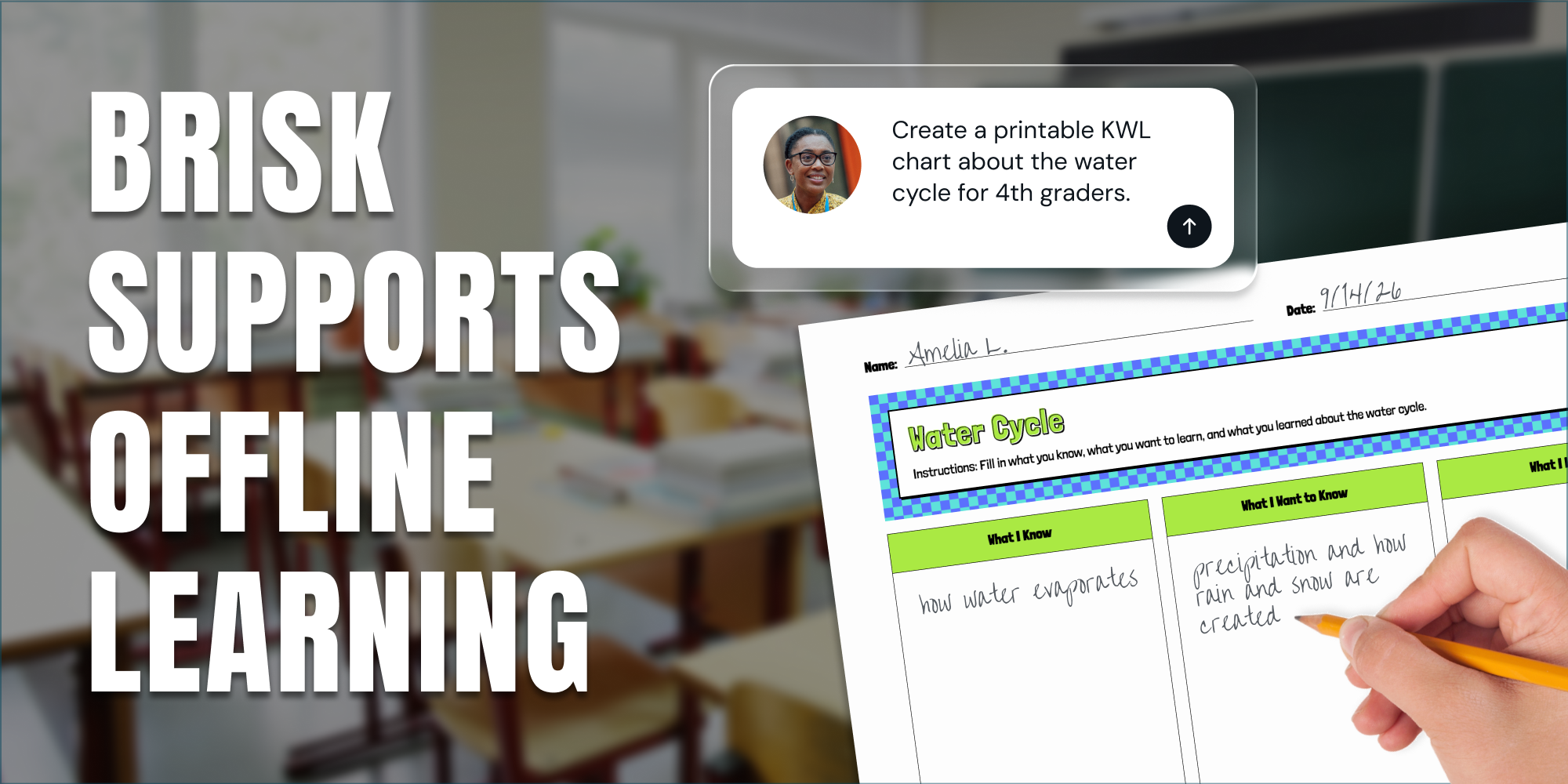
Print It, Project It, or Skip the Screen: How Brisk Fits Any Classroom

Brisk provides teachers with a variety of ways to support student learning, even when they’re focused on scaling back screen time in their classrooms.

Library shelves filled with books
August 14, 2026
Thought Leadership

Brisk in New White Paper on AI's Instructional Impact

Brisk founder Arman Jaffer shares his key takeaways from Whiteboard Advisors’ new white paper on measuring the instructional impact of AI in the classroom.

Library shelves filled with books
July 27, 2026
Tips for Teachers

60 Get-to-Know-You Questions for Students (For Every Grade)

60 get-to-know-you questions for students, organized by category and grade — plus, easy ways to use them for icebreakers, morning warm-ups, and first-day connection.

Library shelves filled with books
8
min
October 30, 2025
Tips for Teachers

45 Writing Prompts for Every Grade Level [2026 Edition]

Get 45 fresh, adaptable, ready-to-use writing prompts for students for every grade level. Our prompts are designed to meet students where they are and nurture their creative thinking.

In 2025, teachers face new challenges alongside timeless ones. Screen fatigue is at an all-time high, AI tools are reshaping how students think about “original” work, and there’s a renewed push for authentic creativity in every subject. Having quality, thought-provoking writing prompts for every grade level is more important than ever. The right question can spark creativity, build fluency, and turn hesitation into confidence.

If you’re looking for writing prompts for students that are fresh, adaptable, and ready to use, you’ve landed in the right spot. Below, you’ll find grade-specific prompts for every level K-12, designed to meet students where they are and help them grow.

And if you ever want even more ready-to-use options, tools like Brisk’s “Create Anything” button can save time by generating and tailoring prompts to your specific class in seconds.

Why Grade-Level Writing Prompts Matter

As students move through school, their thinking becomes more complex, and the prompts we give them need to match that growth. That’s where grade-level writing prompts make all the difference.

  • Elementary: Younger writers thrive when prompts spark imagination and guide them with simple, scaffolded sentences. The goal is to build fluency while keeping them excited to keep the pencil moving, so much so that they’re disappointed when it’s time to stop.
  • Middle School: At this age, students are rapidly growing into their identities. Low-stakes writing prompts are especially powerful here. Short, casual exercises encourage empathy, creativity, and abstract thought without the pressure of a grade.
  • High School: Older students are preparing for life beyond the classroom. Prompts should challenge them to analyze, persuade, and express their unique perspectives. These grade-level writing prompts invite deeper critical thinking and help students refine their voices.

And across every grade, low-stakes writing prompts serve a bigger purpose than just filling a journal page. Quick, ungraded tasks build fluency, reduce fear of failure, and remind students that writing isn’t only about the grade, it’s about the practice.

Grade-by-Grade Prompts

Elementary Spark: 15 Creative Writing Prompts for Kids

At the elementary level, kids thrive on storytelling, imaginative play, and prompts that bring the abstract into something they can picture. The best elementary writing prompts 2025 are concrete, fun, and visual, perfect for building fluency while keeping young writers engaged. Elementary school teachers, try these creative writing prompts for kids:

  1. If your pet could talk, what would they say about your family?
  2. What would you do if you found a magic key at the playground?
  3. Draw and describe your dream treehouse.
  4. What would happen if the playground turned into a jungle overnight?
  5. Write about a time you felt really proud of yourself.
  6. Pretend you’re a superhero. What’s your power, and what problem do you solve first?
  7. If your shoes had a memory, what story would they tell about your day?
  8. If you could invent a holiday, what would it celebrate and how would people celebrate it?
  9. If you could be any animal for a day, which one would you choose and why?
  10. Describe the best lunch ever. What’s in it, and who’s at the table?
  11. Imagine you found a treasure map on your desk. Where does it lead?
  12. If your shadow came to life, what kind of adventures would you have together?
  13. Imagine your school is floating in the sky. What would be different?
  14. If your backpack could talk, what secrets would it share?
  15. Describe the best ice cream flavor that doesn’t exist yet.

Teacher Tip: Mix narrative, opinion, and descriptive prompts so every student has a way in. One day you’re sparking imagination, the next you’re nudging students toward reflection.

For more targeted grade-by-grade choices, explore our grade-specific prompt guides:

Middle School Moments: Engaging Writing Prompts for Pre-Teens and Teens

Middle school is all about self-discovery and testing new ideas. Middle school writing prompts should offer choice and push students into empathy, creativity, and deeper thinking, without overwhelming them. These creative writing prompts for teens balance imagination with growing critical thought:

  1. Write a story where the main character makes a decision they can’t undo.
  2. If you could swap lives with someone for one week, who would it be and why?
  3. Argue: Should school start later in the morning?
  4. Write about a decision you made that changed your perspective.
  5. Imagine you wake up in 2050. What’s the first thing you notice about the world?
  6. If you could interview any historical figure, who would it be and what would you ask?
  7. Write a story about discovering a locked journal with secrets inside.
  8. Imagine you could relive one day of your life—would you change anything?
  9. Write a story where you’re the hero, but everyone thinks you’re the villain.
  10. Should students have three-day weekends every week? Why or why not?
  11. If your community had to choose one student as mayor for a year, what would you do if it were you?
  12. Imagine the internet shut down worldwide. What would happen at your school?
  13. Write a letter to your future self in high school.
  14. Write about a time you stood up for something you believed in.
  15. Imagine a world where adults went to middle school and kids were the teachers.

Teacher Tip: Offer 2-3 prompt choices at once. Students stay more engaged when they can pick something that resonates, and you’ll enjoy more variety when grading.

High School Depth: Critical & Creative Essay Prompts for 2025 Classrooms

By high school, students are ready for complex ideas that push them toward critical thinking, voice, and audience awareness. The best high school writing prompts ask them to wrestle with real-world issues and reflect on personal experience. Try these writing prompts for teens to stretch their skills:

  1. Write an op-ed about the role of technology in shaping your generation.
  2. Describe a single day that changed your perspective on life.
  3. Imagine a world without social media. What would be better, what would be worse?
  4. What does freedom mean to your generation?
  5. Write about a time you failed at something. How did it shape you?
  6. If you could erase one event from history, what would it be and why?
  7. Write about a moment that made you see the world differently.
  8. Imagine meeting your 80-year-old self. What advice would they give you?
  9. Should art and music be considered as important as math and science? Why or why not?
  10. Write a story where the ending completely changes how the reader understands the beginning.
  11. What would happen if teenagers ran the world government for a year?
  12. Describe a tradition or routine that means more to you than most people realize.
  13. Argue whether schools should keep, change, or drop grades as we know them.
  14. Do you think AI will make students stronger or weaker writers? Explain.
  15. Write a college admissions essay about something no one else would think to write about.

Teacher Tip: Encourage students to mix informal journaling with polished argumentative pieces. It keeps writing fresh and lets students hear their own voices in both casual and academic contexts.

Low-Stakes Writing Prompts vs. High-Stakes Writing: Finding the Balance

So how do you know when to use low-stakes writing prompts and when to shift into high-stakes writing? The key is balance. You want students writing often enough that it feels natural, but not so often that the task becomes robotic. Pairing low- and high-stakes activities helps build fluency while still giving space for rigor and polished work.

What is Low-Stakes Writing?

Low-stakes writing is informal, ungraded, and designed to get students thinking more than stressing about perfection. The purpose isn’t a flawless product; it’s the practice. Low-stakes writing prompts can include:

  • Daily journaling
  • Quick writes at the start of class
  • Exit tickets at the end of a lesson
  • Creative brainstorming exercises

Because they’re short and pressure-free, low-stakes tasks can even double as formative assessments. Used frequently, they encourage fluency, remove fear of failure, and remind students that writing is about ideas, not just grades.

What is High-Stakes Writing?

On the other hand, high-stakes writing involves assignments with weight — polished, graded pieces that measure mastery. These tasks matter for grades, portfolios, or even college applications, so the pressure is higher. Common high-stakes writing assignments include:

  • Essays or research papers
  • Projects and presentations
  • Lab reports or technical write-ups
  • Summative assessments tied to rubrics

Unlike daily journaling, high-stakes writing should be assigned less frequently. Its purpose is to assess learning and mastery, give students practice with structure and polish, and show growth over time.

Teacher Tip: Think of it as a rhythm. Use frequent low-stakes writing prompts to keep students’ pens moving, and reserve high-stakes writing for the moments that matter most.

Tips for Using Daily Writing Prompts to Engage Learners

Not every student walks into class excited about writing, but the right strategies can make even reluctant writers lean in. Here are a few ways to make daily writing prompts for students feel fresh, purposeful, and engaging:

  • Rotate prompts weekly: If the same type of activity shows up too often, students will go through the motions. By switching up narrative, opinion, and creative prompts, you’ll keep energy high and curiosity alive.
  • Let students vote: Offer 2–3 prompts and let the class choose. This small act of agency gives them ownership over the task and makes them more likely to put effort into their work.
  • Cross the subject lines: Don’t limit prompts to ELA. Writing can happen in every classroom; from “Describe the life of a raindrop” in science to “Write a letter to a famous mathematician” in math. Integrating prompts into multiple subjects helps normalize writing as thinking.

Teacher Tip: If you need fresh prompts and are short on time, Brisk’s free AI tools can generate fresh prompts in seconds or adapt existing prompts to different grade levels, making it easier to keep writing relevant and fun.

The Future of Student Writing in 2025

At their best, writing prompts aren’t just tasks, they’re sparks. They ignite creativity, open the door for student voice, and show kids that writing can be about expression as much as structure. When we tailor writing prompts for every grade level, we give students the right amount of challenge at the right time.

The result? Growth in confidence, fluency, and originality. The sooner you weave prompts into your routine, the faster you’ll see gains in student writing and engagement.

Brisk can help you generate fresh, novel writing prompts — based on any topic and tailored to any grade level — in seconds. Start using Brisk for free today.

Library shelves filled with books
8
min
October 1, 2025
Brisk Features

Batch Feedback: Personal Feedback for Every Student, All at Once

Batch Feedback helps teachers give personal, high-quality feedback to every student at once — timely, consistent, and fully teacher-led.

The Challenge Every Teacher Faces

If you’ve ever sat down with a stack of student work and thought, How am I going to get through all of this and still give the kind of feedback my students deserve? — you’re not alone.

Feedback is one of the most powerful ways we move learning forward. It clarifies, motivates, and guides. But it also takes time — sometimes weeks. By the time students see your comments, they’ve already moved on to the next unit.

And here’s the tough part: the first few papers often get your freshest energy, while the later ones get shorter comments. It’s not that you care less. It’s that your time and energy are limited, even when every student deserves your best.

That’s the challenge Batch Feedback is here to solve.

Goodbye Grading Pile. Hello, Batch Feedback.

Brisk has always supported teachers with tools like Glows & Grows, Next Steps, and Rubric Criteria. Until now, though, feedback was one doc at a time. Helpful, yes. But still time-consuming when you’re facing a whole class set.

Batch Feedback takes everything you already love about Brisk’s feedback tools and scales it across your class — in one sitting.

Here’s how it works:

  • Upload a folder of student work from Google Drive or Google Classroom. Essays, PDFs, even photos of handwritten math — it all works.
  • Pick your feedback style: Glows & Grows, Next Steps, or Rubric Criteria.
  • Customize feedback with grade levels, standards, rubrics, or focus areas.
  • Review and edit before sending. Nothing is auto-published — you make the final call.


The result? Thoughtful, personalized feedback for every student, delivered while learning is still fresh.

See Batch Feedback in action:

Keeps Kids Learning, Not Waiting.

Feedback is essential — but it loses impact when it takes too long. Batch Feedback changes the timeline so students get the guidance they need, right when they need it.

  • Keeps kids learning, not waiting. Students get comments while they’re still engaged with the assignment.
  • Closes the timing gap. Typical turnaround is 2–3 weeks. With Batch Feedback, it’s often a single day.
  • Consistency across the class. Every student gets clear, actionable feedback, not just the first few in the pile.
  • Always your words. Every draft is reviewed and shaped by you before it’s shared.
  • Less stress. More teaching. Whole-class feedback in one sitting, without lowering your standards.

Batch Feedback isn’t about lowering the bar. It’s about making high-quality feedback manageable — for every learner, every time.

Feedback That Feels Personal

This is what teachers notice: feedback doesn’t stop being personal just because it’s faster.

Instead of typing the same comment 25 times, you’re refining thoughtful drafts already in place. Students still hear your voice. You still decide what goes back into their work.

The difference? Every learner gets meaningful, supportive feedback — and you don’t have to sacrifice hours of your time to make it happen.

Works on Any Kind of Student Work

Batch Feedback isn’t limited to essays. Whether it’s a PDF, a lab report, or a snapshot of math work, you can return high-quality comments in one go.

Feedback scales across assignments without losing clarity or care. That means more consistency, more equity, and more time back for you.

Try It Today

Batch Feedback is live in Brisk now. Getting started takes just a few clicks:

  1. Open the Brisk extension.
  2. Select Feedback → Batch Feedback or click the Home icon → Batch Feedback.
  3. Import your student work and get started.

Your students get timely, personal feedback that moves learning forward. And you get back the time and energy you need to keep teaching at your best.

Try Batch Feedback today.

`

READY TO BRING BRISK TO YOUR DISTRICT?

See how 20,000+ districts adopted AI with full compliance and teacher buy-in from day one.