
All Blog Posts

Ai cũng có thắc mắc về AI — Đây là cách các nhà lãnh đạo có thể giải đáp

Khi năm học mới bắt đầu, nhiều nhà quản lý giáo dục cấp quận đã nhận được những câu hỏi thẳng thắn về cách họ sẽ quản lý sự bùng nổ của AI — và công nghệ nói chung — trong lớp học. Đây là một thách thức đa chiều đối với các nhà quản trị, vì hội đồng nhà trường, lãnh đạo chuyên môn, giáo viên và phụ huynh đều muốn có câu trả lời, nhưng không phải lúc nào họ cũng đặt ra cùng một câu hỏi.

Để giải quyết thành công thách thức này, cần có sự hiểu biết sâu sắc về đặc thù của từng quận cùng với sự hỗ trợ công nghệ chiến lược phía sau. Điều đầu tiên là yêu cầu cơ bản đối với một đội ngũ lãnh đạo quận hiệu quả; điều thứ hai chính là nơi mà các công ty như Brisk có thể đóng góp vai trò của mình.

Brisk được thành lập với mục tiêu trở thành điểm khởi đầu cho công việc của giáo viên. Sứ mệnh này vẫn là động lực thúc đẩy mọi hoạt động của chúng tôi, nhưng khi giáo dục tiến tới bước ngoặt hiện tại, việc đối mặt với bối cảnh rộng lớn hơn nơi công việc này diễn ra đã trở nên cần thiết.

Đó là lý do tại sao trong suốt năm 2026, chúng tôi đã xây dựng một bộ công cụ giúp các nhà quản trị hỗ trợ giáo viên làm việc hiệu quả nhất. Những công cụ này không áp đặt chính sách của quận, cũng không làm mất đi những nét cá tính riêng biệt tạo nên sự hiệu quả của những giáo viên giỏi. Thay vào đó, chúng cung cấp cho lãnh đạo quận dữ liệu, khả năng quan sát và quyền kiểm soát cần thiết để trả lời những câu hỏi khó nhưng quan trọng về tương lai của giáo dục.

1. Hội đồng nhà trường hỏi: “Những công cụ AI nào đang được sử dụng trong trường học của chúng ta?”

Ngay cả đối với các quận có đội ngũ CNTT hàng đầu, câu trả lời cho câu hỏi này thường chỉ dừng lại ở mức ước tính. Việc quản lý danh sách người dùng tập trung và đăng nhập một lần (SSO) có thể thống kê các công cụ được mua ở cấp trường hoặc cấp quận, nhưng không thể kiểm soát được các công cụ mà giáo viên tự đăng ký sử dụng.

Quản trị AI của Brisk cho lãnh đạo quận biết giáo viên đang sử dụng những công cụ AI nào, bất kể các công cụ đó có được cấp phép hay không. Tính năng Quản trị AI cung cấp khả năng giám sát việc giáo viên sử dụng hơn 20 công cụ AI, từ ChatGPT và Gemini đến Kahoot! và Canva AI. Dữ liệu sử dụng được tổng hợp ở cấp trường, vì vậy giáo viên không cần lo lắng về việc thói quen cá nhân của mình bị soi xét.

Ngoài việc theo dõi mức độ sử dụng công cụ theo thời gian, Brisk còn đối chiếu việc sử dụng với danh sách các công cụ được quận phê duyệt, giúp các nhà quản trị có cái nhìn rõ ràng về mức độ tuân thủ chính sách tại mỗi trường. Với dữ liệu toàn diện và dài hạn này, các nhà quản trị sẽ chuẩn bị tốt hơn cho cả các cuộc họp hội đồng và các đợt đánh giá phần mềm trên toàn quận.

2. Lãnh đạo chuyên môn hỏi: “Làm thế nào để chúng ta định hướng việc sử dụng AI của giáo viên?”

Các quận đầu tư rất nhiều thời gian và nguồn lực vào phát triển chuyên môn, khung sư phạm, ưu tiên tiêu chuẩn và các cơ chế khác để định hình phương pháp giảng dạy trong lớp học. Hướng dẫn của Brisk cung cấp cho các nhà quản trị một cách thức để đảm bảo những khoản đầu tư này tạo ra tác động đến việc giảng dạy mỗi ngày.

Hướng dẫn của Brisk tích hợp mọi yếu tố quan trọng đối với một quận — từ các ưu tiên chiến lược và giá trị văn hóa đến triết lý học tập và tiêu chí đánh giá — vào mọi nội dung giáo viên tạo ra với Brisk. Nếu một nhà quản trị đưa ra các chỉ dẫn như: “Sử dụng cấu trúc Mô hình Hội thảo: bài giảng ngắn, thực hành độc lập, tổng kết” vào Hướng dẫn của Brisk, thì khi giáo viên yêu cầu Brisk hỗ trợ xây dựng kế hoạch bài giảng, kế hoạch nhận được sẽ tự động khớp với Mô hình Hội thảo đó.

Thông qua Brisk Level Up, các chỉ dẫn của nhà quản trị cũng được mở rộng cho tất cả các công cụ AI nằm trong phạm vi Quản trị AI. Giả sử một giáo viên gửi yêu cầu nhanh về một bộ đánh giá quá trình vào ChatGPT. Chỉ trong vài giây, Level Up sẽ chuyển đổi yêu cầu này thành một câu lệnh (prompt) giàu tính sư phạm, phản ánh Hướng dẫn của Brisk dành riêng cho quận và hiển thị cho giáo viên một ghi chú ngắn về những gì đã được cải thiện. Điều này không chỉ giúp các quận nắm bắt được cách thức đặt câu lệnh AI trong trường học đang cải thiện theo thời gian như thế nào, mà còn cung cấp cho họ cách thức mở rộng hỗ trợ sư phạm cho giáo viên trong mọi tương tác với AI.

3. Giáo viên hỏi: “Làm thế nào để tôi điều chỉnh các tài nguyên hỗ trợ bởi AI cho phù hợp với chương trình giảng dạy?”

Hầu hết các công cụ AI không phân biệt được đâu là tài liệu giảng dạy chất lượng cao và đâu là tài nguyên ngẫu nhiên lấy từ internet, vì vậy giáo viên phải tự tay điều chỉnh mọi kết quả đầu ra mà không có nhiều sự hỗ trợ hay cấu trúc. Điều đó không hiệu quả — cũng không thực sự mang lại kết quả tốt.

Là sự bổ sung cho Brisk Guidance, Brisk Curriculum Intelligence cung cấp một bộ công cụ lấy chương trình giảng dạy của học khu làm điểm khởi đầu cho mọi nội dung được tạo ra. Với Curriculum Intelligence, giáo viên nhận được các tài nguyên tự động khớp với phạm vi, trình tự và tiến độ của học khu, đồng thời các nhà quản lý có thể nắm bắt cách chương trình giảng dạy được áp dụng trong các lớp học.

Các nhà quản lý chủ động cũng có thể xây dựng Thư viện Học khu (District Library) trong Brisk, giúp giáo viên dễ dàng tiếp cận bộ sưu tập các tài nguyên giảng dạy đã được phê duyệt. Những gói tài nguyên theo từng bài học này có thể dựa trên các tài liệu sẵn có hoặc được tạo ra bằng các đề xuất thông minh của Brisk.

4. Cộng đồng của bạn đặt câu hỏi: “Các bạn đang kiểm soát việc học tập dựa trên màn hình có sự hỗ trợ của AI như thế nào?”

Nhiều cơ quan lập pháp tiểu bang và hội đồng giáo dục — cũng như nhiều phụ huynh và các nhóm vận động — cho rằng hiện đã có quá nhiều màn hình trong lớp học và lo ngại rằng AI sẽ chỉ làm tăng thêm sự phổ biến của việc học trực tuyến.

Mặc dù tại Brisk, chúng tôi tin rằng công nghệ có nhiều cách để hỗ trợ việc học tập, nhưng chúng tôi cũng nhận ra rằng công nghệ không phải lúc nào cũng là giải pháp tốt nhất cho mọi thách thức giáo dục. Vì vậy, Brisk được thiết kế để cung cấp cho giáo viên nhiều cách thức hỗ trợ học sinh học tập ngay cả khi họ đang cắt giảm thời gian sử dụng màn hình trong lớp học.

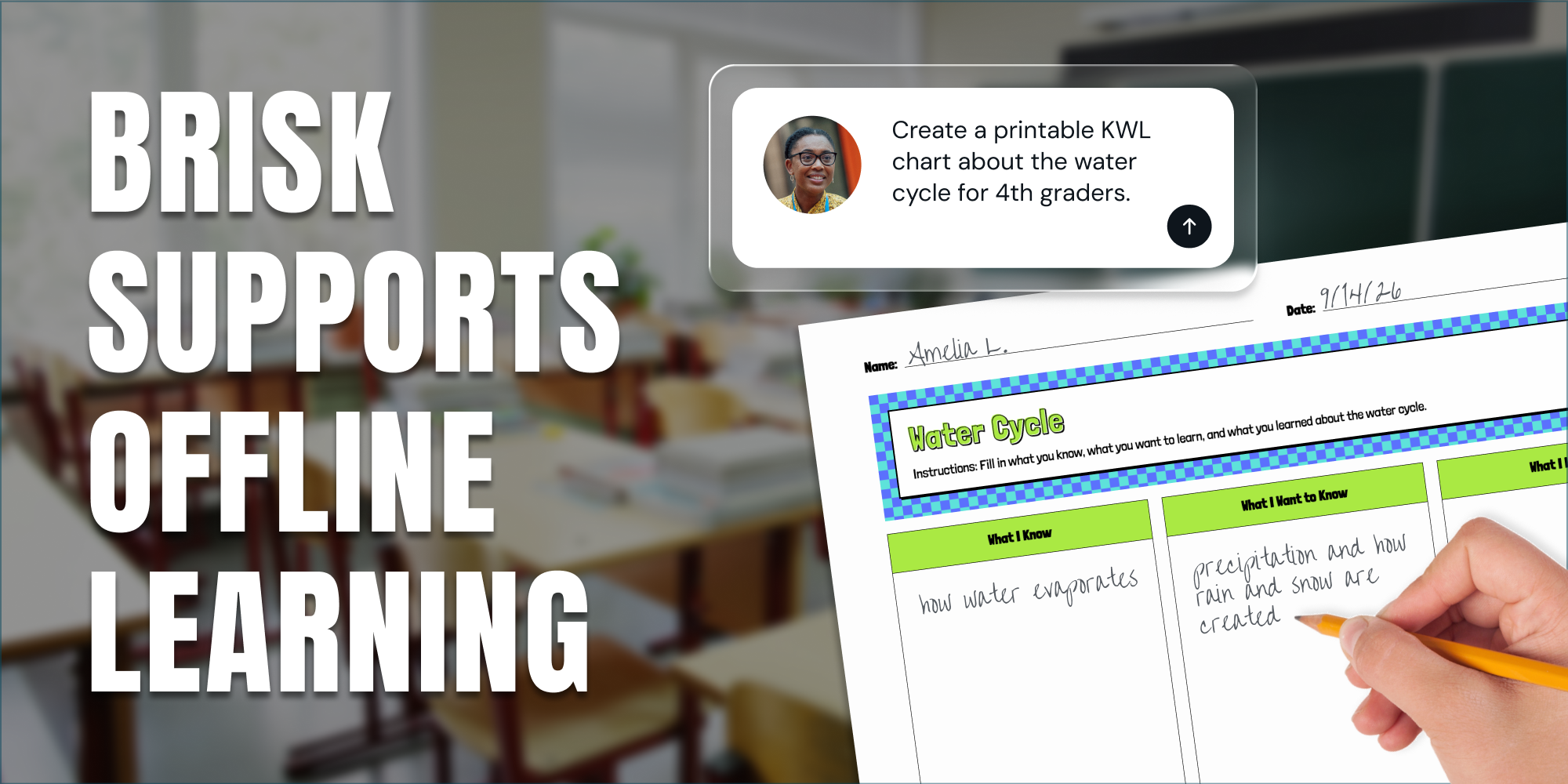
Ví dụ, Brisk Printables Generator giúp giáo viên chuyển đổi các tài nguyên kỹ thuật số yêu thích của họ thành các hoạt động trên giấy bút sẵn sàng để in ấn. Hiện tại, giáo viên có thể sử dụng Brisk để tạo bảy loại tài liệu in: Mô hình Frayer, Biểu đồ KWL, Biểu đồ Venn, Hỏi đáp, Phiếu bài tập, Sơ đồ tư duy, Bản tin.

Điều đó có nghĩa là một giáo viên tiểu học có thể tạo biểu đồ KWL cho học sinh hoàn thành trước khi bắt đầu bài học về vòng tuần hoàn của nước mà không cần tốn nhiều thời gian định dạng tệp thiết kế. Hoặc, chỉ với vài cú nhấp chuột, một giáo viên lịch sử trung học có thể tạo biểu đồ Venn yêu cầu học sinh so sánh và đối chiếu Cộng hòa La Mã và Đế chế La Mã.

Brisk cũng giúp giáo viên đưa ra phản hồi kịp thời cho các bài làm viết tay, dịch, phân cấp và in văn bản để hỗ trợ giảng dạy phân hóa, cũng như đưa ra các hoạt động không cần màn hình như phòng thí nghiệm khoa học, trò chơi thoát hiểm và podcast giáo dục.

Nền tảng vững chắc cho mọi vấn đề cần tìm hiểu

Không có câu trả lời dứt khoát cho việc một học khu nên giải quyết sự gián đoạn do AI tạo ra như thế nào, vì mỗi học khu và cộng đồng đều có những ưu tiên riêng. Điểm chung trên cả nước là mọi người đều có những câu hỏi và mối quan tâm chân thành về ý nghĩa của AI đối với giáo dục.

Cũng như bao người khác, chúng tôi đang thử nghiệm, học hỏi và suy nghĩ sâu sắc về cách hỗ trợ học sinh học tập trong năm 2026 và xa hơn nữa. Trong suốt quá trình đó, chúng tôi nỗ lực trang bị cho các nhà lãnh đạo học khu dữ liệu, khả năng quan sát và quyền kiểm soát cần thiết để trả lời những câu hỏi nêu trên.

Latest Posts

Latest from the Brisk Blog

Explore practical articles for K–12 educators, from classroom-ready strategies to thoughtful guidance on using AI in ways that support real teaching.

Library shelves filled with books
September 18, 2026
Administrators

Ai cũng có thắc mắc về AI — Đây là cách các nhà lãnh đạo có thể giải đáp

Khi các nhà lãnh đạo cấp quận đối mặt với ngày càng nhiều câu hỏi về cách họ quản lý AI, họ cần cả khả năng nắm bắt tình hình sử dụng AI lẫn quyền hạn để định hình công nghệ này.

Library shelves filled with books
September 14, 2026
Brisk Features

In, chiếu, hoặc không cần màn hình: Cách Brisk phù hợp với mọi lớp học

Brisk cung cấp cho giáo viên nhiều cách thức đa dạng để hỗ trợ học sinh học tập, ngay cả khi họ đang tập trung vào việc cắt giảm thời gian sử dụng màn hình trong lớp học.

Library shelves filled with books
August 14, 2026
Thought Leadership

Brisk in New White Paper on AI's Instructional Impact

Brisk founder Arman Jaffer shares his key takeaways from Whiteboard Advisors’ new white paper on measuring the instructional impact of AI in the classroom.

Library shelves filled with books
8
min
June 18, 2026
Administrators

Best AI Solutions for Schools & Districts (2026)

This guide covers the most-vetted AI solutions across three categories that matter most to district buyers: teacher productivity, student learning, and district infrastructure.

The market for K–12 AI tools has matured quickly. Schools are no longer asking whether they should adopt AI, but rather which platforms are safe, effective, and worth the district-level investment.

This guide covers the most-vetted AI solutions across three categories that matter most to district buyers: teacher productivity, student learning, and district infrastructure.

What Schools and Districts Actually Need From AI

Before evaluating tools, district administrators and instructional technology coordinators typically prioritize:

  • FERPA and COPPA compliance: Student data must never be used to train third-party AI models.
  • SOC 2 Type 2 certification or equivalent: Enterprise-grade security infrastructure.
  • Signed Data Privacy Agreements (DPAs): Required for procurement in most districts.
  • LMS integration: Canvas, Google Classroom, PowerSchool Schoology, and Clever compatibility.
  • Teacher control and visibility: Staff must be able to monitor student AI interactions.
  • Scalability: Tools must work across an entire school or district, not just individual classrooms.

Any platform that cannot meet these criteria deserves close scrutiny before it touches student data.

Best AI Tools for Teacher Productivity

Brisk Teaching

Brisk Teaching is the #1 trusted AI platform built for educators. There are two main components of the Brisk AI platform:

Brisk’s Browser Extension

Brisk’s Chrome and Edge browser extension works directly inside the tools teachers already use (Google Docs, Microsoft Word, Google Classroom, Canvas, Schoology, Blackboard, and more) without requiring a separate platform login or workflow change. The extension aspect of Brisk is what makes integration into the tools educators are already using seamless.

Some of Brisk’s core features include:

  • Give Feedback (instant, rubric-aligned feedback on student writing): Brisk generates specific comments on student drafts in seconds, across modes like Glow & Grow, Targeted, and Rubric Criteria. Teachers review, edit, and post without starting from scratch.
  • Inspect Writing (see how student work was written): Brisk replays a document's writing and revision history, so teachers can understand how a draft came together and ground academic-integrity conversations in evidence rather than guesswork. Brisk also includes a built-in AI writing detector.
  • Change Reading Level (text leveling and differentiation): Any article, passage, or document can be rewritten to a target reading level in one click.
  • Create (lessons and materials): Generate quizzes, slides, guided notes, discussion questions, exit tickets, rubrics, and more, directly from existing content or from a prompt.
  • Brisk Boost (student-facing interactive activities): Take any trusted resource and easily create a safe AI learning experience for students.

Brisk on the Web

Brisk on the Web serves as an online hub where educators can plan, assign, and give feedback all in one place. Brisk on the Web surfaces recommendations and ready-to-use resources, refreshed in real-time based on educational needs and classroom insights.

Within Brisk on the Web, educators can:

  • Get ideas for what to teach next with Brisk Next
  • Quickly grade batches of student work at once with Batch Feedback
  • Access their full library of created materials and activities
  • Get insight into how students are engaging with interactive learning activities

Best for: Districts looking for AI that’s purpose-built for real classroom workflows. Because it operates as a browser extension and integrates into existing tools, adoption friction is low — teachers do not need to learn a new interface. Brisk also works inside the LMS tools districts have already deployed.

Additionally, with Brisk, educators are starting from what they already know and trust: your curriculum, a digital textbook, a YouTube video, or a vetted document. These resources power what teachers create, so they’re never getting sloppy AI content.

On the student side, Brisk Boost turns any trusted resource into a safe, guided activity — building AI literacy and helping students work toward understanding rather than just getting answers.

Privacy: Brisk Teaching is built to clear district procurement review. It is SOC 2 Type 2 certified (as of October 2025) and compliant with FERPA, COPPA, and GDPR. Brisk has also earned the 1EdTech Data Privacy Certification and TrustEd Apps Seal and holds a 95% Common Sense privacy rating. Student data is never used to train AI models and is never sold, the underlying content of student work is not stored once a task is complete, and Brisk has signed the National Data Privacy Agreement with twelve states, with district-level agreements available where a state DPA is not in place.

Diffit

Diffit specializes in reading and worksheet differentiation. Teachers paste in any source — an article, a YouTube link, a search topic — and Diffit generates leveled reading versions, comprehension questions, and vocabulary supports at the click of a button. The tool is designed to reduce the time teachers spend manually adapting texts for students who read above or below grade level, making it a practical resource for classrooms with diverse learners.

Best for: English Language Arts teachers, special education departments, and schools serving students across a wide range of reading levels. It is particularly valuable in inclusion classrooms and in buildings where multilingual learners make up a significant portion of the student population.

Privacy and integration: Diffit operates as a standalone web platform. Districts should request a signed DPA prior to any classroom deployment. Because teachers work within Diffit's own interface rather than inside an LMS, schools will want a clear plan for how generated materials are distributed to students — typically by exporting to Google Docs, Slides, or Google Classroom, or by printing. Diffit does not use student data to train AI models.

Best AI for Student Learning and Adaptive Practice

Khanmigo (Khan Academy)

Khanmigo is Khan Academy's AI tutor for students. It provides guided, step-by-step support across subjects like math, science, and writing without giving answers away, reinforcing problem-solving skills rather than bypassing them. For teachers, it also supports lesson planning, Socratic questioning frameworks, and discussion facilitation. Khanmigo is grounded entirely in Khan Academy's content library, giving it a clear and well-defined instructional scope across subjects and grade levels.

Best for: Districts seeking a free or low-cost student tutoring supplement with a trusted brand behind it. Khanmigo is well suited for after-school or homework support programs, math intervention tiers, and schools that want an AI-assisted learning tool with a long-established content foundation. Khan Academy's nonprofit status and track record make it one of the more straightforward privacy evaluations a district procurement team will encounter.

Privacy and integration: Khanmigo connects to Canvas, Google Classroom, and Schoology (the latter via Clever), so its teacher tools slot into the LMS a district already runs. Student access, however, is provisioned through a school or district implementation rather than self-serve signup, so districts should plan rostering accordingly. Khan Academy holds a strong privacy record and does not sell student data; confirm a current DPA is in place before assigning student accounts.

NotebookLM (Google)

NotebookLM is an AI-powered research assistant from Google. Students upload source materials — PDFs, Google Docs, lecture notes, YouTube videos — and NotebookLM generates summaries, answers questions from those sources, and creates study guides.

Best for: Middle and high school students doing research-heavy work or exam preparation. Because it grounds all responses in uploaded source material, it substantially reduces hallucination risk compared to general-purpose AI.

Privacy note: Districts using Google Workspace for Education already have a DPA in place with Google. NotebookLM for Education falls under that agreement for eligible accounts.

Best District-Wide AI Infrastructure

Gemini for Google Workspace for Education

For districts already running Google Workspace for Education, Gemini is a great option that integrates within Google’s own tool ecosystem. It surfaces within Gmail, Docs, Slides, and Meet, and connects directly to Google Classroom without additional procurement.

What it does for districts:

  • Drafts communications, newsletters, and policy documents for administrators.
  • Helps teachers generate rubrics, lesson plans, and differentiated materials within Google Docs.
  • Supports students with writing assistance and research within the same tools they already use.

Gemini is a general-purpose AI layer, not a purpose-built educator tool. It lacks the classroom-specific features — like rubric-aligned feedback, AI detection, or LMS-embedded grading support — that tools like Brisk Teaching were designed to deliver.

Privacy: Covered under Google's existing Workspace for Education data processing agreements. Google does not use Workspace customer data to train its AI models.

Microsoft Learning Accelerators and Copilot for Education

Microsoft's AI suite for education spans two things districts should treat separately. The Learning Accelerators — Reading Progress, Reading Coach, Search Coach, and others — are included in Microsoft 365 Education licenses down to the free A1 tier, and so is Copilot Chat. Full Microsoft 365 Copilot, the assistant embedded across Word, PowerPoint, Teams, and OneNote, is a paid add-on rather than part of the base license.

Best for: Districts already on Microsoft 365 who want to start with the AI capabilities bundled into their existing licenses, with the option to add full Copilot later.

How to Evaluate and Compare AI Tools for Your District

The Procurement Checklist

Before shortlisting any platform, confirm the below. (Get our guide to evaluating AI tools for your district here.)

Criteria
Questions to Ask
Data privacy
Does the vendor sign a DPA? Is the tool FERPA and COPPA compliant? Is student data used for model training?
Security
SOC 2 Type 2 certified? What is the data retention policy?
LMS integration
Does it connect to your LMS via LTI or API? Does it require roster syncing?
Teacher control
Can teachers monitor student AI interactions? Can they restrict what the AI will discuss?
Adoption requirements
Is this a platform teachers must log into separately, or does it work inside existing tools?
Pricing model
Per-seat, per-school, or district-wide license? What does pilot access look like?

Matching Tools to Use Cases

Use Case
Recommended Tool(s)
In-workflow feedback and grading support
Brisk Teaching
Differentiated reading materials
Brisk Teaching, Diffit
Student tutoring and adaptive practice
Khanmigo, Brisk Teaching
District-wide Google Workspace AI
Gemini for Education, Brisk Teaching
District-wide Microsoft 365 AI
Microsoft Copilot for Education
Research and study assistance
NotebookLM

Frequently Asked Questions

What is the safest AI platform for student data in K–12?

There's no single "safest" platform — what matters is that the vendor commits in writing to never training on student data and will sign a DPA. The purpose-built tools here (Brisk Teaching, Diffit, Khanmigo) bake that in, and Google's and Microsoft's tools provide it under their education agreements. Confirm the signed DPA before any student data touches the platform.

Does Brisk Teaching work with Google Classroom and Canvas?

Yes. Brisk Teaching is an AI platform and browser extension that integrates directly with Google Classroom, Canvas, Schoology, and more. Teachers access its features within those platforms without leaving their existing workflows.

What is the difference between Brisk Teaching and a general AI assistant like ChatGPT?

General AI assistants are not built for education, do not sign education-specific DPAs, and are not designed around teacher workflows. Brisk Teaching is purpose-built for K–12: its features — feedback, grading support, leveling, detection — map directly to classroom tasks, and it complies with the student data privacy requirements that district IT teams require.

How do AI tools integrate with our existing LMS?

Integration depth varies by tool. Brisk’s browser extension works across LMS platforms without requiring IT-managed LTI installation. Gemini and Microsoft Copilot integrate natively into their respective productivity ecosystems. Khanmigo connects to major LMS platforms (Canvas, Google Classroom, and Schoology via Clever), while tools like Diffit operate as standalone web platforms and may require separate login management.

What should districts budget for AI tools in 2026?

Costs vary widely. Khanmigo and NotebookLM for Education have free or low-cost tiers. Brisk Teaching offers both free and paid plans. Gemini and Microsoft's Copilot Chat are typically bundled with existing education licenses, while full Microsoft 365 Copilot is a paid add-on.

Purpose-built district platforms may charge on a per-seat or per-school basis. Many vendors will provide pilot pricing for districts evaluating at scale.

Are AI tools in schools required to comply with FERPA?

Yes, if they process student records or personally identifiable information. Schools must ensure any third-party AI vendor signs a school official exception agreement under FERPA. Vendors who cannot or will not sign a DPA should not be given access to student data.

Summary: How to Choose the Right AI Platform for Your School or District

There is no single AI platform that covers every use case for every school. The strongest approach is layered:

  1. Start with the LMS you already have. If your district runs Google Workspace, start with Brisk Teaching and Gemini. If you run Microsoft 365, Brisk Teaching and Copilot for Education work well.
  2. Add purpose-built classroom tools for teachers. Brisk Teaching fills the gap that general-purpose AI leaves open — specifically in feedback, grading, leveling, and academic integrity — and it does so inside the workflows teachers already use.
  3. Add student-facing learning tools selectively. Khanmigo and NotebookLM serve students well in tutoring and research contexts, with strong privacy track records.
  4. Validate privacy before you deploy. Confirm DPAs, FERPA compliance, and data retention policies for every tool before any student data touches the platform.

Districts that approach AI adoption this way tend to see faster teacher buy-in, fewer procurement delays, and lower risk of the data privacy issues that have slowed adoption in other districts.

Last updated: June 2026. AI platforms and their feature sets change frequently. Verify current integrations, pricing, and privacy certifications directly with each vendor before making procurement decisions.

`

READY TO BRING BRISK TO YOUR DISTRICT?

See how 20,000+ districts adopted AI with full compliance and teacher buy-in from day one.