
All Blog Posts

Todo el mundo tiene preguntas sobre la IA: así es como los líderes pueden responderlas

Con el inicio del nuevo año escolar, a muchos responsables de la toma de decisiones en los distritos se les ha preguntado directamente cómo van a gestionar la proliferación de la IA —y de la tecnología en general— en el aula. Esto representa un desafío multifacético para los administradores, ya que las juntas escolares, los líderes pedagógicos, los docentes y los padres quieren respuestas, aunque no siempre a las mismas preguntas.

Superar este desafío con éxito requerirá tanto un conocimiento profundo del distrito como un apoyo tecnológico estratégico entre bastidores. Lo primero es un requisito indispensable para cualquier equipo de liderazgo escolar eficaz; lo segundo es donde empresas como Brisk tienen un papel que desempeñar.

Brisk se fundó con el objetivo de ser el punto de partida para el trabajo docente. Esta misión sigue siendo la fuerza impulsora de todo lo que hacemos, pero a medida que la educación ha avanzado hacia su actual punto de inflexión, se ha vuelto necesario abordar el contexto más amplio en el que se desarrolla esta labor.

Por eso, a lo largo de 2026, hemos creado un conjunto de herramientas que permiten a los administradores ayudar a los docentes a realizar su mejor trabajo. Estas herramientas no dictan la política del distrito ni eliminan las particularidades que hacen que los grandes maestros sean eficaces. Lo que hacen es dotar a los líderes del distrito de los datos, la visibilidad y el control necesarios para responder a las preguntas difíciles pero importantes a las que se enfrentan sobre el futuro de la educación.

1. Su junta pregunta: "¿Qué herramientas de IA se están utilizando en nuestras escuelas?"

Incluso para los distritos con equipos de TI de primer nivel, la respuesta a esta pregunta suele ser, en el mejor de los casos, una cifra aproximada. La gestión centralizada de usuarios y el inicio de sesión único pueden contabilizar las herramientas adquiridas a nivel escolar o distrital, pero no tienen en cuenta ninguna de las herramientas a las que los docentes se suscriben por su cuenta.

Gobierno de IA de Brisk muestra a los líderes del distrito qué herramientas de IA están utilizando los docentes, independientemente de si están autorizadas o no. El Gobierno de IA proporciona visibilidad sobre el uso que hacen los docentes de más de 20 herramientas de IA, desde ChatGPT y Gemini hasta Kahoot! y Canva AI. Los datos de uso se agregan a nivel escolar, por lo que los docentes no tienen que preocuparse de que sus hábitos individuales sean objeto de escrutinio.

Además de registrar el uso de las herramientas a lo largo del tiempo, Brisk compara el uso con la lista de herramientas aprobadas por el distrito, lo que ofrece a los administradores una imagen clara del cumplimiento de las políticas en cada escuela. Con estos datos exhaustivos y longitudinales, los administradores estarán mejor preparados tanto para las reuniones de la junta como para las revisiones de software en todo el distrito.

2. Su liderazgo pedagógico pregunta: "¿Cómo podemos dar forma al uso de la IA por parte de los docentes?"

Los distritos invierten una gran cantidad de tiempo y recursos en desarrollo profesional, marcos pedagógicos, priorización de estándares y otros mecanismos para definir cómo debe ser la enseñanza en sus aulas. Orientación de Brisk ofrece a los administradores una forma de garantizar que estas inversiones tengan un impacto en la enseñanza día tras día.

La Orientación de Brisk incorpora todo lo que es importante para un distrito —desde prioridades estratégicas y valores culturales hasta filosofías de aprendizaje y criterios de evaluación— en todo lo que los docentes crean con Brisk. Si un administrador incluye instrucciones como: "Utilice la estructura del Modelo de Taller: minilección, práctica independiente, resumen", en su Orientación de Brisk, cuando un docente pida ayuda a Brisk para crear un plan de lección, el plan que reciba se ajustará automáticamente al Modelo de Taller.

A través de Brisk Level Up, las instrucciones de los administradores se extienden también a todas las herramientas de IA cubiertas por el Gobierno de IA. Supongamos que un docente escribe una solicitud rápida para obtener un conjunto de evaluaciones formativas en ChatGPT. En solo unos segundos, Level Up transformará esta solicitud en un prompt pedagógicamente rico que refleja la Orientación de Brisk específica del distrito y muestra al docente una breve nota sobre lo que se ha mejorado. Esto no solo da a los distritos visibilidad sobre cómo mejora el uso de prompts de IA en sus escuelas con el tiempo, sino que les proporciona una forma de escalar el apoyo pedagógico a los docentes en cada interacción con la IA.

3. Sus docentes preguntan: "¿Cómo puedo alinear mis recursos asistidos por IA con nuestro plan de estudios?"

La mayoría de las herramientas de IA no distinguen entre materiales didácticos de alta calidad y recursos aleatorios extraídos de Internet, por lo que los docentes tienen que adaptar cada resultado manualmente con poco apoyo o estructura. Eso no es eficiente, ni tampoco especialmente eficaz.

Como complemento de Brisk Guidance, Brisk Curriculum Intelligence ofrece un conjunto de herramientas que utilizan el plan de estudios del distrito como punto de partida para todo lo que crean. Con Curriculum Intelligence, los docentes obtienen recursos que se alinean automáticamente con el alcance, la secuencia y el ritmo de su distrito, mientras que los líderes obtienen una visión clara de cómo se aplica el plan de estudios en las aulas.

Los administradores proactivos también pueden crear una Biblioteca del Distrito en Brisk, poniendo una colección seleccionada de recursos educativos aprobados al alcance de los docentes. Estos paquetes de recursos específicos para cada lección pueden basarse en materiales preexistentes o generarse mediante las recomendaciones inteligentes de Brisk.

4. Su comunidad pregunta: “¿Cómo están moderando el aprendizaje basado en pantallas impulsado por IA?”

Varias legislaturas estatales y juntas de educación, así como muchos padres y grupos de defensa, sostienen que ya hay demasiadas pantallas en el aula y les preocupa que la IA solo aumente la prevalencia del aprendizaje en línea.

Aunque en Brisk creemos que hay muchas formas en las que la tecnología favorece el aprendizaje, también reconocemos que la tecnología no es automáticamente la mejor solución para todos los desafíos educativos. Por ello, Brisk está diseñado para ofrecer a los docentes diversas formas de apoyar el aprendizaje de los estudiantes, incluso si están reduciendo el tiempo frente a la pantalla en sus aulas.

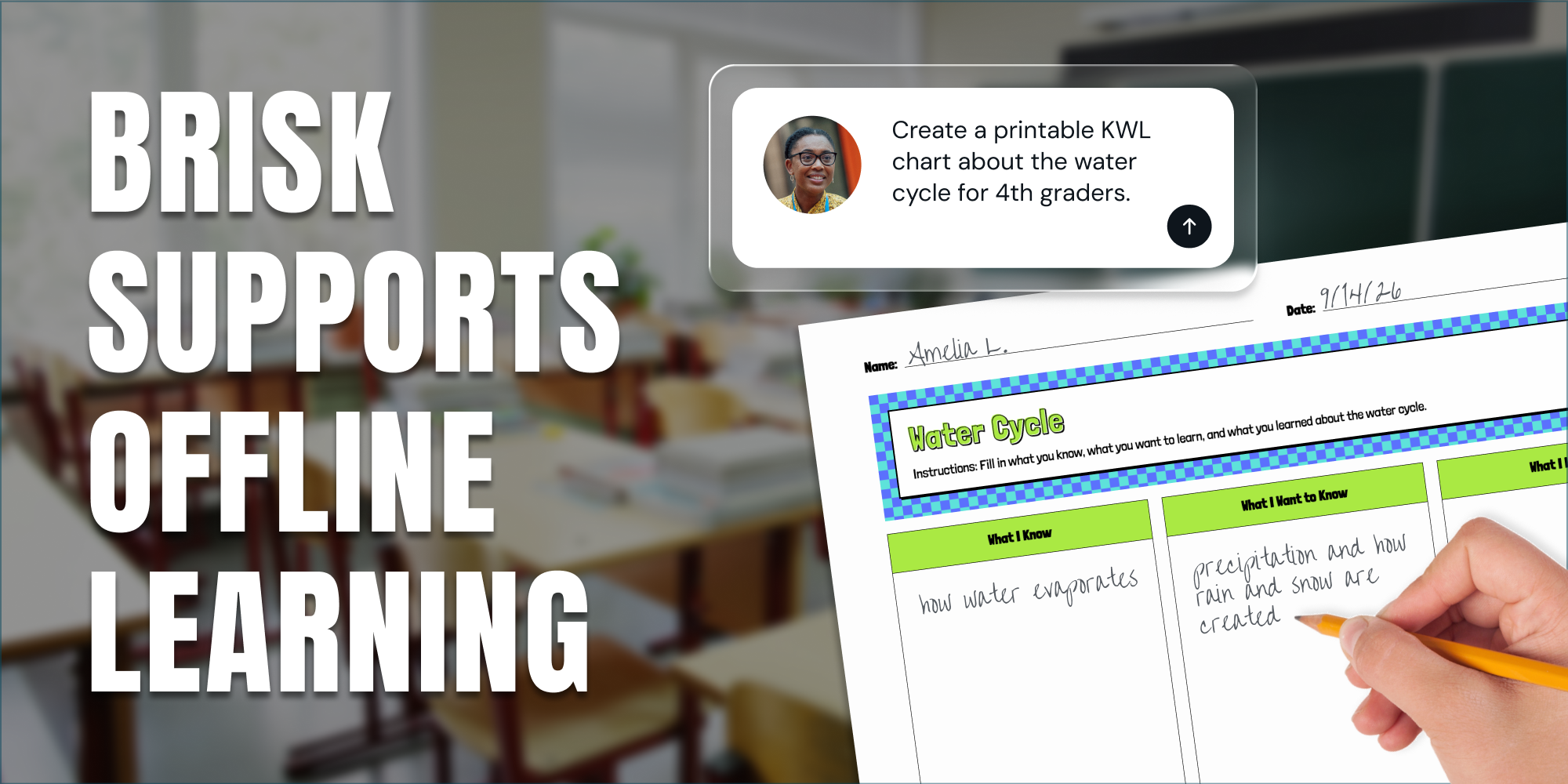
Por ejemplo, el Generador de Materiales Imprimibles de Brisk ayuda a los docentes a transformar sus recursos digitales favoritos en actividades de papel y lápiz listas para imprimir. Actualmente, los docentes pueden usar Brisk para crear siete tipos de materiales imprimibles: modelos Frayer, tablas SQA, diagramas de Venn, preguntas y respuestas, hojas de trabajo, mapas mentales y boletines informativos.

Esto significa que un maestro de primaria puede crear una tabla SQA para que los estudiantes la completen antes de comenzar una unidad sobre el ciclo del agua sin tener que dedicar mucho tiempo a dar formato a un archivo de diseño. O, con solo unos clics, un profesor de historia de secundaria puede crear un diagrama de Venn que pida a los estudiantes comparar y contrastar la República Romana y el Imperio Romano.

Brisk también ayuda a los docentes a proporcionar comentarios oportunos sobre trabajos escritos a mano, traducir, adaptar el nivel y preparar textos para apoyar la instrucción diferenciada, además de idear actividades sin pantallas como laboratorios de ciencias, salas de escape y podcasts educativos.

Una base sólida para cualquier línea de investigación

No existe una respuesta definitiva sobre cómo debe abordar un distrito la disrupción creada por la IA, ya que cada distrito y comunidad tiene sus propias prioridades. Lo que es constante en todo el país es que las personas tienen preguntas e inquietudes legítimas sobre lo que significa la IA para la educación.

Al igual que todos los demás, estamos experimentando, aprendiendo y reflexionando profundamente sobre cómo apoyar el aprendizaje de los estudiantes en 2026 y más allá. En todo este proceso, trabajamos para dotar a los líderes de distrito de los datos, la visibilidad y el control que necesitan para responder a las preguntas planteadas anteriormente.

Latest Posts

Latest from the Brisk Blog

Explore practical articles for K–12 educators, from classroom-ready strategies to thoughtful guidance on using AI in ways that support real teaching.

Library shelves filled with books
September 18, 2026
Administrators

Todo el mundo tiene preguntas sobre la IA: así es como los líderes pueden responderlas

A medida que los líderes de los distritos escolares se enfrentan a un número creciente de preguntas sobre cómo están gestionando la IA, necesitan tanto visibilidad sobre su uso como la capacidad de darle forma.

Library shelves filled with books
September 14, 2026
Brisk Features

Imprímelo, proyéctalo o prescinde de la pantalla: cómo Brisk se adapta a cualquier aula

Brisk ofrece a los docentes una variedad de formas de apoyar el aprendizaje de los estudiantes, incluso cuando se enfocan en reducir el tiempo de pantalla en sus aulas.

Library shelves filled with books
August 14, 2026
Thought Leadership

Brisk in New White Paper on AI's Instructional Impact

Brisk founder Arman Jaffer shares his key takeaways from Whiteboard Advisors’ new white paper on measuring the instructional impact of AI in the classroom.

Library shelves filled with books
8
min
June 18, 2026
Administrators

Best AI Solutions for Schools & Districts (2026)

This guide covers the most-vetted AI solutions across three categories that matter most to district buyers: teacher productivity, student learning, and district infrastructure.

The market for K–12 AI tools has matured quickly. Schools are no longer asking whether they should adopt AI, but rather which platforms are safe, effective, and worth the district-level investment.

This guide covers the most-vetted AI solutions across three categories that matter most to district buyers: teacher productivity, student learning, and district infrastructure.

What Schools and Districts Actually Need From AI

Before evaluating tools, district administrators and instructional technology coordinators typically prioritize:

  • FERPA and COPPA compliance: Student data must never be used to train third-party AI models.
  • SOC 2 Type 2 certification or equivalent: Enterprise-grade security infrastructure.
  • Signed Data Privacy Agreements (DPAs): Required for procurement in most districts.
  • LMS integration: Canvas, Google Classroom, PowerSchool Schoology, and Clever compatibility.
  • Teacher control and visibility: Staff must be able to monitor student AI interactions.
  • Scalability: Tools must work across an entire school or district, not just individual classrooms.

Any platform that cannot meet these criteria deserves close scrutiny before it touches student data.

Best AI Tools for Teacher Productivity

Brisk Teaching

Brisk Teaching is the #1 trusted AI platform built for educators. There are two main components of the Brisk AI platform:

Brisk’s Browser Extension

Brisk’s Chrome and Edge browser extension works directly inside the tools teachers already use (Google Docs, Microsoft Word, Google Classroom, Canvas, Schoology, Blackboard, and more) without requiring a separate platform login or workflow change. The extension aspect of Brisk is what makes integration into the tools educators are already using seamless.

Some of Brisk’s core features include:

  • Give Feedback (instant, rubric-aligned feedback on student writing): Brisk generates specific comments on student drafts in seconds, across modes like Glow & Grow, Targeted, and Rubric Criteria. Teachers review, edit, and post without starting from scratch.
  • Inspect Writing (see how student work was written): Brisk replays a document's writing and revision history, so teachers can understand how a draft came together and ground academic-integrity conversations in evidence rather than guesswork. Brisk also includes a built-in AI writing detector.
  • Change Reading Level (text leveling and differentiation): Any article, passage, or document can be rewritten to a target reading level in one click.
  • Create (lessons and materials): Generate quizzes, slides, guided notes, discussion questions, exit tickets, rubrics, and more, directly from existing content or from a prompt.
  • Brisk Boost (student-facing interactive activities): Take any trusted resource and easily create a safe AI learning experience for students.

Brisk on the Web

Brisk on the Web serves as an online hub where educators can plan, assign, and give feedback all in one place. Brisk on the Web surfaces recommendations and ready-to-use resources, refreshed in real-time based on educational needs and classroom insights.

Within Brisk on the Web, educators can:

  • Get ideas for what to teach next with Brisk Next
  • Quickly grade batches of student work at once with Batch Feedback
  • Access their full library of created materials and activities
  • Get insight into how students are engaging with interactive learning activities

Best for: Districts looking for AI that’s purpose-built for real classroom workflows. Because it operates as a browser extension and integrates into existing tools, adoption friction is low — teachers do not need to learn a new interface. Brisk also works inside the LMS tools districts have already deployed.

Additionally, with Brisk, educators are starting from what they already know and trust: your curriculum, a digital textbook, a YouTube video, or a vetted document. These resources power what teachers create, so they’re never getting sloppy AI content.

On the student side, Brisk Boost turns any trusted resource into a safe, guided activity — building AI literacy and helping students work toward understanding rather than just getting answers.

Privacy: Brisk Teaching is built to clear district procurement review. It is SOC 2 Type 2 certified (as of October 2025) and compliant with FERPA, COPPA, and GDPR. Brisk has also earned the 1EdTech Data Privacy Certification and TrustEd Apps Seal and holds a 95% Common Sense privacy rating. Student data is never used to train AI models and is never sold, the underlying content of student work is not stored once a task is complete, and Brisk has signed the National Data Privacy Agreement with twelve states, with district-level agreements available where a state DPA is not in place.

Diffit

Diffit specializes in reading and worksheet differentiation. Teachers paste in any source — an article, a YouTube link, a search topic — and Diffit generates leveled reading versions, comprehension questions, and vocabulary supports at the click of a button. The tool is designed to reduce the time teachers spend manually adapting texts for students who read above or below grade level, making it a practical resource for classrooms with diverse learners.

Best for: English Language Arts teachers, special education departments, and schools serving students across a wide range of reading levels. It is particularly valuable in inclusion classrooms and in buildings where multilingual learners make up a significant portion of the student population.

Privacy and integration: Diffit operates as a standalone web platform. Districts should request a signed DPA prior to any classroom deployment. Because teachers work within Diffit's own interface rather than inside an LMS, schools will want a clear plan for how generated materials are distributed to students — typically by exporting to Google Docs, Slides, or Google Classroom, or by printing. Diffit does not use student data to train AI models.

Best AI for Student Learning and Adaptive Practice

Khanmigo (Khan Academy)

Khanmigo is Khan Academy's AI tutor for students. It provides guided, step-by-step support across subjects like math, science, and writing without giving answers away, reinforcing problem-solving skills rather than bypassing them. For teachers, it also supports lesson planning, Socratic questioning frameworks, and discussion facilitation. Khanmigo is grounded entirely in Khan Academy's content library, giving it a clear and well-defined instructional scope across subjects and grade levels.

Best for: Districts seeking a free or low-cost student tutoring supplement with a trusted brand behind it. Khanmigo is well suited for after-school or homework support programs, math intervention tiers, and schools that want an AI-assisted learning tool with a long-established content foundation. Khan Academy's nonprofit status and track record make it one of the more straightforward privacy evaluations a district procurement team will encounter.

Privacy and integration: Khanmigo connects to Canvas, Google Classroom, and Schoology (the latter via Clever), so its teacher tools slot into the LMS a district already runs. Student access, however, is provisioned through a school or district implementation rather than self-serve signup, so districts should plan rostering accordingly. Khan Academy holds a strong privacy record and does not sell student data; confirm a current DPA is in place before assigning student accounts.

NotebookLM (Google)

NotebookLM is an AI-powered research assistant from Google. Students upload source materials — PDFs, Google Docs, lecture notes, YouTube videos — and NotebookLM generates summaries, answers questions from those sources, and creates study guides.

Best for: Middle and high school students doing research-heavy work or exam preparation. Because it grounds all responses in uploaded source material, it substantially reduces hallucination risk compared to general-purpose AI.

Privacy note: Districts using Google Workspace for Education already have a DPA in place with Google. NotebookLM for Education falls under that agreement for eligible accounts.

Best District-Wide AI Infrastructure

Gemini for Google Workspace for Education

For districts already running Google Workspace for Education, Gemini is a great option that integrates within Google’s own tool ecosystem. It surfaces within Gmail, Docs, Slides, and Meet, and connects directly to Google Classroom without additional procurement.

What it does for districts:

  • Drafts communications, newsletters, and policy documents for administrators.
  • Helps teachers generate rubrics, lesson plans, and differentiated materials within Google Docs.
  • Supports students with writing assistance and research within the same tools they already use.

Gemini is a general-purpose AI layer, not a purpose-built educator tool. It lacks the classroom-specific features — like rubric-aligned feedback, AI detection, or LMS-embedded grading support — that tools like Brisk Teaching were designed to deliver.

Privacy: Covered under Google's existing Workspace for Education data processing agreements. Google does not use Workspace customer data to train its AI models.

Microsoft Learning Accelerators and Copilot for Education

Microsoft's AI suite for education spans two things districts should treat separately. The Learning Accelerators — Reading Progress, Reading Coach, Search Coach, and others — are included in Microsoft 365 Education licenses down to the free A1 tier, and so is Copilot Chat. Full Microsoft 365 Copilot, the assistant embedded across Word, PowerPoint, Teams, and OneNote, is a paid add-on rather than part of the base license.

Best for: Districts already on Microsoft 365 who want to start with the AI capabilities bundled into their existing licenses, with the option to add full Copilot later.

How to Evaluate and Compare AI Tools for Your District

The Procurement Checklist

Before shortlisting any platform, confirm the below. (Get our guide to evaluating AI tools for your district here.)

Criteria
Questions to Ask
Data privacy
Does the vendor sign a DPA? Is the tool FERPA and COPPA compliant? Is student data used for model training?
Security
SOC 2 Type 2 certified? What is the data retention policy?
LMS integration
Does it connect to your LMS via LTI or API? Does it require roster syncing?
Teacher control
Can teachers monitor student AI interactions? Can they restrict what the AI will discuss?
Adoption requirements
Is this a platform teachers must log into separately, or does it work inside existing tools?
Pricing model
Per-seat, per-school, or district-wide license? What does pilot access look like?

Matching Tools to Use Cases

Use Case
Recommended Tool(s)
In-workflow feedback and grading support
Brisk Teaching
Differentiated reading materials
Brisk Teaching, Diffit
Student tutoring and adaptive practice
Khanmigo, Brisk Teaching
District-wide Google Workspace AI
Gemini for Education, Brisk Teaching
District-wide Microsoft 365 AI
Microsoft Copilot for Education
Research and study assistance
NotebookLM

Frequently Asked Questions

What is the safest AI platform for student data in K–12?

There's no single "safest" platform — what matters is that the vendor commits in writing to never training on student data and will sign a DPA. The purpose-built tools here (Brisk Teaching, Diffit, Khanmigo) bake that in, and Google's and Microsoft's tools provide it under their education agreements. Confirm the signed DPA before any student data touches the platform.

Does Brisk Teaching work with Google Classroom and Canvas?

Yes. Brisk Teaching is an AI platform and browser extension that integrates directly with Google Classroom, Canvas, Schoology, and more. Teachers access its features within those platforms without leaving their existing workflows.

What is the difference between Brisk Teaching and a general AI assistant like ChatGPT?

General AI assistants are not built for education, do not sign education-specific DPAs, and are not designed around teacher workflows. Brisk Teaching is purpose-built for K–12: its features — feedback, grading support, leveling, detection — map directly to classroom tasks, and it complies with the student data privacy requirements that district IT teams require.

How do AI tools integrate with our existing LMS?

Integration depth varies by tool. Brisk’s browser extension works across LMS platforms without requiring IT-managed LTI installation. Gemini and Microsoft Copilot integrate natively into their respective productivity ecosystems. Khanmigo connects to major LMS platforms (Canvas, Google Classroom, and Schoology via Clever), while tools like Diffit operate as standalone web platforms and may require separate login management.

What should districts budget for AI tools in 2026?

Costs vary widely. Khanmigo and NotebookLM for Education have free or low-cost tiers. Brisk Teaching offers both free and paid plans. Gemini and Microsoft's Copilot Chat are typically bundled with existing education licenses, while full Microsoft 365 Copilot is a paid add-on.

Purpose-built district platforms may charge on a per-seat or per-school basis. Many vendors will provide pilot pricing for districts evaluating at scale.

Are AI tools in schools required to comply with FERPA?

Yes, if they process student records or personally identifiable information. Schools must ensure any third-party AI vendor signs a school official exception agreement under FERPA. Vendors who cannot or will not sign a DPA should not be given access to student data.

Summary: How to Choose the Right AI Platform for Your School or District

There is no single AI platform that covers every use case for every school. The strongest approach is layered:

  1. Start with the LMS you already have. If your district runs Google Workspace, start with Brisk Teaching and Gemini. If you run Microsoft 365, Brisk Teaching and Copilot for Education work well.
  2. Add purpose-built classroom tools for teachers. Brisk Teaching fills the gap that general-purpose AI leaves open — specifically in feedback, grading, leveling, and academic integrity — and it does so inside the workflows teachers already use.
  3. Add student-facing learning tools selectively. Khanmigo and NotebookLM serve students well in tutoring and research contexts, with strong privacy track records.
  4. Validate privacy before you deploy. Confirm DPAs, FERPA compliance, and data retention policies for every tool before any student data touches the platform.

Districts that approach AI adoption this way tend to see faster teacher buy-in, fewer procurement delays, and lower risk of the data privacy issues that have slowed adoption in other districts.

Last updated: June 2026. AI platforms and their feature sets change frequently. Verify current integrations, pricing, and privacy certifications directly with each vendor before making procurement decisions.

`

READY TO BRING BRISK TO YOUR DISTRICT?

See how 20,000+ districts adopted AI with full compliance and teacher buy-in from day one.