All Blog Posts

How to Detect AI Writing in Student Work (Without False Alarms)

Today, it’s nearly impossible to prevent students from using AI at some stage of their schoolwork — and that’s not always a bad thing. Many students use tools like ChatGPT or other AI platforms as part of their brainstorming, outlining, or drafting process. AI writing in education is here to stay, even in schools that officially restrict it.

Keep reading this guide to learn:

  • Where common AI detection tools fail
  • What to look out for when evaluating for AI generation
  • Why understanding how a student wrote their work is just as important as what they wrote
  • How Brisk can give you deeper insight into each student’s writing process

Why Traditional AI Detection Isn’t Enough

AI detection software has some benefits, but the limitations are significant enough to call its efficacy into question. Below are some of the most common problems with AI detectors that teachers face:

  • High false positive rate: No matter the writing style, false positives are a major issue across all detection algorithms. Some tools have even flagged the U.S. Constitution as being written by AI!
  • Challenges for multi-lingual writers: In English-language curricula, students who are developing English proficiency sometimes use grammar or spelling tools to refine their writing. Because these supports can make text appear more polished, AI detection software may occasionally misclassify their work as AI-generated.
  • Misleading accuracy claims: Many AI-text-detection tools operate at a much lower reliability than claimed. Studies show they often score well under 80% accuracy in real-world contexts — meaning that at least 1 in 5 decisions could be wrong. That opens the risk of incorrectly flagging a student’s genuine work as AI-generated, or failing to catch actual AI-generated content.

A false accusation can damage trust between teachers and students. The teacher may believe the student is being dishonest, and the student may feel unfairly judged. That kind of mistrust can be difficult to repair.

Teachers deserve tools that do more than say yes or no. What is needed are tools that go beyond detection and provide deeper insight into student writing, so instruction can focus on growth instead of suspicion.

The Best Way to Detect AI in Student Writing

With this rise in AI-generated student work, many teachers worry about plagiarism, the loss of student voice, or inaccurate writing creeping into assignments. On the surface, learning how to detect AI writing seems like the logical next step. The reality is that AI detection tools are often flawed, producing false positives that can hurt student trust and misrepresent their abilities.

This is why a middle ground matters. With Brisk’s Inspect Writing tool, teachers take a different approach: Instead of focusing on a “gotcha” yes-or-no result, teachers gain comprehensive insight into a student’s writing process. By showing where clarity breaks down or where feedback could push learning forward, our Inspect Writing tool helps you understand how students are writing — not just whether AI was involved.

Brisk’s philosophy is not about “gotcha” results. Instead, the focus is on student learning needs above all else. That is what makes the Brisk Inspect Writing tool different from other platforms:

  • Highlights areas of clarity, coherence, or voice: Teachers can see where student writing develops smoothly and where it could use support for continued growth.
  • Shows growth opportunities in real time: Inspect Writing reveals how students respond to feedback by showing changes in organization, argument strength, and evidence use over time.
  • Provides actionable insights instead of a verdict: Teachers can view a playback of the writing process in Google Docs to see how many revisions, edits, or copy-pastes were made.

This approach makes Inspect Writing one of the most effective AI detection tools for teachers. It saves time, reduces stress, and opens the door to meaningful conversations with students about their writing.

Snapshot of Popular AI Detection Tools

When teachers first encounter a concern about AI in student work, the natural instinct is to look for AI detection tools. Search results are full of free and paid platforms that promise to identify AI-generated text. Below are some of the most widely discussed options and their reported strengths and weaknesses:

  • GPTZero: Known for its user-friendly interface and popularity among educators. However, many report a high rate of false positives despite its strong accuracy claims. GPTZero also struggles to flag writing that has been paraphrased from AI.
  • Turnitin’s AI Detection: The most widely used in schools, Turnitin claims 98 percent accuracy. Teachers, however, often report inconsistencies and misclassifications, raising concerns about real-world reliability.
  • Copyleaks: A popular choice in education, Copyleaks advertises very low false positives and supports multiple file formats. The trade-off is that it requires a paid subscription, and teachers still report mixed results in the classroom.
  • JustDone: Claims over 90 percent accuracy but does not publish false positive rates. Marketed primarily to businesses, it offers team dashboards and combines AI detection with plagiarism checks.
  • Originality.AI: Still expanding its academic focus and features. While it integrates plagiarism and AI checks, it has limited independent validation and little data on accuracy or false positives.

Tool Accuracy Claims False Positives Strengths Weaknesses
GPTZero ~80% accuracy (varies by test set) ~20%+ in some teacher tests Free tier, simple interface, popular in education Struggles with paraphrased AI; higher false positives on human text
Turnitin’s AI Detection Claims 98%+ accuracy, 1% false positives Independent tests show higher Widely integrated into schools/LMS; familiar brand Accuracy disputed; not transparent about methodology
Copyleaks Claims 99% accuracy, 0.2% false positives (esp. on GPT-4) Very low per vendor, but varies in practice Strong sensitivity; supports multiple file formats; tailored to education Subscription-based; teachers report mixed results in classroom

Common Signs of AI in Student Writing

No one knows a student’s writing style better than their teacher. Even the most advanced software cannot always pick up on the subtle cues you notice when reading your students’ work. If you are wondering how to detect AI in student writing, here are a few common signs of AI writing that may raise a red flag:

  • Repetition or generic phrasing: AI-generated essays often sound predictable and may reuse the same words or sentence patterns throughout an assignment.
  • Sudden shifts in writing style: A paper might suddenly feel “off.” Word choice, tone, or sentence structure could look very different compared to the student’s past work. The writing may even appear at a higher grade level than the student has demonstrated before.
  • Lack of depth or personal voice: Student writing typically carries personality, preferences, and quirks. AI text, on the other hand, can feel flat or surface level, missing the nuance of a student’s unique perspective.
  • Overly formal or unnatural fluency: If a student’s language suddenly becomes too polished, complex, or professional for their level, this may be another indicator that AI has been involved.

It is important to remember that these are indicators, not proof. Spotting AI-generated essays is never as simple as checking a box. Unless a student openly acknowledges their use of AI, you will rarely have absolute certainty. This is why combining professional judgment with the right tools gives the clearest picture of how students are approaching their writing.

When you suspect AI involvement in student writing, the goal isn’t punishment — it’s education. Use the moment to start a conversation about academic integrity and authorship. Encourage students to explain how they used AI tools in their process, and teach them how to properly cite or disclose that assistance. By framing AI as a writing support rather than a shortcut, you help students develop critical digital literacy: knowing when, why, and how to use technology responsibly. These conversations not only build trust but also equip students with ethical decision-making skills they’ll carry beyond the classroom.

Best Practices for Combining Human and Tool-Based Insights

When considering possible AI use, teachers need to balance software results with professional judgment. Here are some best practices for AI detection to guide your approach:

  • Do not rely on any tool as the final verdict: You make the final call, not the algorithm. Always consider multiple pieces of evidence before reaching a conclusion.
  • Check the writing process evidence: In Google Docs, for example, review version history to see if the student typed steadily or pasted large sections of text at once.
  • Use oral reflections or in-class writing for comparison: Ask students to explain or expand on their work. If they can clearly discuss the ideas in their essay, it is unlikely AI generated it.
  • Consider cultural and linguistic contexts: English language learners are more likely to be flagged incorrectly. Always account for student background before assuming AI use.
  • Teach digital literacy early: AI is not inherently bad. Framing it as a thought partner helps students learn to use it responsibly rather than rely on it to do the work.

By using these strategies, teachers can move away from suspicion and toward conversations that build trust and digital responsibility.

Remember, no AI detector is perfect. Teachers’ professional judgment is the most important factor.

Brisk helps teachers navigate that gray area by providing insights into the writing process. The Inspect Writing tool allows you to see how students draft, revise, and grow as writers, giving you a clearer picture of their progress over time.

Start using Brisk today to gain deeper insight into your students’ work and save time in the process.

FAQs

Teachers often have questions when it comes to AI use in student writing. Here are some of the most common:

  • Can AI detectors wrongly flag human writing? Yes. False positives happen often, especially for non-native writers. Always consider the student’s background and context before assuming AI use.
  • Is there a 100% accurate AI detector? No. All tools make mistakes, and even paraphrased AI writing can slip through undetected.
  • How can teachers ethically handle suspected AI use? Focus on growth rather than punishment. Look at how far the student has come since the start of the year. If you suspect AI use, have a conversation first instead of jumping to accusations.
Latest Posts

Latest from the Brisk Blog

Explore practical articles for K–12 educators, from classroom-ready strategies to thoughtful guidance on using AI in ways that support real teaching.

Library shelves filled with books
September 14, 2026
Brisk Features

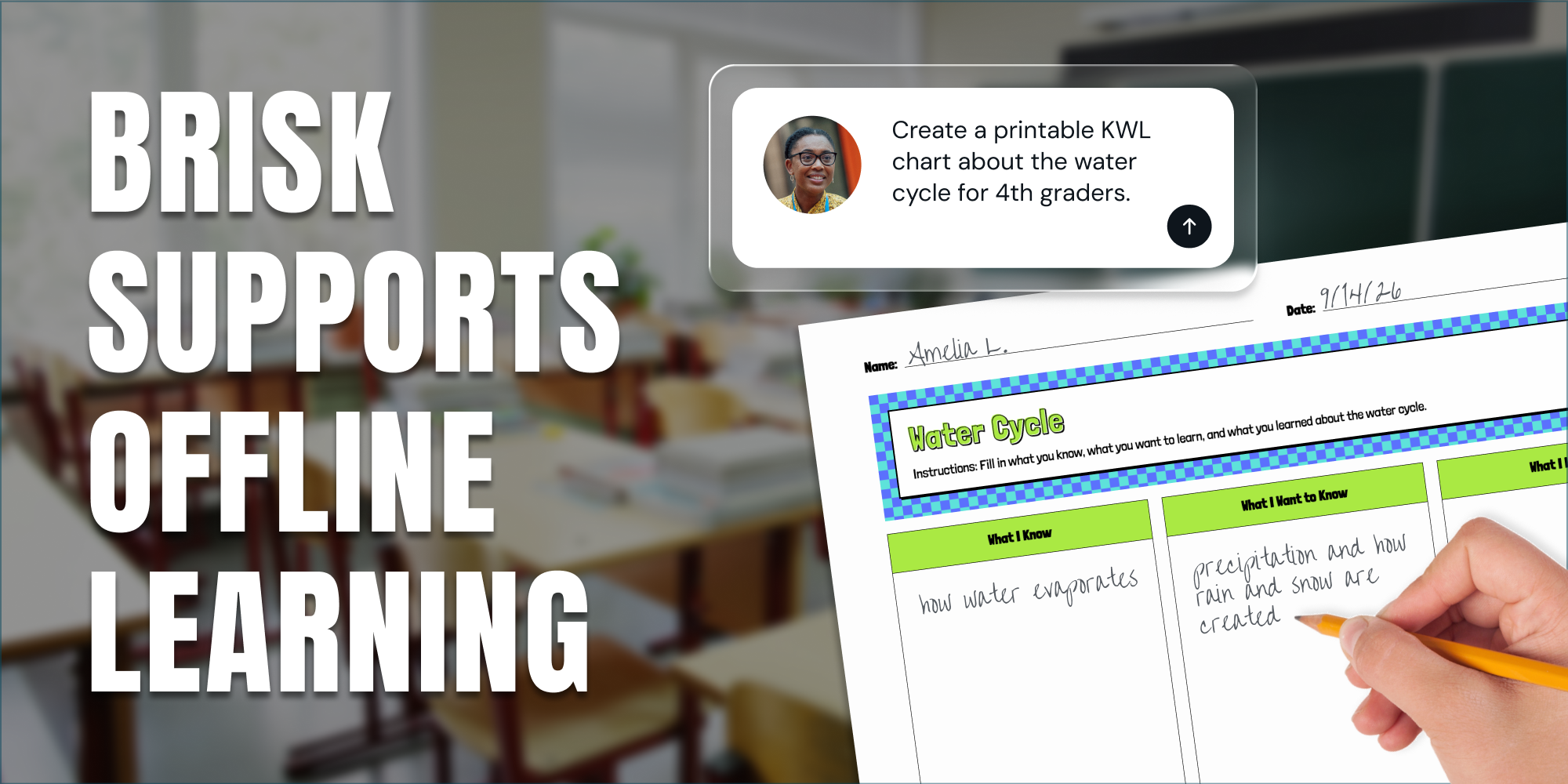
Print It, Project It, or Skip the Screen: How Brisk Fits Any Classroom

Brisk provides teachers with a variety of ways to support student learning, even when they’re focused on scaling back screen time in their classrooms.

Library shelves filled with books
August 14, 2026
Thought Leadership

Brisk in New White Paper on AI's Instructional Impact

Brisk founder Arman Jaffer shares his key takeaways from Whiteboard Advisors’ new white paper on measuring the instructional impact of AI in the classroom.

Library shelves filled with books
July 27, 2026
Tips for Teachers

60 Get-to-Know-You Questions for Students (For Every Grade)

60 get-to-know-you questions for students, organized by category and grade — plus, easy ways to use them for icebreakers, morning warm-ups, and first-day connection.

Library shelves filled with books
8
min
October 25, 2023
AI Tips

A Guide to Responsible Use of AI in the Classroom

What is AI? How should I use AI in the classroom? We'll answer all your questions in this article.

Note this guidance reflects the current state of this technology at the date of writing. These models are advancing rapidly, and we’ll keep this article up to date as new developments emerge.

What is AI?

AI is a popular term that seems to be coming up more and more in day-to-day conversation. But what is it actually? According to ChatGPT, AI is:

AI, or Artificial Intelligence, refers to the simulation of human intelligence in machines that are programmed to think and act like humans. The term can also be applied to any machine that exhibits traits associated with a human mind, such as learning and problem-solving.

This is a good start, but, as we’ll discuss later in this guide, we’ll also cross-reference this definition with another source:

It is the science and engineering of making intelligent machines, especially intelligent computer programs. - What is Artificial Intelligence? - John McCarthy

While AI tools like ChatGPT that generate language have become very popular, AI is already a fundamental part of how we interact with technology and the internet. Assistants like Alexa and Siri use AI to understand commands, entertainment providers like Netflix and YouTube use AI to generate recommendations, and smartphone cameras use AI to identify faces and adjust lighting. The recent fascination with chat-based AI tools such as ChatGPT, Bard, and Claude is just one of many applications of AI.

How does ChatGPT work?

ChatGPT is what’s known as a Large Language Model (LLM). LLMs are “trained” on billions of pages of text from the internet. Because they are trained on such a huge amount of information, they’re able to create convincing responses to a wide variety of requests. These LLMs often have a chat interface, allowing users to type in questions and ideas as if they were chatting with another person.

The technical details of how these models are developed, trained, and fine-tuned is a very deep subject. For the purposes of this article, we’ll only cover this basic understanding of LLMs. The great thing about tools like ChatGPT, Claude, and other LLMs is that you don’t need to understand exactly how they work in order to use them effectively.

Strengths and weaknesses of AI

Probably more important than understanding how or why they work the way they do, it’s critical to understand the strengths and weaknesses of LLMs.

Weaknesses

Knowledge gaps - Although Large Language Models are trained on information from the internet, it’s important to understand that they are not hooked up directly to the internet by default. You can think of these systems as very sophisticated auto-complete. They write the most likely word to come next in the sentence, but they’re not pulling from a source for their knowledge. This means that 1) you shouldn’t use them the same way as Google search and 2) they generally have a cutoff date for their knowledge. Unless you’re working with ChatGPT Plus style plugins (the paid version of ChatGPT) that give the AI access to web search, you’ll need to provide significant additional context to the LLM in order to ask it questions about current events or books written in the last year or two.

  • Tip: ask the AI to say “I don’t know” if it doesn’t know the answer to the question. While this isn’t foolproof, it encourages the AI to say “I don’t know” rather than answering your question with false information.

Incorrect information - LLMs are known to “hallucinate” meaning they can sometimes make things up! While they are great at writing authoritative, convincing-sounding language, the actual factual basis of that language has the chance to be fabricated. It’s important to verify or cross-reference information provided by an AI. In particular watch out for:

  • Errors in writing math problems. LLMs aren’t designed to solve math equations. While this ability has improved with updates, it’s important to double-check math solutions in particular. More advanced models like ChatGPT 4 show significant improvements in math reasoning.
  • Wrong book chapters. LLMs don’t flip through a copy of The Great Gatsby when you ask what happened in chapter 7. They may make up information about that chapter or cite events from different chapters in the book. If you want to use AI to create materials based on a book chapter, it’s a good idea to give the AI context on that specific chapter by using an existing summary or synopsis.
  • Made-up sources. Don’t ask AI to write a research paper for you! AI isn’t able to reliably cite sources, papers, or texts. Even in cases where it correctly identifies a book or author, it may misrepresent or misquote content from the book.

Strengths

As a creative thought partner - Generative AI can suggest new ideas, offer feedback, and combat “blank page syndrome.” Think of AI tools as very fast, helpful assistants to stretch your thinking. 

Here are some examples to get you started:

  • Science: Ask AI to give you some analogies for explaining a tough Physics concept.
  • ELA: Ask AI to come up with some activities related to a specific learning standard (make sure to provide the learning standard and description).
  • History: Ask AI to develop a worksheet for a primary and secondary source analysis.
  • Math: Ask AI to come up with challenging word problems to stretch your students’ thinking.
  • World Language: Ask AI to come up with a Spanish vocabulary quiz about navigating the grocery store.

Generating quality material very quickly - LLMs can generate large amounts of text in the blink of an eye, taking a fraction of the time that a person would spend (especially a slow typer like yours truly). This technology opens up the possibility of differentiating material, creating new scaffolds, and offering formative feedback faster than ever before. At Brisk, we’re enthusiastic about the possibilities for AI to transform the way we support teachers and students.

AI Best Practices

Use the 80/20 rule - AI can do 80% of the work but make sure you do the final 20% to review for accuracy, personalize, and make the material relevant to your students. This is where your expertise and personality as the teacher in the classroom comes into play. 

Be as specific as possible in your prompts - “Prompts” are what we call the instructions you give to an LLM. When writing prompts, use precise language formulated as complete sentences. You can even provide examples of the format or style you want from the final output. In general, you’ll get a much better response typing something like “Create an exemplar 12th-grade student response addressing the following prompt: discuss how the character of Sethe in Toni Morrison’s Beloved is influenced by her memories of slavery. How do these memories shape her actions and relationship with her children?” than something like, “Create a student response about Beloved.

Check for accuracy before distributing material - We’ve already discussed this above, but it can’t be overstressed! Always review material generated by AI before assigning them to students. Taking this guidance to heart can also be a useful way of talking about critical thinking, checking multiple sources, and best research practices with students.

Stay curious! - Don’t expect material generated by AI to come out perfect. Like any skill, interacting with AI takes some amount of practice and patience. Keeping an open, exploratory mind can help make this an engaging experience rather than a frustrating one.

Ethical Considerations of Using AI

Privacy - Never put sensitive information or student data into AI systems.

Bias - AI models are a reflection of the data that they are trained on. It’s important to recognize that a large swath of the internet is created by an English-speaking, American audience. This kind of subtle cultural bias can influence the way that these LLMs respond to certain prompts. However, it’s possible to overcome these biases. Try specifically asking AI models to pull from examples across the globe, include a particular viewpoint, or expand the worldview of the material. 

Final thoughts

Like any new technology, AI evokes a mix of fear, opportunity, anxiety, and excitement. We believe that this tool provides incredible benefit to teachers and students. As powerful as this tool is, AI will never replace teachers. The role of a teacher goes far beyond transmitting knowledge or presenting material. Emotional connection, motivation, cultural context, and so much more go into the teaching profession, and all of those qualities are uniquely human.

We’ve already heard from thousands of teachers who’ve used Brisk Teaching's AI tool to get their weekends back and rediscover the joy in their teaching practice. You can check out how we’re putting all of these learnings into practice in our Free Chrome Extension. Use Brisk to generate formative feedback, create dozens of different types of curricula, and change the reading level of texts.

Further reading and resources

`

READY TO BRING BRISK TO YOUR DISTRICT?

See how 20,000+ districts adopted AI with full compliance and teacher buy-in from day one.