All Blog Posts

Give Every Student a Personal Writing Coach with Boost Writing Activities

Now, instead of running from desk to desk, you can give every student a writing coach right inside their Google Docs with Boost Writing Activities!

What are Boost Writing Activities?

Boost Writing Activities helps students plan, draft, and revise their writing with instant, AI-powered feedback. Whether they need help brainstorming, strengthening their argument, or refining their final draft, Boost is there – so you can focus on teaching, not troubleshooting.

Here’s what you can do with Boost Writing Activities:

  • Instantly share a writing prompt – Each student gets their own copy or a blank document to work in.
  • Students get real-time feedback – Boost offers guidance as they write, from idea development to final revisions.
  • Attach a rubric – Guide Boost’s feedback based on your specific grading criteria.
  • Use any starting point – A Google Doc with a writing prompt or template, a YouTube video, or even an article.

How to Use Boost Writing Activities:

  1. Open the Google Doc, YouTube video, or article you want students to write about, then open Brisk. Click Boost Student Activity.

  1. Click on the Write tab. Choose from these writing activities: Writing Coach, Glows & Grows, Next Steps, and Goal Setting, and click Next.

  1. Enter in your prompt, or go with the one we automatically input for you!

  1. Add the grade level, standards, or a rubric if you'd like. Then click Next.

  1. Choose what students will see when you share the Boost activity. (Hint: We'll automatically recommend the best option for you!) Then click Brisk It and share with your students!

💡 Pro Tip: Use Brisk to create your writing prompt, too! Click Create, Create Anything, and tell Brisk what you want students to write about. When you’re happy with your prompt, click Boost Student Activity to give students personalized writing support!

Ready to give your students a personal writing coach? 

Try Boost Writing Activities and see how it transforms the way your students write.

We’d love to hear how it’s working for you! Tag @briskteaching on social media to share your experience.

Latest Posts

Latest from the Brisk Blog

Explore practical articles for K–12 educators, from classroom-ready strategies to thoughtful guidance on using AI in ways that support real teaching.

Library shelves filled with books
August 14, 2026
Thought Leadership

Brisk in New White Paper on AI's Instructional Impact

Brisk founder Arman Jaffer shares his key takeaways from Whiteboard Advisors’ new white paper on measuring the instructional impact of AI in the classroom.

AI is in the midst of a massive hype cycle. You know. I know it. Any person you stop on the street knows it. That doesn’t mean AI is all hype — far from it. It just means that, especially in a field like education, we shouldn’t treat every use of AI as equally valuable.

As with any tool, technology, or technique, our ability to scale the benefits of AI will hinge on how effectively we quantify AI-supported practices in the classroom. To that end, we recently commissioned a white paper from Whiteboard Advisors, “From Efficiency to Efficacy: Measuring AI’s Instructional Impact,” that explores a new way to approach this measurement.

The white paper details the need for a well-defined framework for connecting AI use to the learning science principles that research tells us drive student outcomes. It highlights the newest metric that school and district leaders will see in their Brisk dashboards this year, Quality Instructional Moments, as a strong example of how educators can draw these connections.

AI helps teachers do more of what they know works

There are decades upon decades of peer-reviewed research on the kinds of instructional practices that promote student achievement. The biggest obstacle to effective teaching isn’t knowing what to do, but finding the bandwidth to do it. As the white paper states:

We know that students learn better when they receive frequent, specific feedback rather than waiting weeks for a test grade. We know that students learn more when they’re working at the edge of their ability, challenged but not overwhelmed. And we know that the practices most likely to move students — responsive instruction, meaningful relationships, timely feedback and intervention — are also the ones most likely to get crowded out by everything else educators are asked to do.

Minimizing this “crowding out” is where AI has the greatest potential in education. AI isn’t a replacement for great teaching; it’s the infrastructure that makes it possible to implement proven practices with greater frequency, fidelity, and consistency.

Moving from higher productivity to increased teaching capacity

To reiterate: AI’s true value is not just that it enables teachers to do more, but that it enables them to do more of what really works.

Which is not to say that productivity and efficiency boosts are meaningless. For a long time, Brisk measured our impact in terms of hours saved on tasks like grading, resource writing, and administrative work. We all want to save time wherever we can — no harm in that. But as school and district leaders repeatedly asked, “How does Brisk actually support student learning?”, we realized we needed to take a more comprehensive view of what happens in the classroom.

What really matters is what teachers do with the time they save. When they reinvest the time in implementing proven instructional practices — differentiating instruction for every student, using data to drive decisions, intentional planning — that’s when student outcomes tend to improve.

Using Quality Instructional Moments as a leading indicator of learning

You might be wondering, “How do you track if and when any of this is happening?” It’s a good question.

Traditional success metrics like standardized test scores and graduation rates paint part of the picture, but they lag years behind the instructional actions that shaped them. In an effort to provide leaders with a leading indicator of effective instruction, we landed on Quality Instructional Moments.

As we define it, an instructional moment is a discrete, observable student interaction that:

  1. Is grounded in learning science;
  2. A teacher wouldn’t have been able to facilitate on a regular basis without the increased capacity carved out by AI.

Think: A teacher uses Brisk to provide every student with personalized, rubric-aligned feedback on the same day students turn in their essays. Or, a teacher uses Brisk to generate multiple versions of an activity to ensure each student’s assignments are challenging enough to promote growth but scaffolded enough to remain achievable.

These are the kinds of instructional moments that drive results. They’re also the kinds of moments that school and district leaders can now track in Brisk. (We get that every district has different priorities, so districts are able to customize how they measure instructional moments in Brisk based on their unique pedagogical approach.)

Get the full story

Whiteboard Advisors’ white paper does a great job of unpacking all the considerations that go into tracking AI’s impact in the classroom. It covers the entire spectrum of research-backed instructional practices that ground instructional moments, the five questions every district leader should ask when evaluating AI solutions, and a whole lot more.

It’s a quick and, for those of us who are interested in these things, incredibly compelling read. I’d encourage you to check it out.

– Arman Jaffer, Founder, Brisk Teaching

Library shelves filled with books
July 27, 2026
Tips for Teachers

60 Get-to-Know-You Questions for Students (For Every Grade)

60 get-to-know-you questions for students, organized by category and grade — plus, easy ways to use them for icebreakers, morning warm-ups, and first-day connection.

The first week of the school year sets the tone for the months of learning that follow. The fastest way to establish a classroom environment in which students feel comfortable talking, laughing, and taking productive risks together is to provide regular opportunities for students to build meaningful connections with each other.

A good set of get-to-know-you questions can do a lot of the heavy lifting here. These questions lower the temperature for nervous students, give quieter kids an easy on-ramp into discussions, and show you what kind of personalities you have in the room before you even start your first lesson.

Below are 60 get-to-know-you questions for students, sorted into categories you can pull from all year — not just on day one. (Skim to the grade-specific notes near the end for tips for getting the most out of these questions in your classroom.)

How to Use Get-to-Know-You Questions

While these questions are invaluable during the first week of school, they’re just as powerful in many other contexts throughout the year. In addition to using them as first-day icebreakers, always keep a few on hand for:

  • Morning (or class period) warm-ups: Pose one question a day (or every Monday) to get everyone’s juices flowing.
  • Exit tickets: Use a reflection question to keep students engaged during the final few minutes of class.
  • Digital or remote learning: Drop a question into a poll, a shared doc, or a discussion board so students can answer without the pressure of the spotlight. If you want a quick set of interactive questions tailored to your grade and subject, you can generate them with Brisk Boost, a student-facing, AI-supported workspace that puts you in control of what’s shared.

Regardless of when you’re using these get-to-know-you questions, make sure you keep these best practices in mind:

  • Keep it low stakes: Let students pass if a question doesn’t land for them, and answer the questions yourself so the sharing feels mutual.
  • Specify a format: Pick a response format that aligns with the energy in your classroom on the day, whether it’s a turn-and-talk with a partner, a quick go-around, a written response, or a digital poll.
  • Return to high-impact questions: Asking a question in September and then again in January is a great way to show students how much has changed over the course of a few months.

Icebreaker & First-Day Questions

These icebreaker questions for students invite short, low-stakes answers. Pair these with a few active icebreaker games to get everyone moving.

  1. What are you hoping this year will be like?
  2. What’s one word your friends would use to describe you?
  3. If we were going to pick a mascot for our class, what should it be?
  4. What’s something you’re looking forward to this year?
  5. What makes a classroom feel like a good place to be?
  6. What’s a fun fact about you that surprises people?
  7. What fictional world would you like to live in?
  8. What’s the farthest you’ve ever traveled from home?
  9. If you could switch places with anyone for a day, who would it be?
  10. What makes you feel welcome in a new group?

Fun & Favorites Questions

Easy, low-pressure questions are perfect for any time you need a quick warm-up.

  1. What’s something you’re really good at that most people don’t know about?
  2. If you had to eat only one meal for the rest of your life, what would it be?
  3. What’s the best movie or show you’ve watched recently?
  4. What song do you have on repeat right now?
  5. What’s your favorite way to spend a Saturday?
  6. If you could instantly master any skill, what would it be and why?
  7. What’s a book, game, or hobby you could talk about forever?
  8. What’s your go-to snack?
  9. What’s the best gift you’ve ever received?
  10. If you had a whole day with no plans, what would you do?

This-or-That & Would-You-Rather Questions

These this-or-that-questions for students promote whole-class participation. For a more active experience, let students respond with a hand gesture or by walking to one side of the room or the other.

  1. Summer or winter?
  2. Sweet or salty?
  3. Early bird or night owl?
  4. Books or movies?
  5. Mountains or beaches?
  6. Would you rather be able to fly or be invisible?
  7. Would you rather never have homework or never have a test again?
  8. Would you rather explore space or the deep ocean?
  9. Would you rather always be 10 minutes late or 20 minutes early?
  10. Would you rather have a rewind button or a pause button for your life?

Getting Comfortable Questions

A step past the icebreakers, these questions help students share a little more about themselves once the classroom has been established as a welcoming environment.

  1. Who’s someone you look up to, and why?
  2. What’s something you’ve worked hard to get better at?
  3. What’s a tradition your family or friends have?
  4. When do you do your best thinking?
  5. What’s a mistake that taught you something?
  6. What’s something that always makes you laugh?
  7. Where’s your favorite place to be?
  8. What’s a small thing that makes any day better?
  9. What have you been curious about lately?
  10. What’s something you’d love to spend more time doing?

Questions About Learning & School

These are the kinds of questions to ask students when you want insights you can incorporate directly into your teaching — how students learn, what helps them, and what gets in their way.

  1. What’s a subject or topic you genuinely enjoy?
  2. How do you like to work best: alone, in pairs, or in a group?
  3. What helps you focus when things get noisy or busy?
  4. What’s something a teacher has done that really helped you?
  5. When you’re stuck, what do you usually do first?
  6. What does a good day at school look like for you?
  7. What’s something you wish teachers understood about you?
  8. How do you like to get feedback on your work?
  9. What’s a goal you have for this year?
  10. What’s one thing that would make this class better for you?

Social-Emotional Learning Questions

Save these questions for later in the year, as they require a certain level of trust and familiarity among students.

  1. What does being a good friend mean to you?
  2. When was a time you felt really proud of yourself?
  3. How can you tell when someone’s having a hard day?
  4. What helps you calm down when you’re frustrated?
  5. What’s something kind someone did for you that you still remember?
  6. Who do you go to when you need help?
  7. What are you grateful for right now?
  8. What’s something you’d like to get better at as a classmate?
  9. What makes you feel respected?
  10. What inspires you?

Picking the Right Questions for Your Grade

  • Elementary school: Start with favorites and this-or-that questions. As you incorporate more complex questions, provide your answer first as a way to model what a complete response looks like. Movement voting — e.g., walking to the “sweet” side of the room or the “salty” side of the room — can help keep younger learners engaged.
  • Middle school: Make sure students are comfortable by using low-spotlight formats like written responses, anonymous polls, or partner shares before jumping into whole-class go-arounds. (Pro tip: Students at this age love debating would-you-rather questions.)
  • High school: Lean into the learning styles and SEL questions. Older students can handle real reflection, and they notice when you incorporate what they share into your teaching. Frame the conversations as “help me teach you well,” not just “share your feelings.”

Frequently Asked Questions

What makes for a good get-to-know-you question for students?

Early on in the school year, the best questions are specific, low stakes, and easy to answer in a sentence — favorites, would-you-rather choices, and light “tell me about yourself” prompts. Save deeper reflection questions for once you’ve built a positive classroom dynamic.

How do you use get-to-know-you questions in the classroom?

Use them as first-day icebreakers, daily warm-ups, exit tickets, or digital polls. Give students a clear format (partner talk, go-around, written response), let them pass, and answer each question yourself.

What questions can I ask to get to know my students better as learners?

Ask about what they enjoy learning, what helps them focus, and what they wish teachers understood. The answers will give you insights you can teach with, not just fun facts.

When should I use get-to-know-you questions?

The first week of school is the most obvious opportunity, but they’re just as useful after long breaks, when a new student joins your class, or any time you want to reset class energy.

Start the Year by Connecting with Your Students

You don’t need to step into the classroom on the first day of school and ask 60 get-to-know-you questions. In fact, you really shouldn’t — that might scare students a little.

Instead, pick five of your favorites for the first day, keep a few in your back pocket for slow moments, and work your way toward the deeper questions as trust develops. The questions may be simple, but the payoff can be huge: A class that knows each other, trusts you, and is ready to learn together.

Want to generate your own get-to-know-you questions in seconds? Use Brisk's Create Anything tool to generate a list of get-to-know-you questions tailored to your classroom needs in seconds. Free to use for teachers — get started with Brisk today.

Library shelves filled with books
July 20, 2026
Back to School

30 Fun First-Day-of-School Activities [2026 Edition]

Kick off the year with 30 first day of school activities for elementary, middle, and high school — icebreakers, games, and get-to-know-you ideas, each with a Brisk prompt to get you started.

Set the Tone for the New School Year

Students thrive when they feel safe, valued, and inspired. And that kind of classroom doesn’t just happen. It’s built in the small, intentional moments where students get to reflect, laugh, lead, and learn with each other. That’s what these activities are designed for.

From creative icebreakers and curiosity sparks to reflection prompts and student-led challenges, this collection of back-to-school activities helps you create a space where students feel like they belong, and where learning feels meaningful, not mandatory.

While these activities are perfect for back-to-school season, they’re just as powerful anytime you want to build connection, spark curiosity, or shift the energy in your classroom. Whether you’re kicking things off with a new group, regrouping mid-semester, or hitting reset after a tough week, these ideas help you reconnect, recharge, and refocus — no matter the date on the calendar.

Each first day of school activity includes a Brisk prompt using our Create Anything tool to help you plan faster, personalize with ease, and meet every learner where they are. Here’s how to use them:

  1. Open Brisk in your Chrome browser.
  2. Search for “Create Anything.”
  3. Copy and paste the prompt from this post.
  4. Refine your request with Brisk, then generate your activity, resource, or discussion.

Don't have Brisk yet? It's free for teachers — sign up for Brisk today.

Whether you’re trying something new tomorrow or saving it for a future refresh, this list is here when you need it. Because what you do today sets the stage for what comes next.

First Day of School Activities by Grade Level

The same activity lands differently depending on who's in front of you, so here's where to start for each grade band. Every pick points to an activity already in this list.

  • Elementary school: Keep directions short and visual and build in movement — the Would You Rather Movement Game (#2), Emoji Introductions (#3), and Chain of Kindness (#8), paired with a first-day read-aloud.
  • Middle school: Protect social comfort with structured interaction — Find Someone Who… with a Twist (#1), Personality Playlist (#4), and the One-Word Wall (#16) let students share on their own terms.
  • High school: respect their time with activities that have a clear payoff — "Dear Future Me" Letters (#20), Student TED Talks (#19), Silly Debates (#29), and Timeline of Me (#24) reveal something genuine without feeling juvenile.

Get-to-Know-You Games

Looking specifically for first day of school games? Start with the six below — these activities are quick, playful, and designed to help students feel seen without the spotlight being too bright. Whether it’s laughing over shared quirks or finding out who else puts hot sauce on everything, these ideas ease students into the room while helping you start learning who they are. Low pressure, high connection.

1. Find Someone Who... with a Twist

Each student receives a bingo-style sheet — but instead of generic traits, include quirky prompts like “loves pineapple on pizza” or “can make a weird animal noise.”

  • Why it works: Students discover fun facts and unexpected common ground. 
  • Brisk prompt: Generate a playful “Find Someone Who” board with 25 unique, humorous, and culturally inclusive prompts for [insert grade level] students.

2. Would You Rather? Movement Game

Read off questions like “Would you rather teleport or time travel?” and students move to a side of the room to show their answer.

  • Why it works: Builds comfort, encourages participation, and gets students moving.
  • Brisk prompt: Create a list of 20 fun “Would You Rather” questions for [insert grade level] students.

3. Emoji Introductions

Students pick 3 emojis that represent them and explain why. Can be shared verbally, drawn, or written.

  • Why it works: Invites self-expression in a digital-native language.
  • Brisk prompt: Generate a prompt asking students to introduce themselves using only emojis and a brief explanation for [insert grade level] students.

4. Personality Playlist

Each student picks a song that represents their energy or personality. Play short clips and have classmates guess who picked what.

  • Why it works: Fosters self-awareness and community through music.
  • Brisk prompt: Generate a student-friendly prompt: “If your personality were a song, what would it be and why?”

5. Memory Match: Name + Fun Fact Edition

Pair students to share a fact, then remix into a memory game: “This is Max — he once ate a cricket!”

  • Why it works: Makes names and stories stick through fun repetition.
  • Brisk prompt: Create a guide for a memory-style name game with student facts for [insert grade level] students.

6. Icebreaker Skits

Students act out mini scenes that represent a favorite hobby, habit, or summer moment.

  • Why it works: Adds movement, fun, and laughter to self-intros.
  •  Brisk prompt: Generate a list of silly skit prompts that students can act out in pairs or groups of three for [insert grade level] students.

Community + Belonging

Build a classroom culture where everyone matters. From day one, students are looking for signs that this is a space where they belong. These activities help co-create that space — one where every voice is valued, and students help shape the culture they’re part of. You’re not just setting expectations — you’re setting the tone for trust, respect, and ownership.

7. Community Vision Board

Create a shared collage (paper or digital) of images and words that represent your ideal classroom culture.

  • Why it works: Visualizes collective values and sparks creativity.
  • Brisk prompt: Generate a classroom vision board activity where students co-create a vision for their ideal classroom environment.

8. Chain of Kindness

Each student writes a kind message for a classmate and links their message on a paper chain that grows daily.

  • Why it works: Fosters trust, kindness, and visibility.
  •  Brisk prompt: Generate sentence starters for student-to-student affirmations.

9. “We Are…” Identity Wall

Students each finish the phrase “We are…” with a word or phrase that reflects their background, values, or hopes.

  • Why it works: Emphasizes collective identity and diversity.
  • Brisk prompt: Create a reflective writing prompt that invites students to complete the phrase “We are…”

10. Culture Curators

Groups create mini exhibits (posters, slides, or videos) about their cultures, traditions, or favorite foods.

  • Why it works: Promotes cultural awareness and student agency.
  • Brisk prompt: Generate a template for a “Culture Curator” student presentation.

11. Respect Roundtable

Students write down what respect looks like, sounds like, and feels like — then turn it into class agreements.

  •  Why it works: Turns abstract values into real behaviors.
  •  Brisk prompt: Generate prompts that help students define respectful behavior in a classroom for [insert grade level] students.

12. Compliment Constellations

Each student draws their name at the center of a star and classmates write one-word compliments on rays radiating out.

  • Why it works: Builds a visible map of positive traits and inclusion. 
  • Brisk prompt: Generate a guide for creating visual “Compliment Constellations” for [insert grade level] students.

Looking for more ways to foster classroom community? Check out our article 75 Ways to Build Classroom Community.

Creativity & Expression

Let students show who they are—beyond the surface. Your students aren’t just learners — they’re storytellers, artists, problem-solvers, and creators. These activities give them space to express their full selves while sparking imagination and joy. Bonus: you’ll quickly learn how they think, what excites them, and which learners light up when given creative freedom.

13. Design a Class Mascot

In teams, students invent a character that reflects their shared values and vibe.

  • Why it works: Promotes collaboration, humor, and belonging. 
  • Brisk prompt: Generate a prompt asking students to create and pitch a class mascot.

14. “Me in a Bag” (Remixed)

Instead of bringing in items, students draw or digitally collage five objects that represent them.

  • Why it works: Makes the activity more inclusive and creative.
  • Brisk prompt: Create a visual storytelling prompt: “Design a digital ‘Me Bag’ that shares five things about you” for [insert grade level] students.

15. Dream Classroom Design

Students sketch or model a dream classroom — complete with features that support fun, focus, and learning.

  •  Why it works: Combines imagination with critical thinking.
  •  Brisk prompt: Generate a STEM-based design prompt for reimagining the perfect learning environment through a [insert grade level] student lens.

16. One-Word Wall

Each student selects a word that reflects their mindset or intention for the year.

  • Why it works: Promotes introspection and builds a shared visual culture.
  •  Brisk prompt: Generate a reflection prompt to help students choose a meaningful “One Word” for the year.

17. Personal Coat of Arms

Design shields that highlight students’ values, strengths, and dreams.

  •  Why it works: Supports identity-building and artistic expression.
  •  Brisk prompt: Create a Coat of Arms template with guiding categories like “values,” “strength,” and “passion.”

18. Identity Maps

Students build webs showing different layers of who they are—family, interests, languages, and more.

  • Why it works: Builds empathy and celebrates multidimensional identity.
  • Brisk prompt: Generate identity map guiding questions that explore culture, community, and individuality.

Reflection & Leadership

Give students the mic — then get out of the way. The first day isn’t just about learning names — it’s a chance to hear students’ hopes, experiences, and ideas for the kind of classroom they want to build. These activities foster student voice, agency, and leadership, helping students feel not just included, but essential to how the year unfolds.

19. Student TED Talks

2-minute talks on topics students love, know, or wonder about.

  • Why it works: Builds voice, courage, and confidence.
  • Brisk prompt: Generate a student-friendly planning guide for a short TED Talk for [insert grade level] students.

20. “Dear Future Me” Letters

Students write letters to themselves to open at the end of the year.

  • Why it works: Encourages goal-setting and emotional reflection.
  •  Brisk prompt: Create a guided “Dear Future Me” letter-writing template for [insert grade level] students. 

21. Student-Led Icebreaker Stations

Small groups design and lead their own quick games.

  • Why it works: Builds leadership and autonomy from day one.
  • Brisk prompt: Generate a list of creative icebreaker ideas students could choose from to lead.

22. Class Norms Design Sprint

Teams draft and pitch classroom norms, then vote on which to adopt.

  • Why it works: Makes expectations feel collaborative and democratic.
  • Brisk prompt: Generate a lesson guide for co-creating classroom norms through student pitches.

23. Hope & Wonder Walk

Invite students to anonymously share their hopes and questions for the year ahead—what they’re excited for, curious about, or unsure of. Then, walk through the responses as a class to spot shared themes and offer encouragement.

  • Why it works: This activity builds emotional safety and connection by helping students see they’re not alone in their thoughts.
  • Brisk prompt: Generate sentence starters like: “This year, I hope to…” or “One thing I wonder about is…” for 6th grade students.

24. Timeline of Me

Students map key moments in their lives to reflect on growth and goals.

  • Why it works: Brings awareness to identity and builds connection.
  • Brisk prompt: Create a timeline activity that helps students map meaningful moments in their lives —highlighting personal growth, challenges overcome, and goals for the future. Include sentence stems like “A moment that shaped me was…” and “One goal I’m working toward is…”

Curiosity & Exploration

Start with wonder, stay curious together. What if the first day of school wasn’t just about routines, but about questions? These activities ignite student curiosity and open the door to discovery, showing learners that school is a place where their ideas matter and exploration is encouraged. Lead with wonder, and you’ll build momentum that lasts all year.

25. “What Do You Wonder?” Wall

Students write big, bold questions on sticky notes or digital boards.

  • Why it works: Builds a culture of curiosity and inquiry.
  • Brisk prompt: Generate a list of sample “I wonder…” starters across subject areas.

26. Me in Numbers Infographic

Students create an infographic using personal data: age, pets, screen time, books read, etc.

  • Why it works: Combines data literacy and self-expression.
  • Brisk prompt: Generate a prompt for a “Me in Numbers” data storytelling activity.

27. Book Tasting Café

Transform your classroom into a cozy café where students sample genres and share “flavor notes.”

  • Why it works: Makes book choice feel fun and social. 
  • Brisk prompt: Generate a genre menu and reading reflection prompts for a book tasting for [insert grade level] students.

28. Curiosity Sparks

Use mystery items, images, or facts to spark discussion and theories.

  • Why it works: Activates wonder and group problem-solving. 
  • Brisk prompt: Create a set of curiosity-driven mini-mysteries to use on day one for [insert grade level] students.

29. Silly Debates

Is cereal a soup? Should socks match? Students take sides and defend with logic.

  • Why it works: Teaches respectful argumentation with a twist.
  • Brisk prompt: Generate 10 lighthearted debate topics that are perfect for warm-up thinking for [insert grade level] students.

30. Invent an Icebreaker

Challenge students to invent, test, and refine their own icebreaker activity.

  • Why it works: Puts creativity and student leadership at the center.
  • Brisk prompt: Create a challenge prompt for students to design and lead their own original icebreaker for [insert grade level] students.

Keep It Going Through the First Week

Day one is a launch, not the whole mission — the first week is where routines actually stick. Thread one community-building activity through each of the first few days of the back-to-school season: practice a single routine on day two, introduce a low-stakes academic task on day three so students feel competent early, revisit your class agreements on day four, and close the week with a quick game or reflection on day five. For more, see our guides to icebreaker games and get-to-know-you questions for students.

What You Build Today Shapes What’s Next

The best classrooms aren’t built in a day, but they are built in moments like these. When students feel connected, challenged, and inspired, everything else gets easier. This list isn’t about checking a box or filling time; it’s about creating a space where students feel like they matter, and where learning actually feels worth it.

And with Brisk, you’re not just getting through the day. You’re planning with purpose, responding to real needs, and building toward something bigger — your next move, your next idea, your next level.

Whatever comes next, we’ve got you. Explore all Brisk Teaching Tools here, or start using Brisk for free today.

Library shelves filled with books
8
min
Brisk Features

Why Brisk Boost Is The Ultimate AI For Students

Brisk Boost is a dynamic tool that allows teachers to seamlessly "boost" educational materials like articles, videos, and documents directly to students using the Brisk Chrome extension. It offers customizable student interactions such as quizzes, writing coaching, and character chats, tailored to fit specific lesson plans. Additionally, it provides real-time monitoring of student engagement, ensuring a safe and productive learning environment.

Why Brisk Boost Is The Ultimate AI For Students

Do you ever feel like your learning journey could use a boost? Are you seeking personalized feedback that goes beyond the limitations of traditional education? Do you wish there was a way to make daily academic progress easier and more efficient? And could all of this be achieved while also lightening the load on educators?

With today's fast-paced educational landscape, students are constantly seeking tools that can enhance their learning experience, provide personalized feedback, and streamline their academic progress. Using cutting-edge AI for students, such as Brisk Boost, does just that.

Watch a preview of all of the features Brisk Boost has to offer:

What Are AI Tools For Students?

AI tools for students are software and apps that use artificial intelligence to help with learning. Unlike regular tools, these AI tools adjust to each student's needs and learning style. Here's what they do:

  • Personalized learning - They adapt to how each student learns best, offering tailored content like readings, quizzes, or tutorials.

  • Instant feedback - AI tools analyze assignments and give feedback right away, helping students see where they can improve without waiting for teacher feedback.

  • Productivity help - They help students manage time and tasks better, from organizing study schedules to setting reminders for deadlines.

  • Interactive learning - Many AI tools have chatbots and interactive features to make learning fun and engaging.

  • Data insights - These tools collect data on student performance, showing strengths, weaknesses, and areas to improve.

  • Accessibility - AI tools often include features to make learning accessible for all students, including those with disabilities, with options like voice-to-text and visual aids.

How Students Can Best Use AI

AI has the potential to change how students learn, but it's essential to use it effectively. Here's how:

  • Set clear goals. Start by setting SMART goals. What do you want to achieve? Whether it's improving writing skills or organizing study time, clarity helps.

  • Combine old and new. AI tools work best alongside traditional methods. After using AI for feedback, discuss it with a teacher or friend for more insights.

  • Use interactive tools. AI platforms like chatbots or virtual tutors engage you in real-time, making learning easier.

  • Analyze and adapt. AI tools track your learning patterns. Check these regularly to see where you excel and where you need to focus.

  • Protect your data. When using AI tools, especially those needing personal info, ensure your privacy is respected.

  • Be open to feedback. AI gives instant feedback to improve your skills. Embrace critiques and suggestions for growth.

  • Stay curious. AI is exciting! Explore its features and how it can help your learning journey.

Brisk Boost As AI For Students

Incorporating AI For Students On Their Learning Journey Is An Important Aspect Of Empowering Them

At the core of Brisk Boost's mission is the empowerment of students on their learning journey. Gone are the days of one-size-fits-all education. Brisk Boost leverages the power of AI to deliver personalized learning experiences tailored to each student's unique needs, preferences, and learning styles. Whether it's mastering a challenging concept, refining writing skills, or preparing for exams, Brisk Boost equips students with the tools they need to thrive academically.

Transforming Feedback With AI For Students

One of the key features that sets Brisk Boost apart is its ability to transform how students receive personalized feedback. Traditional feedback methods can be time-consuming and often lack specificity, leaving students feeling uncertain about how to improve. Brisk Boost changes the game by providing instant, targeted feedback that is tailored to each student's strengths and areas for growth. This personalized approach not only helps students understand their mistakes but also empowers them to take ownership of their learning and strive for continuous improvement.

Boosting Daily Academic Progress With AI For Students

With Brisk Boost, students can expect a significant boost in their daily academic progress. The platform's intuitive interface makes it easy for students to set goals, track their progress, and stay motivated along the way. Whether they're studying for a test, completing assignments, or working on projects, Brisk Boost provides students with the support and guidance they need to stay on track and achieve their academic goals. In addition to streamlining the learning process, Brisk Boost encourages a growth mindset among students.

Reducing Teacher Workloads With AI For Students

As an added benefit, Brisk Boost also serves as a valuable resource for educators. Our software automates time-consuming tasks such as grading and providing personalized feedback so teachers can spend more time and energy interacting with their students. This not only enhances the learning experience for students but also enables teachers to foster deeper connections and better support the individual needs of each student.

How Brisk AI For Students Won Over The Hearts Of Educators Everywhere

As teaching methodologies evolve, educators seek innovative tools that not only enhance their teaching experience but also enrich student learning. Among these tools, Brisk Boost has played a pivotal role in transforming the way educators engage with their curriculums and students. Let's hear it from the educators themselves.

Reigniting Passion & Empowering Educators

Cascade D., a seasoned educator with nearly two decades of experience, attests to the transformative power of Brisk Teaching AI. For Cascade, Brisk has not only reignited their passion for teaching but has also revitalized the entire teaching staff. The tool's intuitive interface and comprehensive features have not only increased morale but have also fostered a sense of hope and well-being among educators. Cascade believes that supporting and nurturing teachers is crucial for strengthening the education system, and Brisk is a catalyst for achieving this goal.

User-Friendly Innovation

Michael S. echoes Cascade's sentiment, highlighting Brisk's user-friendly interface as a standout feature. Despite being inundated with various educational tools, Michael found Brisk to be refreshingly intuitive. The platform's ease of use surpassed their expectations, leaving them "mind-blown" by its capabilities. This sentiment is shared by Carly S., who praises Brisk for its accessibility, particularly for teachers who may not be technologically savvy. 

Simplicity

Jessica A., an education professional, emphasizes the simplicity and efficiency of Brisk Teaching AI. Jessica noticed Brisk's straightforward approach among a sea of competing products. With just four buttons, Brisk offers a streamlined experience that resonates with educators seeking simplicity without sacrificing functionality. This minimalist design aligns perfectly with the needs of educators, ensuring that Brisk remains accessible and user-friendly for all.

Seamless Integration For Enhanced Workflow

Kalo H. applauds Brisk for its seamless integration with Google Suite of tools, highlighting its ability to maximize workflow efficiency. With Brisk, educators can seamlessly integrate resources without the hassle of manual copy-pasting, enabling them to focus more on teaching and less on administrative tasks. This integration streamlines the entire teaching process, allowing educators to deliver engaging lessons with ease.

In short, Brisk Teaching AI is more than just a tool—it's a teacher's best friend, simplifying tasks and reigniting passion for education. With Brisk, teaching has never been easier or more rewarding. Secure your spot on the Brisk Boost waitlist now.

FAQs On AI For Students

What is the best AI for students?

Brisk Boost is the top AI tool for students. It helps them improve their academic progress safely using AI. With personalized feedback, Brisk Boost supports students on their learning journey, making it easier for them to succeed. 

How can AI help students?

AI, like Brisk Boost, makes learning personalized. By understanding each student's needs, AI creates tailored learning plans. With Brisk Boost, students get feedback and resources that fit their learning style, helping them do better in school.

How will AI affect students?

AI changes how students learn. It gives them access to personalized learning materials and feedback, making learning easier and more effective. With AI, such as Brisk Boost, students can improve faster and achieve their goals.

Want Access To The Ultimate AI For Students? Join The Waitlist For Brisk Boost Today!

Brisk Boost is a powerful tool designed to help learners boost their daily academic progress using safe AI. Brisk Boost's feedback feature will soon be available to select partner schools and those on our waitlist.

Brisk is rolling out an extension for learners because of the amazing feedback from educators like you. Your stories of students succeeding with Brisk's feedback have inspired us. We've heard your desire for deeper student engagement, and this extension will help learners and support educators better.

Don't miss out on this opportunity to transform your learning experience. Join the waitlist for Brisk Boost today!

Library shelves filled with books
8
min
Tips for Teachers

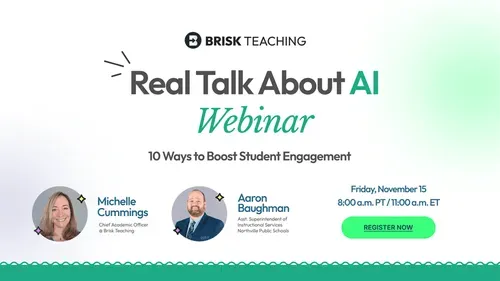
Discover 10 Ways to Boost Student Engagement with Brisk and Boost

In our recent Real Talk About AI webinar, I explored groundbreaking strategies for enhancing student engagement using Brisk and Boost with educators from Northville Public Schools. They shared amazing interactive learning experiences from leveraging AI-powered feedback to creating character chats with Chrysanthemum and personalized career exploration.This session took student engagement to the next level.

Webinar Highlights: Engaging Students with Innovative Tools

During the webinar, we discussed ten effective strategies to boost student engagement:

1. Feedback on Student Writing: Automate and enhance feedback processes to provide detailed, personalized comments that improve student writing.

2. Inspect Writing: Watch a playback of a student’s writing process to offer personalized coaching and insights.

3. YouTube Exit Tickets: Boost a history video to students and turn passive watching into active learning with interactive features that keep students engaged and accountable.

4. Hot Topic Debates: Foster critical thinking and argumentation by Boosting an article to students to have a structured debate with Boost’s chatbot on relevant issues like the role of homework in learning.

5. Character Chats: Bring literature, science, and history to life by allowing students to interact with beloved characters, historical figures, or butterflies in the garden. 

6. Online Curriculum Tutor: Boost your adopted curriculum to students for an AI-powered  tutoring session.

7. Art Project Brainstorms: Boost can help students brainstorm their next art projects like Shoe Designs Inspired by Candy. Interdisciplinary projects encourage creativity and self-expression.

8. Support Multi-Language Learners: Select any world language and Boost will tutor, debate, brainstorm, or chat with students in that language. Adapt lessons for multilingual students by translating any article, curriculum or resource seamlessly. 

9. Career Explorations: Provide scaffolded support for students with learning differences with a customized career questionnaire. Students fill out a Google form supported by Boost’s AI chatbot. 

10. Social Skills Development: Some students need support developing social skills and maintaining a conversation. Why not give them plenty of scaffolded practice using a Reciprocal Interaction template to Boost an AI-powered chat experience? 

Watch the Webinar to Learn More

Educators from Northville Public Schools shared these inspiring real-world examples showcasing how Brisk and Boost bring innovative teaching methods to life. Whether you're enhancing feedback processes or creating immersive character chats, our tools are designed to save teachers time and increase student engagement. Brisk and Boost make teaching and learning more effective and more fun! 

Watch the full webinar here for a comprehensive overview and practical insights on how to implement these strategies in your classroom.

Library shelves filled with books
8
min
September 9, 2024
Administrators

Brisk: The Safest AI Tool that Ensures Student and Teacher Privacy in Schools

As AI use in schools grows, data privacy is a major concern. Brisk Teaching ensures top-tier protection for student and teacher data, setting it apart from other AI tools. Read to learn more.

As AI becomes more common in schools, protecting student and teacher data is at the forefront of everyone’s minds. While the specifics of privacy are unique to each AI-powered tool, Brisk Teaching proudly leads the way in safeguarding student and teacher data! Continue reading for answers to common concerns about student and teacher privacy with AI and how Brisk is different from other AI tools used in schools. 

What is Brisk Teaching?

Brisk is an AI platform that brings AI into the tools teachers already use, helping them build lessons, personalize learning for every student, and determine what to teach next. Brisk works with Google Docs, Google Slides, Microsoft Word Docs, Microsoft Powerpoint, articles, YouTube videos, PDFs, and more.

  • Brisk Extension: The Brisk browser extension lives where teachers already work — in their Chrome or Edge browser, on the sites they’re already using — and offers time-saving, in-the-moment support when they need it.
  • Brisk Next:  The extension handles in-the-moment work. Brisk Next (app.briskteaching.com) is where teachers plan, review, and build at scale — based on real data from their students.
  • Brisk Boost: Brisk Boost is a safe student-facing AI workspace where teachers stay in control. Teachers can take any resource on the web and personalize learning for each student — while getting real-time insights into student engagement and understanding.

Understanding Data Privacy

To fully appreciate Brisk’s approach to student and teacher privacy with AI, you first need to understand what student and teacher data are:

What is Student Data with AI?

Student data is any personal information about students that is given to an AI-powered tool by a school or collected by the AI tool when in use. 

This information might include things like:

  • Names and contact information
  • Grades and test scores 
  • Attendance records
  • Behavioral reports
  • Special education plans
  • Health information
  • Family details

*More information about what is considered “student data” can be found in the Family Educational Rights and Privacy Act, California’s Student Online Personal Information Protection Act, and information protected by similar student data privacy laws.

What is Teacher Data?

Much like that student data, teacher data is personal information given to or retrieved by an AI tool. It can include:

  • Names and contact information
  • School name and district
  • Information about courses you teach
  • Specially created resources or classroom materials

In many situations, teacher data is profitable for companies. This profitability isn’t always in the best interest of teachers though. Teacher data can be used to measure professional performance, impact state and national policies about education, and make critical employment decisions like tenure and terminations.

When student or teacher data is in the hands of an AI tool without many protections, it can have long-term negative consequences.

Brisk's Approach to Student and Teacher Data

Brisk believes student and teacher privacy is of utmost importance and takes our part in it seriously. Neither student nor teacher data is ever sold.

Student Privacy with Brisk

Student data is never used for targeted advertising! Brisk believes:

  1. Student data belongs to schools
  2. Protecting student information is essential 
  3. Adhering to privacy laws is crucial

With Brisk, student data is only used to provide service to schools. Brisk seeks to access the least amount of student information needed to provide the highest quality impact.

For students under the age of 13, Brisk only collects and processes personal data at the direction of and under the control of the school.

As found in Brisk’s Privacy Notice, student data used with Brisk is still owned by the students’ schools. Brisk acts more like a caretaker of the data— not the owner. Schools can request to access or delete student data at any time by contacting privacy@briskteaching.com.  

Brisk also follows important privacy laws like FERPA (Family Educational Rights and Privacy Act) in the USA and GDPR (General Data Protection Regulation) in Europe.

Teacher Privacy with Brisk

Brisk uses as little personal data as possible to manage its organization and run its daily operations. Teacher data is used to:

  • provide Brisk’s services
  • understand how teachers are using Brisk to improve Brisk’s services
  • conduct research for Brisk, if a teacher opts in, and, where a school has purchased AI Governance and turned it on, provide that school with aggregated insights into AI use across its classrooms
  • send communications like emails and newsletters
  • let other teachers know about Brisk’s services 
  • provide top-notch customer service

*More information about personal data can be found in Brisk’s Privacy Notice.

Common Concerns about Student and Teacher Privacy with AI 

There are many concerns about student and teacher privacy with AI, but Brisk addresses them all proactively and thoroughly.

Data Usage and Sharing

Concern: Will student data be used for ads or sold to other companies?

Brisk's Response: Student data is never used for ads.

For example, if a student struggles with fractions, Brisk won't use this information to show the student ads for math tutoring services. Student data is never sold. 

Profile Building

Concern: Will AI tools create personal profiles of students for non-school purposes?

Brisk's Response: No personal profiles of students are made except for school-approved reasons. 

For example, Brisk might create a profile of a student's reading level to recommend appropriate books. This information would not be used to predict the student's future career choices or other personal decisions.

Data Security

Concern: How is sensitive student information protected from being stolen or hacked?

Brisk's Response: Brisk has a strong security program designed to protect student data. This includes:

  • Encrypting data both when it's stored and when it's being sent
  • Restricted access for personal data
  • Use of firewalls
  • Disciplinary process for privacy violations
  • Student Data Breach Response Protocol available to schools

Transparency

Concern: Will schools and parents know about how data is used?

Brisk's Response: With student and teacher privacy at its forefront, Brisk’s data policies were crafted using easy-to-understand verbiage to ensure total transparency for everyone.

Schools and individual Brisk users will also be notified about any big changes to their privacy rules, like if they plan to collect a new type of data or use existing data in a new way.

How Brisk Stands Out

In a time when maintaining privacy is very important, Brisk is exceptional! Our standards include:

  • Strict data usage policies
  • Enhanced control for schools
  • Compliance with education privacy laws
  • Using de-identified data

We have earned the Data Privacy Certification and TrustEd Apps Seal from 1EdTech, are SOC 2 Type II compliant, and comply with the GDPR and all student data privacy laws, including FERPA, COPPA, and Canadian provincial and territorial privacy legislation. We're also proud to have earned a 95% Privacy Rating from Common Sense Education, reflecting our strong commitment to protecting student data.

We have signed the National Data Privacy Agreement with Alabama, Arizona, Arkansas, California, Illinois, Iowa, Maine, Massachusetts, Michigan, Missouri, Montana, New Hampshire, New York, Ohio, Oklahoma, Oregon, Rhode Island, Tennessee, Texas, Utah, Vermont, Virginia, Washington, and Wisconsin.

Next Steps

Book a demo to learn more about using Brisk with your school and district. Our School & District plans include the most advanced features of Brisk, priority support, professional development opportunities, and detailed data analytics.

As Brisk continues to create new tools, we stay committed to these high standards in student and teacher privacy with AI and lead the way in responsibly using it in education.


`

READY TO BRING BRISK TO YOUR DISTRICT?

See how 20,000+ districts adopted AI with full compliance and teacher buy-in from day one.