All Blog Posts

16 AI Teaching Hacks for Elementary, Middle, & High School Math Teachers

Math teachers juggle a lot. Between planning lessons, writing word problems, and finding ways to reach every learner, it can feel like the planning never ends. Many math teachers spend more time preparing than they do teaching, which leaves less energy for the moments that matter most with students.

AI tools for math teachers can change that. Brisk is designed to be a classroom partner that takes on the heavy lifting of lesson planning while leaving teachers in control. With standards-aligned outputs ready in seconds, you get a solid foundation that you can personalize to your students’ needs. These 16 AI teaching hacks show how Brisk can support elementary, middle, and high school math teachers with everyday planning and prep.

Elementary School - Make Math Playful and Easy to Prep

Elementary students thrive on playful learning, and short attention spans mean teachers need plenty of engaging activities. Brisk simplifies the prep so you can focus on adding personal touches that make lessons come alive.

  1. Math Games for Young Learners: Use Brisk’s Math Word Problem Generator to create simple, age-appropriate practice in seconds. Add classroom themes or student names to turn routine problems into games that feel fun and relatable.
  2. Family Newsletters with Math Tips: The Newsletter Generator makes it easy to share quick math strategies or at-home activities with families. A few small edits let you shape the message in your own voice while encouraging stronger teacher–parent communication.
  3. Spiral Review Activities: Brisk’s Spiral Review Generator helps keep key skills like addition and subtraction fresh with minimal effort. You choose what to assign and when, so students build fluency without reteaching.


By streamlining prep, Brisk makes it easier to keep elementary math playful, structured, and connected to home support.

Middle School Hacks – Balance Structure with Critical Thinking

Middle schoolers want structure, but they are also ready to start thinking critically about math. Brisk supports that balance by creating a reliable framework that you can adapt to your goals.

  1. Daily Agendas and Lesson Slides: Brisk’s Lesson Plan Generator produces slides and daily agendas that are already aligned to standards. Add in unit-specific examples or discussion prompts to match what your students need.
  2. Pre- and Post-Assessments: Create quick checks for understanding without hours of work. Brisk can generate short quizzes or even turn a YouTube video into an interactive assessment, giving you more ways to measure growth.
  3. Depth of Knowledge Questions: Use Brisk to draft prompts that push students into analysis and reasoning. You can fine-tune the questions so they connect directly to your current unit.


These hacks save time while giving middle school math teachers more room to focus on guiding student thinking and problem solving.

High School Hacks – Foster Rigor Without Burnout

High school math demands rigor, but that does not mean teachers should carry the burden of endless prep. Brisk helps create challenging materials quickly, leaving you free to focus on instruction and differentiation.

  1. Complex Word Problem Generation: Brisk’s Math Word Problem Generator can produce algebra, geometry, or function-based problems in seconds. Choose real-world contexts like budgeting or sports statistics to make the work meaningful.
  2. Exemplars for Higher-Level Thinking: The Exemplar Generator delivers accurate, step-by-step solutions at the rigor level you select. From SAT practice sets to project launch problems, you decide which exemplars to share to meet the range of abilities in your class.
  3. Critical Thinking Prompts: Draft prompts with Brisk that encourage students to explain reasoning or apply math concepts in new contexts. These small additions build habits of deeper thinking without adding hours to your prep.


With Brisk as a partner, high school teachers can maintain rigor without sacrificing balance.

Universal Time-Saving Workflow Tips

Brisk fits naturally into daily routines when used with a consistent workflow. A few small habits can make planning smoother and more sustainable.

  1. Batch Your Planning: Generate a week’s worth of word problems, quizzes, or exemplars in one session. Brisk makes batch lesson planning with AI fast and reliable, leaving you less stressed during the week.
  2. Adapt Instead of Starting From Scratch: Let Brisk create the draft, then add your own expertise. This blend of automation and personalization keeps planning efficient without losing your style.
  3. Track the Time You Save: Notice how your planning time shrinks once Brisk becomes part of your routine. Sharing those results with colleagues can encourage them to explore time-saving tools for teachers too.


Tips and Best Practices for Math Teachers

Brisk handles the time-consuming prep, but the real value comes when you combine its speed with your expertise. Here are some best practices for getting the most out of Brisk’s AI tools at every grade level:

  1. Elementary: Use the Math Word Problem Generator for quick practice, then personalize the problems with classroom themes to make them more engaging.
  2. Middle School: Leverage Brisk’s Depth of Knowledge prompts to challenge students beyond recall. Because the outputs are aligned with standards, you can trust the foundation and adjust them to fit your unit.
  3. High School: Brisk’s Exemplar Generator provides accurate, step-by-step solutions at the rigor level you choose. You remain in control of which ones to share, making differentiation simple.
  4. All Levels: Brisk’s Lesson Plan Generator and Spiral Review Generator deliver standards-aligned materials from the start, helping you stay on track while keeping flexibility in your hands.


Teaching math is demanding at every grade level, which is why teachers are always looking for practical hacks that save time and boost engagement. Brisk is built as a classroom partner: reliable, flexible, and aligned with your teaching goals. It takes on the heavy lifting so you can focus on guiding discussions, checking for understanding, and celebrating student growth.

If you are ready to save time and bring new energy to your planning, try Brisk today. Get started for free or request a demo of AI tools for math teachers to see how it fits into your classroom.

Latest Posts

Latest from the Brisk Blog

Explore practical articles for K–12 educators, from classroom-ready strategies to thoughtful guidance on using AI in ways that support real teaching.

Library shelves filled with books
September 14, 2026
Brisk Features

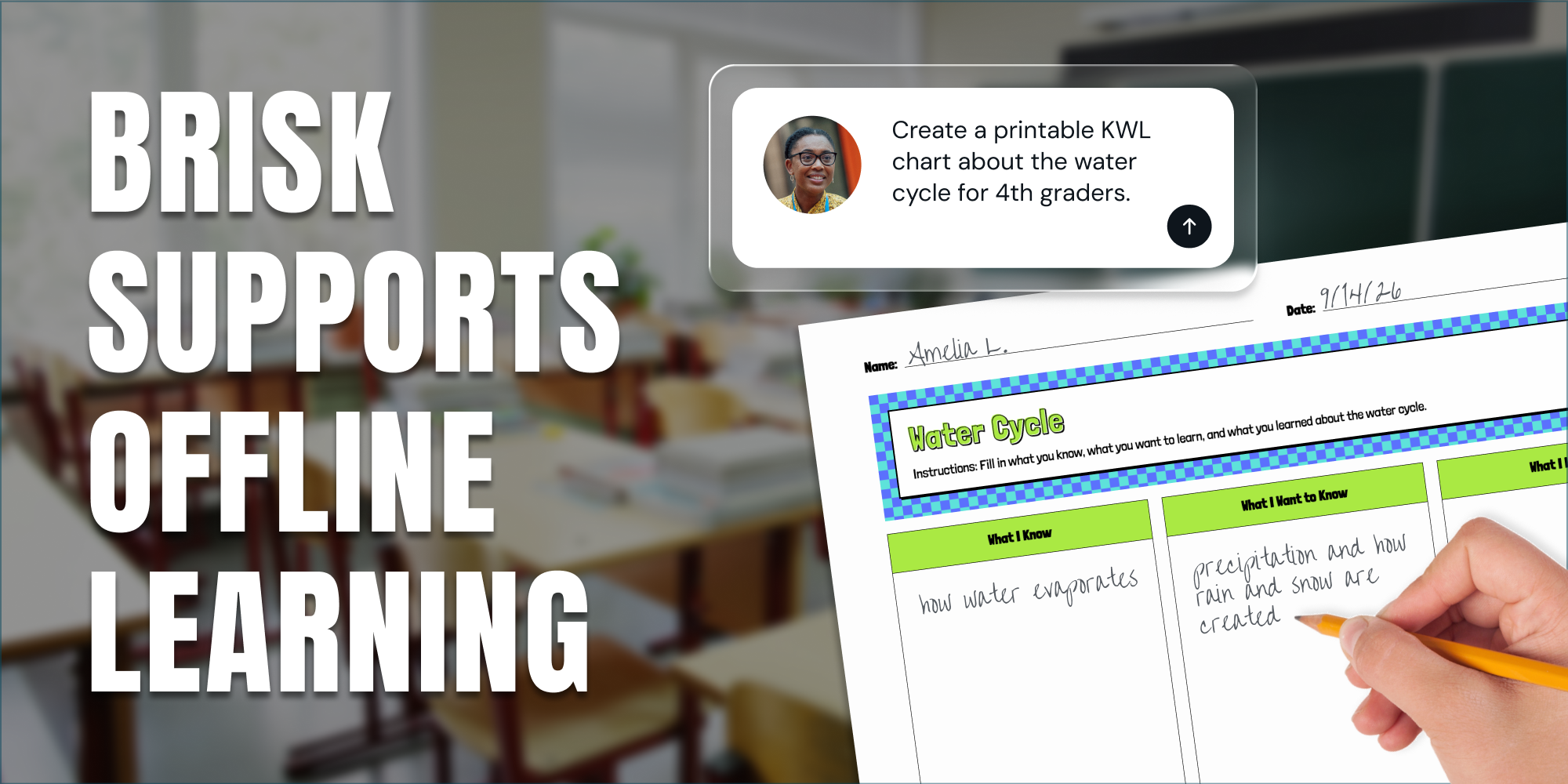
Print It, Project It, or Skip the Screen: How Brisk Fits Any Classroom

Brisk provides teachers with a variety of ways to support student learning, even when they’re focused on scaling back screen time in their classrooms.

Library shelves filled with books
August 14, 2026
Thought Leadership

Brisk in New White Paper on AI's Instructional Impact

Brisk founder Arman Jaffer shares his key takeaways from Whiteboard Advisors’ new white paper on measuring the instructional impact of AI in the classroom.

Library shelves filled with books
July 27, 2026
Tips for Teachers

60 Get-to-Know-You Questions for Students (For Every Grade)

60 get-to-know-you questions for students, organized by category and grade — plus, easy ways to use them for icebreakers, morning warm-ups, and first-day connection.

Library shelves filled with books
8
min
January 31, 2025
Math Resources

Unlocking Problem Solving with Graphic Organizers for Math Word Problems

Graphic organizers for math word problems are powerful tools that help students break down complex math problems into manageable steps. By visually organizing key information and operations, these organizers enhance problem-solving skills, critical thinking, and understanding of mathematical concepts. Need something for simple addition or multi-step word problems? They make math more accessible and engaging for students at every grade level. Teaching math word problems can be a challenging task, especially when you're working with students of all ages and grade levels. Teaching basic addition in 1st grade, tackling multi-step word problems in 5th grade, or helping middle school students prepare for high school math all come with their own challenges! The use of graphic organizers for math word problems is one of the best ways to help students process information and improve their problem-solving skills. By creating a visual representation of the problem, students can better understand the problem-solving process, which is essential for developing strong math skills. Here’s how graphic organizers for math word problems can help students at all levels—from 2nd grade to high school—solve problems more effectively. Plus, how Brisk Teaching AI tools can help create these great tools for the classroom.

Why Graphic Organizers Are the MVP of Math Problem-Solving

Graphic organizers are sort of like those visual superheroes that swoop in to save the day (and maybe your sanity). These nifty tools can work magic for anyone, from 1st graders trying to add apples to middle schoolers drowning in algebraic drama. Ready to see how these problem-solving pros get it done?

Clear Visuals

Number lines, Venn diagrams, and flowcharts transform math chaos into something, well, manageable. It’s like giving kids a map in a maze, making it easier for them to connect the dots. Suddenly, word problems don’t seem like riddles written in ancient code.

Baby Steps

Graphic organizers break problems into bite-sized chunks. Forget the "just wing it" strategy; this is the math equivalent of step-by-step IKEA instructions (minus the extra screws). Perfect for middle schoolers trying to figure out where x ran off to this time.

Word Problems Made Less Evil

Word problems have a reputation—no one likes them. But with the right organizer, students can zero in on what matters: Is this a multiplication story? Division? Why does Susan have 37 apples anyway? Graphic organizers make it all click.

Problem-Solving in Action

Visuals make math feel a lot less like a mind game. By organizing the info clearly, students develop actual skills instead of just guessing. Who knows, maybe they’ll even stop saying, "I’ll never use this in real life."

Fits Every Age 

It doesn’t matter if you’re helping a 2nd grader add up their LEGO collection or a 7th grader solve for y. Graphic organizers are adjustable to match any grade level. 

Types of Graphic Organizers: The Squad You Need

Not all graphic organizers are created equal. Here’s a rundown of the all-stars and how they make math problems a breeze:

  1. Basic Math Organizers: These are perfect for baby mathematicians (1st- 2nd grade) who are just learning the ropes of addition and subtraction. They’re simple, like training wheels for math.

  2. Number Lines: Subtraction is basically reverse counting, and number lines are the cheat sheet kids didn’t know they needed. Bonus: they work for decimals and fractions, too—math’s double agents.

  3. Venn Diagrams: Two circles walk into a math problem...and now you’ve got a way to compare numbers, data sets, or mathematical concepts. Younger kids think they’re fun; older kids realize they’re lifesavers.

  4. Problem-Solving Organizers: These beauties are the step-by-step guides for cracking multi-step word problems. Middle schoolers struggling with math? Meet their new best friend.

  5. Schematic Diagrams: For the big leagues (think complex high school problems), these diagrams are like having a GPS for your brain. They’re all about logic and structure—very grown-up, very cool.

How Brisk Teaching Makes Graphic Organizers Easy

Creating graphic organizers might sound like a chore, but Brisk Teaching makes it ridiculously easy. Here’s why you’ll want to high-five their AI tools:

  • Tailored Templates: Whether you’re dealing with 3rd-grade addition or high school-level equations, Brisk Teaching has a template for it. Customize it faster than you can say "word problem."

  • Save Time, Save Sanity: No need to fiddle with PowerPoint slides or Canva templates for hours. Let Brisk Teaching do the heavy lifting so you can actually, you know, teach.


  • Organizers + Answer Keys: Ever wonder if your students’ answers are on the right track? Brisk Teaching’s got you covered with answer keys that make grading a breeze.

  • All Ages, All Stages: Whether you’re wrangling 2nd graders or prepping high schoolers for SAT-level math, there’s a graphic organizer for that.

Graphic organizers aren’t just another tool—they’re the math equivalent of a cheat code. From number lines to schematic diagrams, they help students tackle problems confidently and clearly. And with Brisk Teaching’s AI tools, creating them is as easy as pie (or 3.14, if we’re being nerdy).

So, what are you waiting for? Grab a graphic organizer, unleash your inner math superhero, and watch your students go from “I hate this” to “I got this!”

`

READY TO BRING BRISK TO YOUR DISTRICT?

See how 20,000+ districts adopted AI with full compliance and teacher buy-in from day one.