All Blog Posts

​​AI Agents Will Transform Work. They'll Set Back Learning.

There's a new wave in AI right now, and it's not about chatbots. Over the past several months, something shifted. AI systems went from answering questions to doing things: writing entire codebases, managing complex projects, executing multi-step tasks with minimal human oversight. Tools like Clawdbot, an open-source agent framework that blew up almost overnight, let people run AI locally on their own machines, connected to their own apps, acting on their behalf. Claude Code is changing how software gets built.

McKay Wrigley, a developer whose judgment I trust, called Opus 4.5 "to agents what Sonnet 3.5 was to code" — the inflection point. METR, an independent evaluation org, found that the time horizon over which AI can work autonomously is doubling every four to seven months. Engineers at Brisk are handing over nearly all of their coding to AI and spending their time reviewing, directing, and deciding.

This isn't hype. The agent paradigm works for knowledge work, and it's going to change how a lot of industries operate.

‍

Why the Agent Paradigm Fails Students

A reporter asked me recently what this means for K-12 education. I've been thinking about this for a while, and my honest answer is: probably a lot of smoke. Not because agents aren't powerful, but because the logic that makes them work for software engineering is almost exactly the logic that makes them harmful for learning. I don't think enough people in education are making this distinction clearly.‍

The easiest way to see it is to ask: what's the goal?

In software, the goal is the output. Ship the feature, fix the bug, deploy the system. If an AI agent writes the code for you, better and faster than you could have, that's the point. The agent doing the work is the product. An engineer's job increasingly becomes reviewing, directing, and deciding while the AI handles execution.

In school, the goal is the opposite. The output (the essay, the problem set, the lab report) is almost beside the point. What matters is what happened in the student's brain while they produced it.

A student who uses an AI agent to complete an assignment has not been helped. They've been robbed of the only thing that mattered. The fact that the output looks better is, if anything, worse: it creates the illusion of learning where none occurred.

We now have hard evidence for this. A randomized controlled trial across nearly a thousand high school students in Turkey, published in PNAS, tested exactly this scenario. Students were split into three groups: no AI access, a standard ChatGPT-like tool, and a carefully guardrailed AI tutor designed with input from their teachers.

Students using the standard AI tool performed 48% better on practice problems. They also performed 17% worse on the exam, when the AI was taken away. Most troublingly, they didn't know it.

They believed they had learned more than the control group. The OECD, in its 2026 Digital Education Outlook published just weeks ago, coined a term for this: metacognitive laziness. Students offload not just the work but the awareness of whether they're actually learning.

The guardrailed tutor group did somewhat better (127% improvement on practice) but on the unassisted exam, they did no better than students who never had AI at all. Even the most thoughtfully designed student-facing AI tool produced zero measurable learning gains on the assessment that actually mattered.

This isn't just about students being lazy. It's something structural about what agents are and what K-12 education is.

‍

Three Structural Mismatches

Mismatch 1: The Expert-in-the-Loop Problem

Agents are built for a specific kind of work. They're good at open-ended, novel problems where the human in the loop is skilled enough to evaluate the output. An engineer using Claude Code can read the pull request, spot the error, understand the tradeoff, and redirect. The agent proposes; the expert disposes. This works because the human has enough domain knowledge to be a real check on the agent's work.

A ninth-grader can't do this. When an AI tutor walks a student through a math problem or drafts a paragraph for their essay, the student lacks the very knowledge they're supposed to be acquiring. They can't evaluate whether the AI's reasoning is sound, whether a step was skipped, or whether the explanation, while fluent, is subtly wrong.

The human-in-the-loop model breaks down precisely when the human is the one who is supposed to be learning.

This isn't something better prompt engineering or more sophisticated guardrails can fix. It's structural. The student is, by definition, not yet the expert.

‍

Mismatch 2: Routine Work vs. Novel Reasoning

There's a second mismatch. Agents are designed for novel, generalizable tasks, the kind that requires flexible reasoning across unfamiliar territory. But K-12 education isn't novel. It's 180 days of structured, sequenced curriculum. A third-grade teacher in Houston and a third-grade teacher in Memphis are teaching roughly the same standards in roughly the same order. The work is routine in the best sense: carefully designed to build knowledge incrementally, each lesson resting on the one before. You don't need an AI that reasons from scratch every time. You need something that executes reliably against a known scope and sequence. The agent paradigm is pointed at the wrong problem.

‍

Mismatch 3: Productive vs. Unproductive Struggle

Then there's the deepest issue, one that good teachers understand intuitively but that's almost entirely absent from the AI-in-education discourse: the difference between productive and unproductive struggle.

Not all difficulty is the same. When a student wrestles with a challenging math problem and feels that friction of not quite getting it — that's productive struggle. That's where learning happens. But when a teacher spends forty minutes reformatting a lesson plan across three different platforms, or manually differentiating a reading passage for five reading levels, or hunting through an LMS for the right standard to tag — that's unproductive struggle. It produces no learning for anyone. It's pure overhead.

A general-purpose AI agent can't tell the difference between productive and unproductive struggle. Its default is to collapse both.

When you point an agent at a student, it eliminates the productive struggle — the part where learning lives — right alongside the busywork. That's what the Turkey study showed. The AI made the work feel easier. The students felt like they were learning. But the ease was the problem.

‍

What Actually Works for Students

So if autonomous agents are the wrong model for students, does that mean AI should never touch a student? No. But the direction of the AI has to be completely different from the agent paradigm, and the teacher has to stay in control of what the AI is driving toward.

Think about two different designs for a student-facing AI activity. In the first, a student opens a general-purpose AI and says "help me write an essay about the causes of the Civil War." The agent obliges. It drafts an outline, suggests a thesis, offers paragraphs to refine. The student ends up with a polished essay and a vague sense of having participated. This is the agent model applied to learning, and it's what the Turkey study measured. It doesn't work.

In the second design, a teacher creates an activity grounded in this week's unit. The AI's job isn't to help the student complete the task. It's to drive the student toward demonstrating a specific learning outcome. The student can't advance by asking the AI to do the thinking. The AI asks questions, pushes back, requires the student to articulate their reasoning. The only way through is to show you understand. The teacher defines the outcome; the AI enforces the path.

In the first model, the AI is pointed at the task, and its success metric is task completion. In the second, the AI is pointed at the student, and its success metric is whether the student demonstrated understanding.

That distinction sounds small but it changes everything. One is an agent. The other is an instrument of the teacher's pedagogy. This is what we've built with Brisk Boost: student-facing AI activities where the teacher sets the learning objective, the AI is grounded in the actual curriculum, and the student has to do the thinking. The AI's job is to make the productive struggle unavoidable, not to eliminate it.

The issue was never "should AI touch students." It's: who is in control, and what is the AI optimizing for? A general-purpose agent optimizing for task completion will always tend to do the work for the student. That's what agents are built to do. When the teacher defines the learning outcome and the AI is constrained to drive toward it, the dynamic flips. The AI becomes a tool for enforcing rigor, not bypassing it.

‍

Where Agents Do Belong: The Teacher Workflow

The teacher side is equally important, and it's where the agent paradigm actually does fit.

Teachers are drowning, but not in the work of teaching. In the work around teaching. The average teacher touches half a dozen platforms daily: their LMS, their SIS, their curriculum portal, Google Docs, email, grading tools. The overhead of navigating these systems, reformatting content between them, and manually adapting materials for different student needs is enormous. Data shows that teachers using AI weekly save an average of nearly six hours per week. Over a school year, that's six full weeks of time back.

The tasks that eat teachers alive are exactly the kind agents do well: differentiate this unit for three reading levels, align this assessment to the district's standards, generate a parent communication about this week's objectives, build a small-group activity grounded in the lesson's scope and sequence. These are constrained, repeatable, reviewable workflows. They're not open-ended. They're not novel. They're the same types of tasks, executed hundreds of times a year, against a known curriculum.

And the teacher is the expert in the loop. They review the AI's output before it reaches a student. They catch the error, adjust the tone, redirect the approach. The human-in-the-loop model works here because the human has the domain knowledge to evaluate what the agent produces.

This is the kind of AI that K-12 actually needs: not an autonomous agent reasoning from first principles about what a student should learn next, but a system that executes reliably against a district's actual curriculum: their scope and sequence, their adopted materials, their standards and pacing guides. The intelligence isn't in the general reasoning. It's in the retrieval, the grounding, the fidelity to what this district, in this grade, in this unit, is actually teaching this week.

‍

The fact that AI agents are transforming software engineering doesn't mean they'll transform everything. The logic of code is not the logic of learning. In code, you want the AI to do the work. In school, the student doing the work is the entire point. Treating learning like another knowledge-work task to be automated is a mistake that could set back a generation of students while making everyone feel like progress is being made.

The technology is powerful. The question is whether we point it at the work, or at the people who are supposed to be learning from the work.

The opportunity in K-12 is real and it's significant, but it's in putting teachers in control. Of the curriculum the AI draws from. Of the learning outcomes it drives toward. Of the workflows it executes on their behalf. Not in handing students a general-purpose agent and hoping for the best.

Latest Posts

Latest from the Brisk Blog

Explore practical articles for K–12 educators, from classroom-ready strategies to thoughtful guidance on using AI in ways that support real teaching.

Library shelves filled with books
September 18, 2026
Administrators

Everyone Has Questions About AI — Here’s How Leaders Can Address Them

As district leaders face a growing number of questions about how they’re handling AI, they need both visibility into AI use and the power to shape it.

Library shelves filled with books
September 14, 2026
Brisk Features

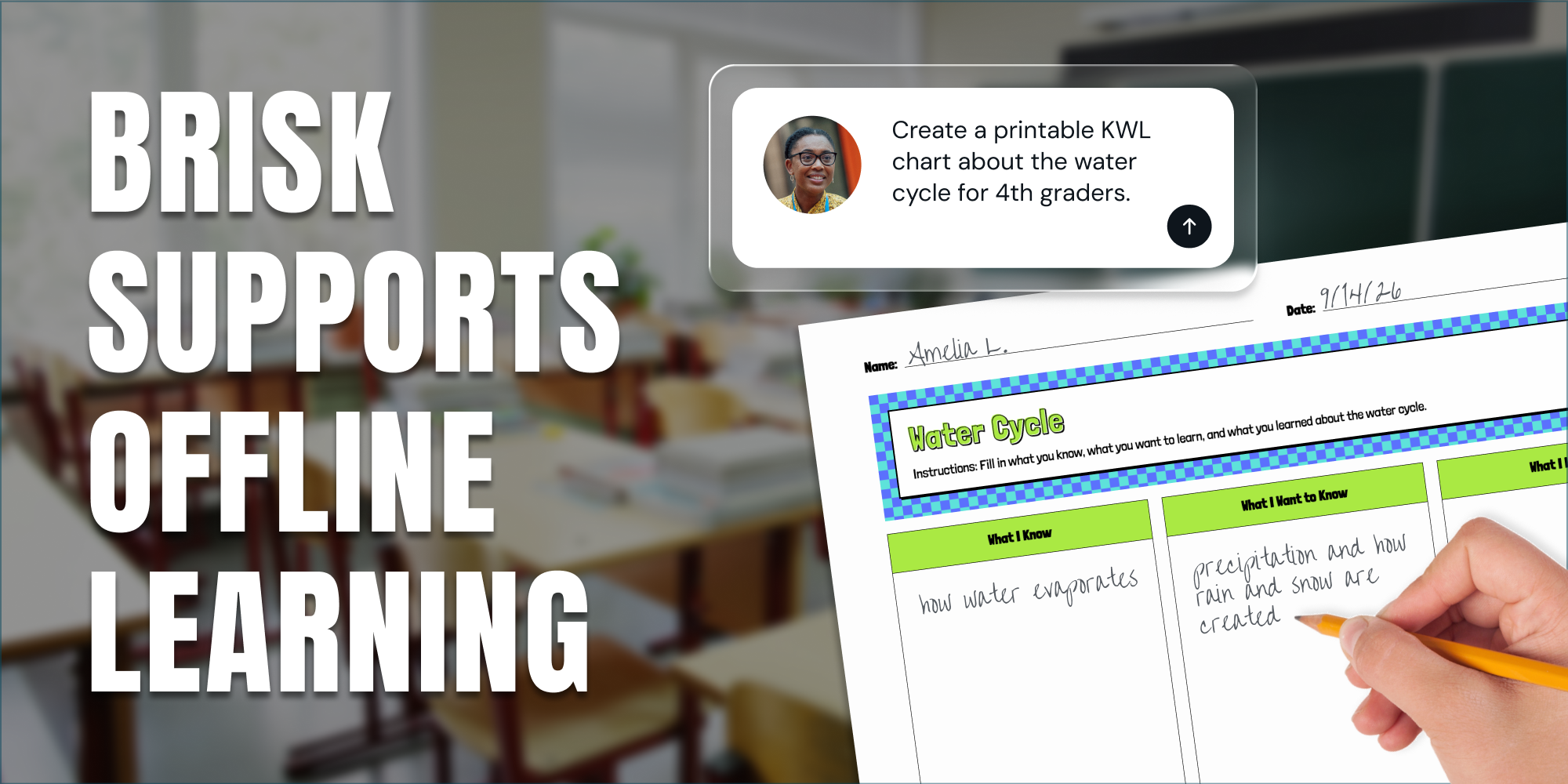
Print It, Project It, or Skip the Screen: How Brisk Fits Any Classroom

Brisk provides teachers with a variety of ways to support student learning, even when they’re focused on scaling back screen time in their classrooms.

Library shelves filled with books
August 14, 2026
Thought Leadership

Brisk in New White Paper on AI's Instructional Impact

Brisk founder Arman Jaffer shares his key takeaways from Whiteboard Advisors’ new white paper on measuring the instructional impact of AI in the classroom.

Library shelves filled with books
8
min
December 1, 2025
Tips for Teachers

AI Literacy for Students: A Teacher’s Guide to Preparing Students for the Future

Discover what AI literacy means in today’s classrooms and how to build AI literacy for students through practical routines, supportive teaching strategies, and clear expectations. This teacher-friendly guide offers simple ideas, student-centered practices, and natural ways to integrate AI tools like Brisk into your instruction.

As AI becomes embedded in daily routines, students are engaging with it independently — well before it shows up in the classroom. Teaching AI literacy for students is no longer about learning one tool. It’s about helping them understand how AI works, how to use it responsibly, and how to stay curious as the world around them changes.

When we build AI literacy for students, we strengthen the skills that matter most, like critical thinking, problem-solving, and digital citizenship. Students learn to ask better questions, evaluate information more carefully, and use AI to support their learning rather than avoid it. This guide breaks down what that can look like in your classroom, using strategies that feel practical and manageable for real teachers.

‍

What AI Literacy Looks Like in the Classroom

Understanding AI in Student-Friendly Language

Students do not need technical definitions — they need simple, clear explanations that help them see AI as a tool created by people. You might describe AI as a system that learns patterns, similar to how students learn spelling rules or multiplication facts. This approach removes the intimidation factor and builds curiosity. When students understand the basics, they feel more confident exploring new tools.

Using AI to Support Thinking, Not Replace It

One of the core pieces of AI literacy for students is showing them that AI can help brainstorm, draft, explain, or clarify, but it does not replace their own ideas. When students see AI as a helper, they stay engaged in the thinking process. They make stronger choices, ask better questions, and reflect more deeply on their work.

Building Responsible Use Habits

Instead of strict rules, focus on expectations that help students make thoughtful choices. Model how you ask AI questions, what you accept, and what you double-check. When routines are clear, students develop habits that transfer beyond your class. These habits strengthen digital citizenship and give students the tools they need to navigate an AI-shaped world.

‍

Essential AI Literacy Skills for Students

Critical Thinking and Questioning

AI responses are not always correct; students need practice analyzing accuracy and asking follow-up questions. A simple activity is comparing their answer to an AI-generated answer and discussing strengths in each one. This type of reflection builds independence and supports stronger academic writing and research skills.

Creativity and Problem Solving

AI should spark creativity, not limit it! Let students use AI to help brainstorm ideas for a project, generate alternate endings for a story, or create variations of a concept. Students stay in the lead, and AI becomes a partner that helps them take creative risks they might avoid on their own.

Looking for a tool to enable students to engage with AI safely? Brisk Boost is a free tool that allows teachers to create guided, interactive, AI-powered experiences for students that help build confidence and digital literacy.

Ethical Awareness

Bias, privacy, and fairness can be taught in age-appropriate ways. Students begin to understand that AI tools are shaped by the data they learn from, which means they can make mistakes. These discussions help students think about digital spaces more thoughtfully and make informed choices.

Collaboration and Communication

Students can use AI to help draft feedback, generate discussion questions, or organize ideas for group work. These practices strengthen communication skills and help students learn how to use AI in collaborative settings, a key part of AI literacy for students.

‍

Practical Ways to Build AI Literacy Into Daily Instruction

Start With Quick, Low-Lift Routines

Simple activities help students build confidence, like predicting how an AI tool might answer a question or comparing two AI-generated examples to decide which one is stronger. These routines encourage students to think critically about quality and accuracy.

Integrate AI Into Work Students Already Do

AI can support vocabulary building, summarize complex text, scaffold research questions, or help students outline a writing piece. When AI fits naturally into existing tasks, students stay focused on learning goals rather than the tool itself. This approach reduces frustration and boosts engagement.

Model Purposeful Use

Share your own thinking out loud. Explain why you asked a certain question or why you revised the AI’s answer. Students learn not just how to use AI, but why certain choices matter. Clear expectations make the learning experience feel supportive and manageable.

Lean on Brisk When You Need Support

If you want to preview or adapt an AI activity before introducing it to students, Brisk can help you rewrite or differentiate materials in minutes. It is also a quick way to communicate with families. You can use Brisk to draft a warm, simple explanation of how your class is approaching AI literacy for students.

Not yet a Brisk user? Download Brisk to save time and simplify your planning.

‍

Helping Students Reflect on Their AI Use

Use Reflection Routines to Build Metacognition

Reflection does not have to be long. Try exit tickets that ask:

  • What did AI help you understand today?
  • What did you revise or question?
  • What would you do differently next time?

These short routines make students aware of their choices and the impact those choices have on their learning.

Educators can use Brisk to generate exit tickets that foster meaningful reflection — in the click of a button. Download Brisk for free today.

Encourage Peer Conversations

Pair or group discussions about prompts, strategies, and outcomes help students learn from one another. These conversations build community, reduce confusion, and help students feel more comfortable exploring new tools.

‍

Supporting Diverse Learners in AI Literacy

Scaffolded Prompts for Accessibility

Provide sentence starters or guided questions that help students use AI without feeling overwhelmed. When supports are available, all students can participate meaningfully, which boosts confidence.

Multiple Ways to Show Understanding

AI can generate outlines, visual organizers, summaries, or practice questions. Students can choose the format that helps them show what they know. This flexibility creates access without lowering expectations.

Building Agency

Let students choose which AI strategies work best for them. Choice encourages ownership, and ownership leads to stronger engagement.

‍

Helping Families Understand Student AI Literacy

Families want clarity, not technical detail. Share a short explanation of what AI literacy means, how it supports student learning, and what your expectations look like in class. If you need help drafting a letter or newsletter blurb, you can use Brisk to create a friendly, accessible message that builds trust and transparency.

‍

Looking Ahead: Preparing Students for an AI-Shaped Future

You do not need to be an AI expert to teach AI literacy for students. You simply need to model curiosity, ask thoughtful questions, and create space for exploration! When students learn to use AI responsibly and confidently, they are better prepared for a world where digital tools evolve quickly.

The most important thing they learn from you is that they can handle new technology with flexibility and purpose. Your openness gives them the permission to try, reflect, and grow in ways that will stay with them long after they leave your classroom.

‍

Use Brisk to create resources on AI literacy for your classroom — a lesson plan, a quiz, a presentation, guided notes, and so much more. Get started with Brisk for free today.

Library shelves filled with books
8
min
August 12, 2024
Tips for Teachers

Preventing Teacher Burnout: How Brisk’s AI Tools Are Supporting Educators

It’s no secret teachers are experiencing burnout on a daily basis due to their professions. Now there’s an AI tool that’s determined to change that.

Teachers Are Battling Burnout

We’ve seen teachers all over social media poke fun at their teacher stress. However, behind every shareable meme about a “funny” classroom experience lies the scary truth: teachers are stressed, overwhelmed, and burnt out. 

And what’s even scarier? Many teachers are quitting or planning to quit. 

In 2024, a Gallup survey found that 39% of teachers reported feeling burnout 'very often' or 'always.' This alarming statistic indicates that nearly half of the teaching workforce is experiencing significant stress on a daily basis. 

Brisk Teaching is tackling teacher burnout head on. This AI tool for teachers is revolutionizing how educators plan, grade, and create engaging instructional materials for their students. 

Teachers are required to wear many hats and complete dozens of tasks, sometimes even at the same time. In a typical classroom it’s not rare to witness the teacher giving a grammar lesson, helping a student realize they forgot a period at the end of their sentence, and trying to contact a parent.…sometimes all at once! 

With the high demands of the job and little to no help, It’s no surprise teachers are experiencing an overall decline in their mental health. 

‍

Unrealistic Expectations Are Leading To Teacher Stress 

Speak to any teacher and they’ll most likely talk to you about the stress of the job and lack of support and resources that are available to them or their students. Teachers are expected to balance things like grading hundreds of papers, communicating effectively with parents, planning engaging lessons, and creating resources for their students. 

Don’t forget they should also be keeping up with the ever-changing ways kids learn in the modern day classroom. 

It’s unrealistic to think a teacher can do all of that while balancing life outside of the classroom. That’s why many teachers must take their work home, or they won’t ever come close to getting through their workload. 

The demand is too high, and the time to do it all is just not there. 

Teachers are constantly playing catch up, but they might not have to for much longer. 

‍

Can an AI Tool For Teachers Really Make That  Much Of A Difference? 

Brisk Teaching is the mighty Google Chrome extension that gives teachers 10+ hours back on average every week. An added bonus is that Brisk is free for teachers to use. 

This free AI tool is installed as a Google Chrome extension. Once added, all you have to do is open any Google Doc, slide, web article,  PDF,  or video and click on the Brisk icon to experience the magic. Teachers are able to create resources, lesson plans, quizzes, presentations (and more) in just a few seconds. 

‍

10 Ways Brisk Saves Teachers 10+ Hours Each Week

With Brisk, there are over 30 AI-powered tools teachers can use in their classrooms. 

Some of the teacher favorites include the Targeted Feedback Generator, AI Presentation Maker, and AI Quiz Maker. There’s even an AI Lesson Plan Generator and AI powered tools to help with administrative, time-sucking tasks like emails. 

With Just One Click Teachers Can…

ONE: Create A Classroom Newsletter In Under Two Minutes:

‍Keeping families informed of upcoming tests, events, or important information can be a challenge. It can also be one more thing added onto a teacher’s plate. Now with Brisk’s AI Newsletter Generator, teachers can create a classroom newsletter in under a minute. Learn how: 

  1. Open up a new Google Doc. 
  2. Click on your Brisk icon in the bottom right corner. 
  3. Click on “Create.” 
  4. Choose “Newsletter.” 
  5. Copy the following prompt (or write your own) and add in your info: I am a [grade level] teacher named [name]. I would like you to write a classroom newsletter for parents that includes the following information about my classroom. [Add information about rules, upcoming assignments, tests, events, etc. in the form of a short paragraph]. 
  6. Click on “Brisk It” and watch your newsletter create itself! 

TWO: Create A Presentation From A YouTube Video in 30 Seconds:

‍Could coming up with new ideas to keep students engaged be contributing to a teacher’s stress? With Brisk’s AI Presentation Maker, teachers can show a video to the class and use that same video link to create a presentation that will actually keep students engaged in the lesson. Here’s how: 

  1. Copy the YouTube video link. 
  2. Click on your Brisk icon in the bottom right corner.  
  3. Click on “Create.” 
  4. Choose “Presentation.” 
  5. Click on “Brisk It” and let the class discussions begin!

THREE: Cut Down Essay Grading From Hours To Seconds:

‍Teachers can almost always be spotted taking work home, but now they can at least leave the essay grading to Brisk. What would it feel like to easily give feedback to students on their writing in just a few seconds? It’s time to try it out and find out: 

  1. Open a student’s writing from a Google Doc. 
  2. Click on your Brisk icon in the bottom right corner and click “Give Feedback.”
  3. You can choose the type of feedback you’d like to give that’s aligned to your standards, shows areas of growth or strength, or bases your feedback on a rubric (another AI tool for teachers offered by Brisk). 
  4. After you have made your choice, click on “Brisk It” and witness your students’ essays grade themselves!  

FOUR: Create Decodable Reading Passages From Scratch:

‍Brisk’s “Decodable Text” AI tool can help elementary teachers create texts personalized to their students’ needs. Try it! 

  1. Open up a new Google Doc. 
  2. Click on your Brisk icon in the bottom right corner and click “Create.” 
  3. Click on “Decodable Text.” 
  4. Choose your grade level, the main focus of your decodable text (ex: short vowel, long vowel, etc.) 
  5. Type in a sentence that explains the specifics of the decodable text you’d like, for example, “Create a decodable text that focuses on short a and short i sounds” 
  6. Click on “Brisk It” and voila! Your decodable text is ready! 

FIVE: One Click To Reading Comprehension Questions For Your Decodable Text:

Your young learners have read the text, now what? Practice their comprehension with Brisk and that same Google Doc. 

  1. In the same Google Doc that you created the decodable text in, click on your Brisk icon in the bottom right corner, and click “Create.”  
  2. Choose “Quiz.” 
  3. Select your grade level, the type of quiz you would like created, and the number of questions. 
  4. Type in a prompt such as, “Create comprehension questions based on the decodable text.”
  5. You get to choose if you’d like the quiz on the same Google Doc, or a brand new one. 
  6. Click on “Brisk It” and your quiz is ready! 

SIX: Personalized Math Word Problems In A Few Easy Steps:

‍You can create math word problems that are aligned to your curriculum. 

  1. Open up a new Google Doc. 
  2. Click on your Brisk icon in the bottom right corner and click “Create.” 
  3. Click on “Math Word Problems” 
  4. Choose your grade level and the number of math word problems you’d like. 
  5. Type in a prompt that includes a sample math word problem from your math curriculum. It can look like this, “Create word problems that model this skill [your math curriculum’s word problem].” 
  6. Click on “Brisk It” and get math word problems to assess your students with! 

SEVEN: From Your Lesson Plan To A Made-For-You Quiz:

‍Stop getting burnt out creating assessments. 

  1. Open up your lesson plan as a Google Doc OR open a new Google Doc, click on your Brisk icon in the bottom right corner, and click on the paperclip icon to upload it as an attachment. 
  2. Click “Create” and choose “Quiz.” 
  3. Type in a prompt such as, “Create a quiz from this lesson plan that focuses on the author's purpose.” 
  4. Click “Next.” 
  5. You can then choose to create the quiz in the same Google  Doc or through Google Forms. 

EIGHT: Turn Your Test Into A Google Form:

‍Want your students to turn in their tests digitally? Brisk Teaching can help! 

  1. Open up a new Google Doc. 
  2. Click on your Brisk icon in the bottom right corner and click “Create.” 
  3. Click on the paperclip icon to upload your assessment as an attachment. 
  4. Choose “Quiz.” 
  5. Choose your grade level and the number of questions  you’d like. 
  6. Brisk Teaching will add a prompt for you that you may edit. 
  7. Click “Next,” choose “Google Form,” and click on Brisk It! 
  8. Your students can now answer the questions digitally, and you can grade it in seconds. Goodbye teacher burnout due to grading! 

NINE: Sub Plans In Seconds:

Teachers deserve to take their sick days without worrying about writing sub plans. 

  1. Open up a new Google Doc. 
  2. Click on your Brisk icon in the bottom right corner and click “Create.” 
  3. Click on the paperclip icon to upload a file or copy and paste an article, file, or resource your students are working on. 
  4. Choose “Lesson Plan.” 
  5. Choose your grade level and the amount of time you’d like the lesson to be. 
  6. Click on “Brisk It!” and you’re ready for that day off to avoid teacher burnout! 

TEN: Extend The Life Of Your Lesson With A Personalized Presentation:

If you’re in need of a presentation to anchor understanding and foster class discussions, the “Presentation Maker” AI teaching tool is your best friend. 

  1. Open up the resource or lesson plan you’re working on as a Google Doc OR open a new Google Doc, click on your Brisk icon in the bottom right corner, and click on the paperclip icon to upload an attachment. 
  2. Click “Create” and choose “Presentation.”
  3. Choose your grade level, the number of slides, and if you want to add images. 
  4. Type in a prompt such as, “Create a presentation that focuses on [topic].” 
  5. Click on “Brisk It!” and present it to your students! 

… and so much more.

‍

Conclusion

Brisk Teaching is doing things differently. Instead of adding another item to the never-ending teacher to-do list, this free Google extension is taking tasks off! 

With more than 30 AI classroom tools, teachers can significantly reduce their workload in just one click. Brisk Teaching is determined to help end teacher burnout and teachers are here for it.

READY TO BRING BRISK TO YOUR DISTRICT?

See how 20,000+ districts adopted AI with full compliance and teacher buy-in from day one.