In 2025, teachers face new challenges alongside timeless ones. Screen fatigue is at an all-time high, AI tools are reshaping how students think about “original” work, and there’s a renewed push for authentic creativity in every subject. Having quality, thought-provoking writing prompts for every grade level is more important than ever. The right question can spark creativity, build fluency, and turn hesitation into confidence.
If you’re looking for writing prompts for students that are fresh, adaptable, and ready to use, you’ve landed in the right spot. Below, you’ll find grade-specific prompts for every level K-12, designed to meet students where they are and help them grow.
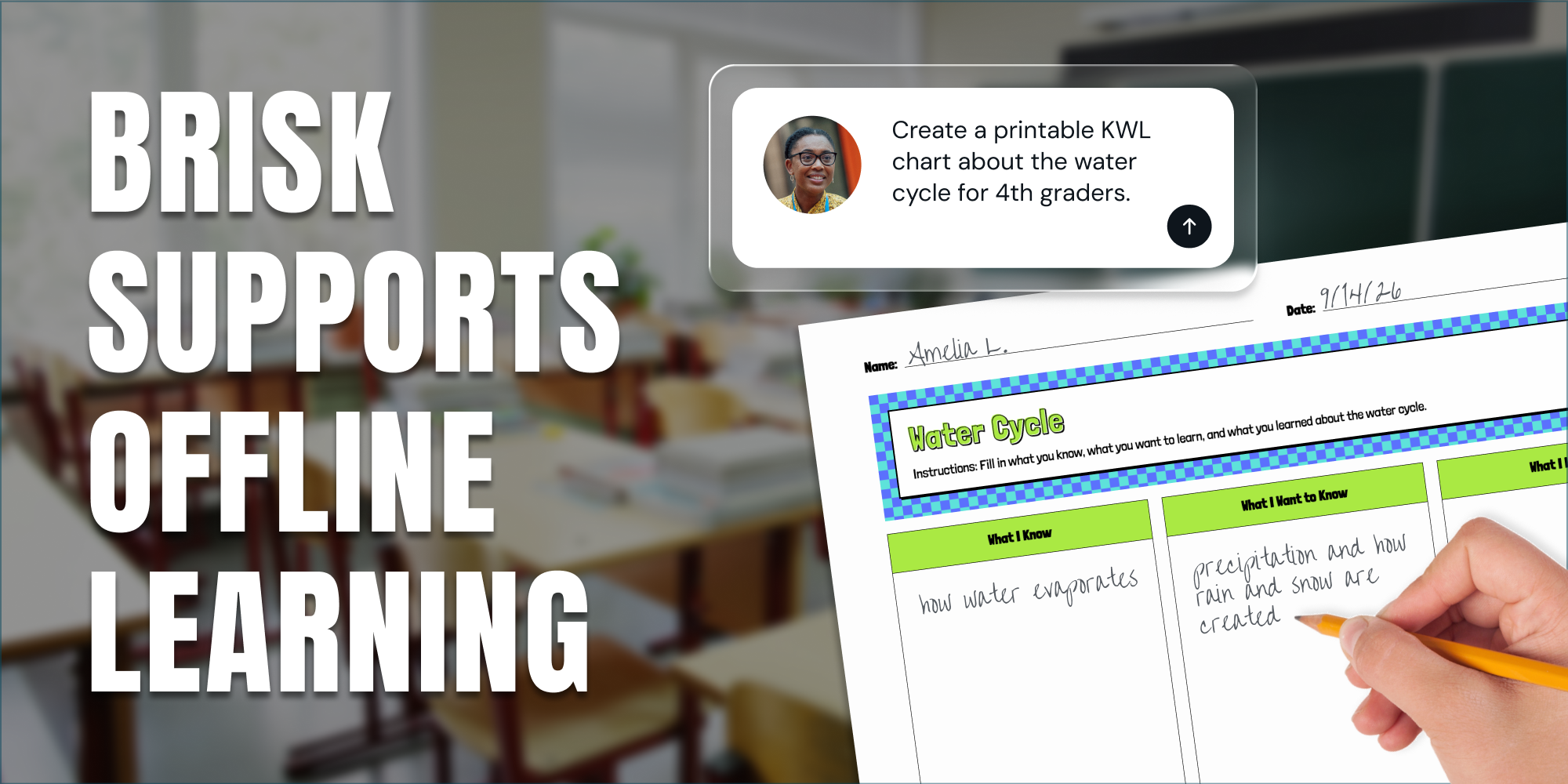
And if you ever want even more ready-to-use options, tools like Brisk’s “Create Anything” button can save time by generating and tailoring prompts to your specific class in seconds.
Why Grade-Level Writing Prompts Matter
As students move through school, their thinking becomes more complex, and the prompts we give them need to match that growth. That’s where grade-level writing prompts make all the difference.
- Elementary: Younger writers thrive when prompts spark imagination and guide them with simple, scaffolded sentences. The goal is to build fluency while keeping them excited to keep the pencil moving, so much so that they’re disappointed when it’s time to stop.
- Middle School: At this age, students are rapidly growing into their identities. Low-stakes writing prompts are especially powerful here. Short, casual exercises encourage empathy, creativity, and abstract thought without the pressure of a grade.
- High School: Older students are preparing for life beyond the classroom. Prompts should challenge them to analyze, persuade, and express their unique perspectives. These grade-level writing prompts invite deeper critical thinking and help students refine their voices.
And across every grade, low-stakes writing prompts serve a bigger purpose than just filling a journal page. Quick, ungraded tasks build fluency, reduce fear of failure, and remind students that writing isn’t only about the grade, it’s about the practice.
Grade-by-Grade Prompts
Elementary Spark: 15 Creative Writing Prompts for Kids
At the elementary level, kids thrive on storytelling, imaginative play, and prompts that bring the abstract into something they can picture. The best elementary writing prompts 2025 are concrete, fun, and visual, perfect for building fluency while keeping young writers engaged. Elementary school teachers, try these creative writing prompts for kids:
- If your pet could talk, what would they say about your family?
- What would you do if you found a magic key at the playground?
- Draw and describe your dream treehouse.
- What would happen if the playground turned into a jungle overnight?
- Write about a time you felt really proud of yourself.
- Pretend you’re a superhero. What’s your power, and what problem do you solve first?
- If your shoes had a memory, what story would they tell about your day?
- If you could invent a holiday, what would it celebrate and how would people celebrate it?
- If you could be any animal for a day, which one would you choose and why?
- Describe the best lunch ever. What’s in it, and who’s at the table?
- Imagine you found a treasure map on your desk. Where does it lead?
- If your shadow came to life, what kind of adventures would you have together?
- Imagine your school is floating in the sky. What would be different?
- If your backpack could talk, what secrets would it share?
- Describe the best ice cream flavor that doesn’t exist yet.
Teacher Tip: Mix narrative, opinion, and descriptive prompts so every student has a way in. One day you’re sparking imagination, the next you’re nudging students toward reflection.
For more targeted grade-by-grade choices, explore our grade-specific prompt guides:
Middle School Moments: Engaging Writing Prompts for Pre-Teens and Teens
Middle school is all about self-discovery and testing new ideas. Middle school writing prompts should offer choice and push students into empathy, creativity, and deeper thinking, without overwhelming them. These creative writing prompts for teens balance imagination with growing critical thought:
- Write a story where the main character makes a decision they can’t undo.
- If you could swap lives with someone for one week, who would it be and why?
- Argue: Should school start later in the morning?
- Write about a decision you made that changed your perspective.
- Imagine you wake up in 2050. What’s the first thing you notice about the world?
- If you could interview any historical figure, who would it be and what would you ask?
- Write a story about discovering a locked journal with secrets inside.
- Imagine you could relive one day of your life—would you change anything?
- Write a story where you’re the hero, but everyone thinks you’re the villain.
- Should students have three-day weekends every week? Why or why not?
- If your community had to choose one student as mayor for a year, what would you do if it were you?
- Imagine the internet shut down worldwide. What would happen at your school?
- Write a letter to your future self in high school.
- Write about a time you stood up for something you believed in.
- Imagine a world where adults went to middle school and kids were the teachers.
Teacher Tip: Offer 2-3 prompt choices at once. Students stay more engaged when they can pick something that resonates, and you’ll enjoy more variety when grading.
High School Depth: Critical & Creative Essay Prompts for 2025 Classrooms
By high school, students are ready for complex ideas that push them toward critical thinking, voice, and audience awareness. The best high school writing prompts ask them to wrestle with real-world issues and reflect on personal experience. Try these writing prompts for teens to stretch their skills:
- Write an op-ed about the role of technology in shaping your generation.
- Describe a single day that changed your perspective on life.
- Imagine a world without social media. What would be better, what would be worse?
- What does freedom mean to your generation?
- Write about a time you failed at something. How did it shape you?
- If you could erase one event from history, what would it be and why?
- Write about a moment that made you see the world differently.
- Imagine meeting your 80-year-old self. What advice would they give you?
- Should art and music be considered as important as math and science? Why or why not?
- Write a story where the ending completely changes how the reader understands the beginning.
- What would happen if teenagers ran the world government for a year?
- Describe a tradition or routine that means more to you than most people realize.
- Argue whether schools should keep, change, or drop grades as we know them.
- Do you think AI will make students stronger or weaker writers? Explain.
- Write a college admissions essay about something no one else would think to write about.
Teacher Tip: Encourage students to mix informal journaling with polished argumentative pieces. It keeps writing fresh and lets students hear their own voices in both casual and academic contexts.
Low-Stakes Writing Prompts vs. High-Stakes Writing: Finding the Balance
So how do you know when to use low-stakes writing prompts and when to shift into high-stakes writing? The key is balance. You want students writing often enough that it feels natural, but not so often that the task becomes robotic. Pairing low- and high-stakes activities helps build fluency while still giving space for rigor and polished work.
What is Low-Stakes Writing?
Low-stakes writing is informal, ungraded, and designed to get students thinking more than stressing about perfection. The purpose isn’t a flawless product; it’s the practice. Low-stakes writing prompts can include:
- Daily journaling
- Quick writes at the start of class
- Exit tickets at the end of a lesson
- Creative brainstorming exercises
Because they’re short and pressure-free, low-stakes tasks can even double as formative assessments. Used frequently, they encourage fluency, remove fear of failure, and remind students that writing is about ideas, not just grades.
What is High-Stakes Writing?
On the other hand, high-stakes writing involves assignments with weight — polished, graded pieces that measure mastery. These tasks matter for grades, portfolios, or even college applications, so the pressure is higher. Common high-stakes writing assignments include:
- Essays or research papers
- Projects and presentations
- Lab reports or technical write-ups
- Summative assessments tied to rubrics
Unlike daily journaling, high-stakes writing should be assigned less frequently. Its purpose is to assess learning and mastery, give students practice with structure and polish, and show growth over time.
Teacher Tip: Think of it as a rhythm. Use frequent low-stakes writing prompts to keep students’ pens moving, and reserve high-stakes writing for the moments that matter most.
Tips for Using Daily Writing Prompts to Engage Learners
Not every student walks into class excited about writing, but the right strategies can make even reluctant writers lean in. Here are a few ways to make daily writing prompts for students feel fresh, purposeful, and engaging:
- Rotate prompts weekly: If the same type of activity shows up too often, students will go through the motions. By switching up narrative, opinion, and creative prompts, you’ll keep energy high and curiosity alive.
- Let students vote: Offer 2–3 prompts and let the class choose. This small act of agency gives them ownership over the task and makes them more likely to put effort into their work.
- Cross the subject lines: Don’t limit prompts to ELA. Writing can happen in every classroom; from “Describe the life of a raindrop” in science to “Write a letter to a famous mathematician” in math. Integrating prompts into multiple subjects helps normalize writing as thinking.
Teacher Tip: If you need fresh prompts and are short on time, Brisk’s free AI tools can generate fresh prompts in seconds or adapt existing prompts to different grade levels, making it easier to keep writing relevant and fun.
The Future of Student Writing in 2025
At their best, writing prompts aren’t just tasks, they’re sparks. They ignite creativity, open the door for student voice, and show kids that writing can be about expression as much as structure. When we tailor writing prompts for every grade level, we give students the right amount of challenge at the right time.
The result? Growth in confidence, fluency, and originality. The sooner you weave prompts into your routine, the faster you’ll see gains in student writing and engagement.
Brisk can help you generate fresh, novel writing prompts — based on any topic and tailored to any grade level — in seconds. Start using Brisk for free today.