All Blog Posts

How to Create a Rubric: An Easy Guide for Teachers

Step 1: Unpack Your Learning Objectives

First things first—before we dive into the nitty-gritty of rubric categories or scoring, let’s get real about what you want from the assignment. The assignment is the guiding light to determine the learning objectives for your rubric. If it’s clear, your rubric will be clear, too. Because, let’s face it, a vague rubric is about as helpful as decaf on a Monday.

So, ask yourself these questions to get clarity on your learning goals:

  • What’s the actual point of this assignment?
  • What should stand out in your students’ work—clarity, originality, critical thinking skills, or something else?
  • What facepalm moments (aka mistakes) are you getting students to avoid?
  • What separates a “nailed it” assignment from a “nice try”?

Once you get these learning goals down, you’re already ahead in the rubric game.

Step 2: Pick Your Rubric Type

Rubrics come in all shapes and sizes, just like students’ excuses for late homework. The idea is to choose the one that best suits your grading needs. Here are two of the most common types:

Analytic Rubric: This one is the go-to for teachers who want clear and descriptive feedback. You’ll list the criteria for an assignment (like accuracy, problem-solving, or presentation) in the left column, with performance levels like “Excellent,” “Proficient,” and “Unsatisfactory” in the headers. It’s perfect for explaining to your students why their project wasn’t quite an A+.

Holistic Rubric: This is the “one and done” of rubrics. Instead of breaking down the project into individual criteria, you’ll assign a single score based on overall expectations. It helps you grade multiple assignments super quickly (No more canceling those weekend plans!). However, it may not be your best bet if students (or parents) want a detailed explanation of that B minus.

Step 3: List the Assessment Criteria

Remember those learning goals we defined in step one? Here’s where you bring them out and turn them into your grading compass. You’ll use those goals to develop a set of specific, measurable criteria for the assignment. Got too many to count? Group them into logical categories and eliminate anything unnecessary. For example, a rubric for a math teacher might look like this:

  • Accuracy: Are the calculations correct?
  • Problem-solving: Did the students show their work or pull an answer out of thin air?
  • Conceptual comprehension: Can they explain what they did, or did they just follow a formula?
  • Presentation: Is the work organized?

Keep it simple and focus on the skills that matter the most.

Step 4: Think Through the Performance Levels

Scoring time! In this step, you’ll decide how you’ll rate student performance on each criterion. Most rubrics use a scale of three to five levels (e.g., 4-Exceptional, 3-Proficient, 2-Developing, 1-Unsatisfactory), but you can get creative with percentages, numbers, or descriptive labels. The goal is to make your grading system clear, consistent, and easy to communicate—because nobody needs another “but I thought I did great” conversation.

Step 5: Use a Rubric Creator

Want to skip the complicated process of designing a rubric from scratch? A Rubric Creator can do the heavy lifting for you. This handy tool takes over the hard part of designing a rubric—the thinking, the planning, and the brainstorming—and gives you a ready-made, customizable rubric for any subject.

No need to overthink it. All you need to do is input basic instructions into the tool, pick from the tool’s pre-listed academic criteria, and voila—you get a customizable rubric table in minutes.

Want to spend more time teaching instead of formatting tables until midnight? Use Brisk’s Rubric Creator today and create custom, well-structured rubrics for any subject in any language.

Latest Posts

Latest from the Brisk Blog

Explore practical articles for K–12 educators, from classroom-ready strategies to thoughtful guidance on using AI in ways that support real teaching.

Library shelves filled with books
September 14, 2026
Brisk Features

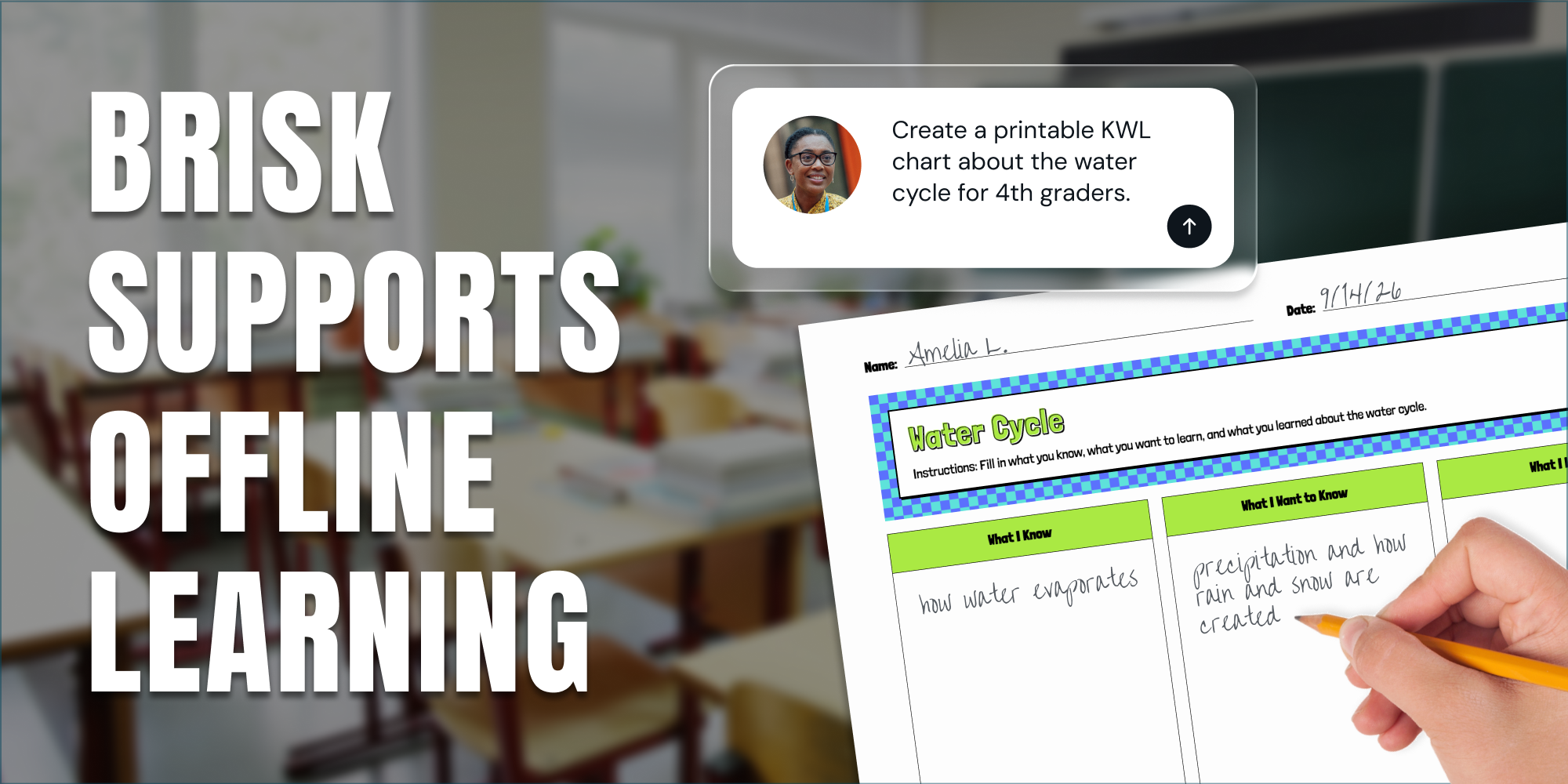
Print It, Project It, or Skip the Screen: How Brisk Fits Any Classroom

Brisk provides teachers with a variety of ways to support student learning, even when they’re focused on scaling back screen time in their classrooms.

Library shelves filled with books
August 14, 2026
Thought Leadership

Brisk in New White Paper on AI's Instructional Impact

Brisk founder Arman Jaffer shares his key takeaways from Whiteboard Advisors’ new white paper on measuring the instructional impact of AI in the classroom.

Library shelves filled with books
July 27, 2026
Tips for Teachers

60 Get-to-Know-You Questions for Students (For Every Grade)

60 get-to-know-you questions for students, organized by category and grade — plus, easy ways to use them for icebreakers, morning warm-ups, and first-day connection.

Library shelves filled with books
8
min
June 5, 2024
AI Tips

How to Create Notes from a YouTube Video Using AI

Learn how to use Brisk Teaching’s AI-powered tools to create streamlined notes from YouTube videos, perfect for students who lack technology access or need extra support. Follow our easy step-by-step guide to turn any YouTube video into effective learning materials in just a few clicks.

Have you ever had a student who doesn't have access to technology and can't watch a video? Or maybe you have a student who needs a copy of notes for better understanding? Perhaps you want to create reference materials from a video for yourself, a substitute teacher, or your students.

Brisk Teaching can help you create notes from a YouTube video so that students can still learn the material covered. This method is better than using transcripts or subtitles because it eliminates natural speaking tendencies and streamlines the message of the video.

How to Create Notes from a YouTube Video with Brisk

Here's a simple step-by-step guide on how to use Brisk to create notes from a YouTube video:

  1. Navigate to YouTube
    • Head over to YouTube and locate the video you want to create a resource from. For example, let's use this YouTube video.
  2. Open the Video
    • Open the desired video on YouTube.
  3. Activate the Brisk Extension
    • Click on the Brisk Extension in the lower right corner of your browser. If you haven't installed it yet, make sure to download and pin it to your Chrome toolbar for easy access.
__wf_reserved_inherit

4. Create Notes

  • Click the "Create" button on the Brisk Extension menu.

5. Select Translation

  • Choose the "Translation" option from the menu. This will help generate notes from the video content.

6. Edit and Customize

  • A pre-filled message will appear. You can edit or add any additional information you want in your notes. If needed, you can also change the language from the drop-down menu.

7. Generate Notes

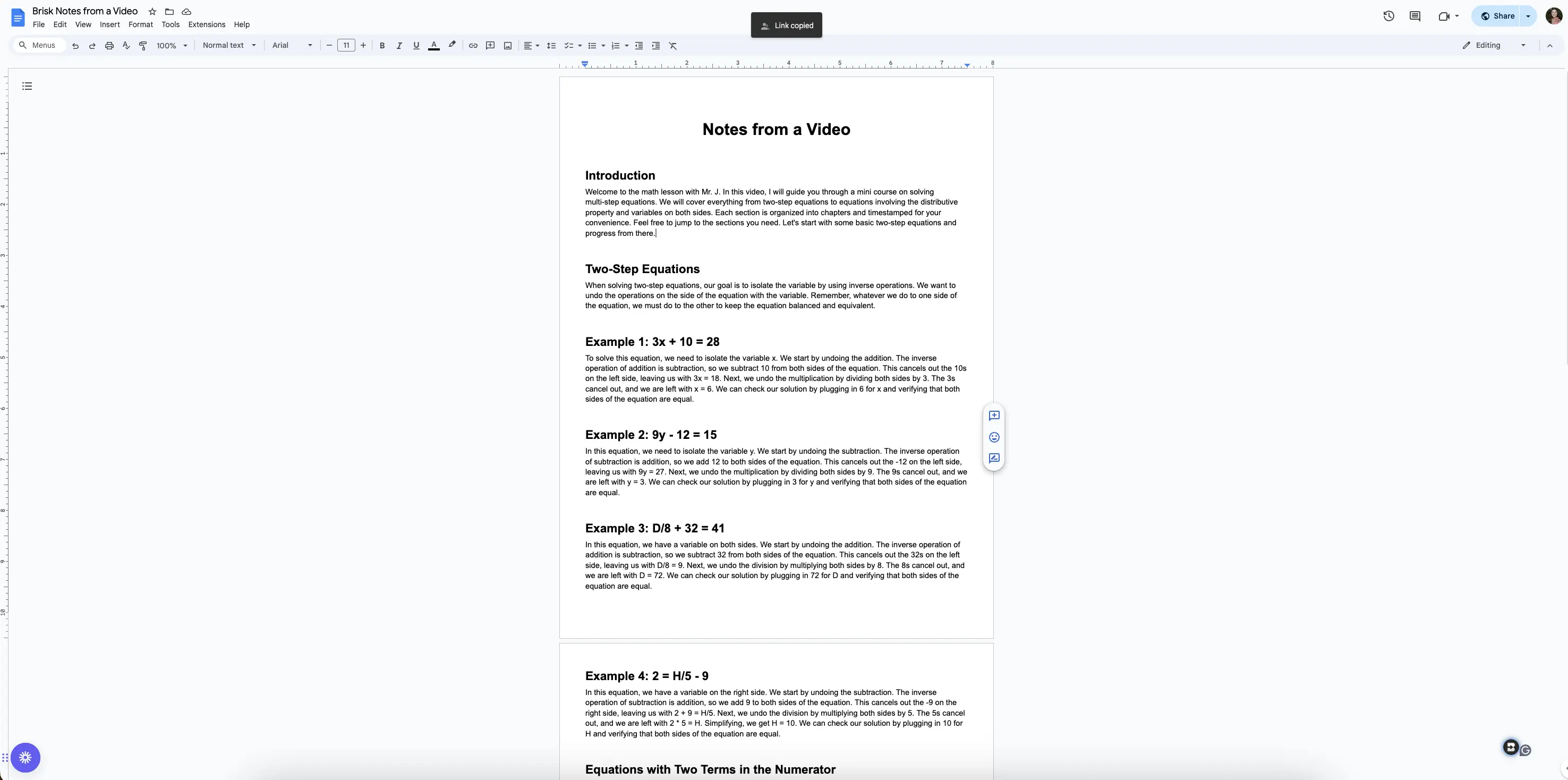
  • Click to generate your notes. Within seconds, your notes will be created and opened in a new tab. Here's an example of notes created from a YouTube video using Brisk: Brisk Notes from a Video.

__wf_reserved_inherit

Creating notes from a YouTube video has never been easier! This tool ensures that all your students have access to the learning material, regardless of their circumstances. Whether it's for a student who needs notes, a substitute teacher, or simply to have a reference material, Brisk makes it simple and efficient.

So, the next time you want to create educational resources from a video, remember to use Brisk. It’s your go-to tool for turning YouTube videos into streamlined, easy-to-understand notes. Happy teaching!

Library shelves filled with books
8
min
February 19, 2025
Tips for Teachers

How to Write a Strong Recommendation Letter for a Student (+ How to Do It Faster with Brisk)

A practical guide to writing recommendation letters for students — learn what strong letters include, a sample with placeholders, and how to write them faster with Brisk.

A student has asked you to write a recommendation letter, and you want to do a good job. You've taught them, you know their work, and you have real things to say. The challenge is turning what you know into a useful, specific, and honest letter.

This guide covers what strong recommendation letters include, what weakens them, and a sample you can adapt. At the end, learn how to use Brisk's Recommendation Letter Generator if you're writing several and need a faster starting point.

What Makes a Recommendation Letter Strong

Cite examples, not generic praise. The difference between a useful letter and a forgettable one usually comes down to one thing: specifics. "John is a natural leader and a joy to have in class" tells the reader nothing they couldn't assume about any student a teacher agreed to recommend. "John is skilled at making group work productive. He stays on top of things, makes sure everyone in the team is heard, and keeps it fun without being domineering. That’s rare to see in a high school student" tells them something real.

Every strong claim in a recommendation letter should be backed by evidence. Not grades or test scores, but behavior and character illuminated by specific moments.

A few examples of specifics you can include that exemplify a student’s personality:

  • The student’s contributions in the classroom, for example, when their class debate sounded like an impressive TED Talk.
  • Their unique personality, earnestness, and work ethic
  • The way they interact in a team
  • Their display of creativity or problem-solving skills, especially those “aha” moments that make teachers proud

Share one good story. The most effective recommendation letters don't try to cover everything the student has ever done. They offer one or two meaningful moments. A paragraph-long anecdote that demonstrates how the student shows up at school is more impactful than three paragraphs of adjectives.

Explain why they’re a fit. Know where the student is applying? Address this in the letter: Why does this student belong in this program or school? What do you know about them that suggests they'll thrive there?

Keep it real. We hate to break it to you, but no one likes reading a recommendation letter laced with over-the-top flattery. The key is to maintain a genuine tone throughout the letter.

For instance, avoid adding superlatives like “Sharon is a shining star, and her intelligence is unparalleled.” Not only does it sound excessive, but it also makes the reader question the integrity of the statement.

The bottom line? Drop the clichés and use honest language that convinces the reader why the student is worth recommending.

An unambiguous close. Lukewarm closings undermine all the statements that came before them. End with a direct statement: "I recommend [Name] without reservation" or "[Name] has my strongest endorsement."

What Weakens a Recommendation Letter

  • Generic openers ("It is my pleasure to recommend..."). They signal template.
  • Adjective stacking without evidence ("She is passionate, driven, and intellectually curious"). Tells the reader nothing.
  • Restating the résumé. Don't list activities and honors – the student has already submitted those.
  • Exceeding one page. Brevity signals confidence. Aim to keep the letter succinct and to-the-point.

What to Include in a Strong Letter of Recommendation

  • Strong opening (1 paragraph): State who you are, how you know the student, in what context, and for how long. Keep it to two or three sentences.
  • Highlight academic or professional strengths (1-2 paragraphs) This is the core of the letter. Lead with your strongest point. Use at least one specific example: a project, a paper, a classroom moment, or a problem they solved. Avoid the tendency to summarize everything and go deep on one or two things instead.
  • Character and community (1 paragraph) What kind of person are they in a room? How do they treat other people? How do they handle difficulty? This is the section admissions readers often value most because only someone who knows the student can write it.
  • Fit (1 paragraph, optional) If you know the program or school, say why this student belongs there. If you don't know enough to write this section authentically, skip it.
  • Close (1-2 sentences) Direct endorsement. Append your name and contact information.

Sample Recommendation Letter for Students

Adapt this for your student and replace everything in brackets.

[Your name] [Title, School Name] [Date]

To the Admissions Committee:

I have had the opportunity to teach [Student name] in [subject] at [school name] for [length of time]. In that time, [he/she/they] has been one of the most [specific quality, e.g., "intellectually curious / analytically strong / genuinely collaborative"] students I have worked with.

What distinguishes [Student name] is not just [his/her/their] academic ability (though that is considerable) but [his/her/their] [specific quality: e.g., "willingness to push past a surface-level answer"]. When we were working on [specific project or assignment], [he/she/they] [specific behavior or action, e.g., "chose to research a dimension of the topic none of the other students considered and came to me with three follow-up questions before the draft was due"]. That kind of [intellectual initiative / persistence / curiosity] is not something I can teach; it's something [he/she/they] brought.

Beyond [his/her/their] academic work, [Student name] is [specific character quality, e.g., "the kind of student who notices when a classmate is struggling and does something about it without being asked"]. [He/She/They] [brief supporting example of character, e.g., "took on an informal mentorship role with a newer student this year, which wasn't required and wasn't graded"]. In a classroom, that matters.

[Optional: I know [Student name] is applying to [program/school], and I think [he/she/they] is a strong fit because [specific reason, e.g., "your emphasis on project-based learning maps directly to where he does his best work"].]

I recommend [Student name] without reservation. If it would be helpful to speak further, I'm reachable at [email].

[Signature]

[Name, Title, School]

Writing Several of These? Here's How Brisk Helps

Many teachers write 10, 20, or more recommendation letters in a given cycle. The guidance above stays the same no matter how many you're writing (specificity, structure, and a direct close) but drafting from scratch every time is a significant time investment.

Brisk's AI Recommendation Letter Generator gives you a structured draft based on what you know about the student. You provide the context (your relationship, the student's strengths, a specific example or two, the program they're applying to), and Brisk generates a draft organized the way a strong letter should be.

The details only you can provide are still yours to add. What Brisk handles is the structure, the phrasing, and the blank-page problem, so you're editing a draft rather than starting from nothing.

Start using Brisk for free today.

Quick Checklist: Before You Send the Recommendation Letter

  • Does the opening establish how you know the student and for how long?
  • Is there at least one specific example that only someone who knows this student could write?
  • Is the closing a direct, unqualified endorsement?
  • Is it one page?
  • Have you proofread the student's name spelling?

If yes to all five, you're done!

FAQs

How long should a recommendation letter be?

Almost always one page. If your draft is running long, look for adjective clusters you can cut and paragraphs that are saying the same thing twice.

How do I start a letter of recommendation?

Open with your relationship to the student — who you are, how you know them, in what context, and for how long. That's it. Two or three sentences that establish why your opinion is worth reading.

How do I end a letter of recommendation?

With a direct, unambiguous endorsement. Something like: "I recommend [Name] without reservation" or "[Name] has my strongest endorsement." One sentence is enough.

If you want to add a second sentence, make it an offer to speak further: "I'm happy to answer any questions at [email]."

Library shelves filled with books
8
min
August 23, 2024
Back to School

How to Create the Perfect Meet-the-Teacher Printable with Brisk AI Tools

Make a great first impression using Brisk Teaching AI to create a customizable meet-the-teacher printable. Introduce yourself and set expectations for a smooth start to the year.

This blog post shows how Brisk Teaching's AI tools can help teachers create the perfect meet-the-teacher printable. Let us help you take the stress out of those nerve-wracking meet-the-teacher nights and create easy-to-use templates that are completely customizable. You can make a great first impression on your students and their families and start a fantastic school year off right.

Teachers across the country know that the start of a new school year is always a tornado of excitement, anticipation, and, let’s be honest, anxiety. One of the first big events on your calendar that might be circled in red? The infamous Meet the Teacher night. It seems to be a night that strikes fear in any teacher’s heart. It doesn’t seem to matter if it’s your first time standing in front of a new class or if you’re a seasoned pro welcoming back familiar faces. The anxiety is real and teachers know creating a great first impression is key. Well, Brisk is here to help you make the entire night easier and introduce yourself to students and families with a beautiful meet-the-teacher printable. 

The Anxiety of Meet the Teacher Nights

We might not be classroom teachers here at Brisk Teaching, but we know Meet the Teacher night can be nerve-wracking. Many teachers spend a lot of time preparing for this night. Balancing a warm welcome for new students and their families, clearly communicating classroom expectations, and sharing a bit about yourself can feel like a lot to juggle. Then there’s the added pressure of creating the perfect meet the teacher template for your meet-the-teacher letter. This single piece of paper is often the first piece of communication that sets the tone for the upcoming school year. 

Luckily, Brisk Teaching is here to help you with all of these stressful moments. Our AI tools are designed with teachers in mind, making it easier than ever to create effective communication pieces that leave a lasting impression.

What to Include in a Meet-the-Teacher Letter

A meet-the-teacher letter is your chance to introduce yourself and set the tone for the school year. Here are some key elements you might want to include:

  • Warm Welcome: A friendly introduction that makes students and parents feel excited and comfortable about the upcoming school year.
  • Classroom Expectations: Outline the rules, expectations, and important information that students and their families may need to know for a smooth year.
  • Teacher Info: Share some personal details, such as your teaching background and favorite things, to help students and parents connect with you.
  • Contact Information: Don’t forget your email address and preferred methods of communication to ensure parents can easily reach you throughout the year. 
  • Syllabus- For middle school or high school teachers, handing out a class syllabus is a standard part of Meet the Teacher night. With Brisk Teaching, you can easily create a customizable printable template to fill in, or even use Brisk to generate a complete syllabus for you based on the guidelines you provide.

How to Make a Meet-the-Teacher Template with Brisk Teaching

Creating a meet-the-teacher template doesn’t have to be a miserable task, especially when you have the right tools at your disposal (like Brisk Teaching wink-wink). Here’s a step-by-step guide on how you can use Brisk Teaching’s AI tools to create a ready-made meet-the-teacher template that will wow your new students and their parents and give them some key information:

Step 1: Install the Brisk Chrome Extension here

  • Pin Brisk to your toolbar. (see how)

Step 2: Access Brisk

  •  Open up Google Docs or Google Slides.
  • Click on the Brisk icon in the bottom right of your screen.

Step 3: Select ‘Create’

  • Once the Brisk menu is open, find the Create feature.
  • Click on the "Create" button.

Step 4: Select ‘Something Else’

Step 5: Customize the Content

  • Use the text box to add personal information, classroom expectations, educational background, teaching philosophy, teaching experience, and even some fun facts about yourself. You can even create different sections for a more structured format.

Step 5: Add Visuals

  • Add an image of yourself or classroom decor to make the template truly your own. Like the old saying goes, A picture is worth a thousand words! 

Step 6: Download and Print

  • Once you’re absolutely in love with your meet the teacher letter, download the digital version or print it out as a ready-made meet-the-teacher printable.

A fun way to create a teacher flier that not only introduces you to your students and their families, Brisk Teaching tools are designed for ease of use. Now you can focus more on preparing for the upcoming year and less on formatting documents.

Other Meet-The-Teacher Resources 

Besides your meet-the-teacher printable, there are plenty of other resources that can make the start of the school year even smoother—and Brisk Teaching can help you create them:

  • Welcome Letter: Create a thoughtful welcome letter to introduce yourself and set a positive tone for the year. Brisk Teaching's AI tools make it easy to design a letter that leaves a great first impression and helps families feel connected from day one.
  • School Night Resources: Be fully prepared for school events like parent-teacher conferences with editable templates for sign-up sheets, supply lists, and other essential information.   
  • Contact Card Editable Templates: Quickly create personalized contact cards with your email address, phone number, and other key bullet points using Brisk Teaching’s tools. These are perfect for handing out during meet-the-teacher night or including in welcome packets, ensuring parents can easily reach you throughout the year.

The Perfect Way to Make a Lasting Impression

The beginning of a new school year is full of firsts—first impressions, first letters home, and first interactions with your new students and their parents. By using Brisk Teaching’s AI tools to create your meet-the-teacher printable, you’re setting yourself up for success. Our tools help you make a great first impression that will last all year long.

So, the next time you’re feeling anxious about Meet the Teacher night, remember that Brisk Teaching is here to help you every step of the way. You’ll be well on your way to a successful and stress-free start to the school year.

`

READY TO BRING BRISK TO YOUR DISTRICT?

See how 20,000+ districts adopted AI with full compliance and teacher buy-in from day one.