All Blog Posts

Signs of Teacher Burnout – And How to Avoid It

If you’ve ever found yourself grading late into the night or running on empty before the week even begins, you’re not alone. Teacher burnout isn’t a lack of dedication; it’s the natural result of giving everything, day after day, without enough time or space to recharge.

Recognizing the early signs of teacher burnout and learning how to prevent it can make all the difference for you and for your classroom. This post shares tips about how to protect your energy so you can keep doing what you love: inspiring students to grow, learn, and discover.

Small shifts in mindset, routine, and technology can bring balance back into your day. Tools like Brisk are designed to help lighten your workload, so you can focus on what matters most: your students. With Brisk, you can create lesson plans, presentations, quizzes, and more in seconds — start using Brisk free today.

What Teacher Burnout Really Looks Like

Teacher burnout shows up differently for everyone, but there are common signs that it may be creeping in:

  • You feel drained even after a full weekend of rest.
  • It’s harder to feel excited about lessons you used to love.
  • Your patience feels shorter than usual.
  • The to-do list never seems to end, no matter how much you cross off.

These are signals, not failures. Awareness is the first step toward reclaiming your joy and energy. When teachers feel balanced and supported, students benefit from calmer classrooms, more creative lessons, and deeper connections.

Teacher-to-teacher tip: Don’t wait for a breaking point. If you notice these patterns, it’s time to pause and reflect on how you can address them.

Why Teacher Burnout Happens — and How Systems Play a Role

Teacher burnout doesn’t come from weakness — it comes from imbalance. The expectations placed on teachers have grown, while time and resources haven’t kept up. Between planning, grading, parent communication, and meetings, it can feel like the work never ends.

The emotional weight of teaching adds to the pressure. Teachers carry student stories, family challenges, and classroom energy all at once. It’s no wonder so many feel stretched thin.

This isn’t about blaming yourself; it’s about recognizing that sustainable systems support both teachers and students.

How digital tools can help

Digital tools like Brisk can ease some of the daily stressors that lead to teacher burnout by:

With Brisk taking care of repetitive, time-consuming tasks, you’re able to spend more time teaching, connecting, and recharging.

4 Ways to Prevent Teacher Burnout Before It Starts

You don’t have to overhaul your life to protect your energy. A few intentional changes can go a long way.

  1. Set Boundaries That Protect Your Energy: Create clear “off hours,” and honor them. The work will always be there, but you deserve time that’s yours. Say no to extra commitments that don’t directly support student learning. Modeling balance helps your students see that mental health matters.
  2. Build Sustainable Routines, Not Quick Fixes: Find systems that make your day smoother, like simplified grading rubrics, prep templates, or batch-planning days. The goal is to spend less time on formatting and more on creativity.
  3. Prioritize Joy and Connection in the Classroom: When you bring joy into your lessons, students feel it too. Add moments of laughter, student choice, or mini-brain breaks. Reignite your excitement for teaching through projects or topics that inspire you. Shared joy strengthens your classroom community.
  4. Find Your Support System: Connect with colleagues who lift you up. Share strategies, co-plan lessons, or just vent when you need to. Collaboration not only eases the workload but also reminds you that you’re part of something bigger.

When You’re Already Feeling Burnt Out

If you’re already deep in teacher burnout, start small. You don’t need a full reset, just one intentional step forward.

  • Reclaim one prep period each week for rest or reflection.
  • Revisit your “why,” the reason you started teaching in the first place.
  • Celebrate small wins, like a meaningful student conversation or a smooth transition between classes.


When you’re stretched thin, every minute counts. Brisk can help you get some of that time back by drafting student feedback, helping with lesson prep, or generating templates for progress notes. Those small moments can add up to a big breath of relief.

Teaching Shouldn’t Cost Your Well-Being

You give so much of yourself to your students every day. Avoiding teacher burnout isn’t selfish; it’s essential. Protecting your time, energy, and joy means you’ll have more to give to the learners who depend on you.

Start small, stay consistent, and give yourself grace along the way. You deserve the same care and encouragement you pour into others.

Action Step: Take one thing off your plate today. Get started with Brisk for free to simplify the planning, feedback, and communication that drain your time — so you can focus on what actually fuels you and your students.

Latest Posts

Latest from the Brisk Blog

Explore practical articles for K–12 educators, from classroom-ready strategies to thoughtful guidance on using AI in ways that support real teaching.

Library shelves filled with books
August 14, 2026
Thought Leadership

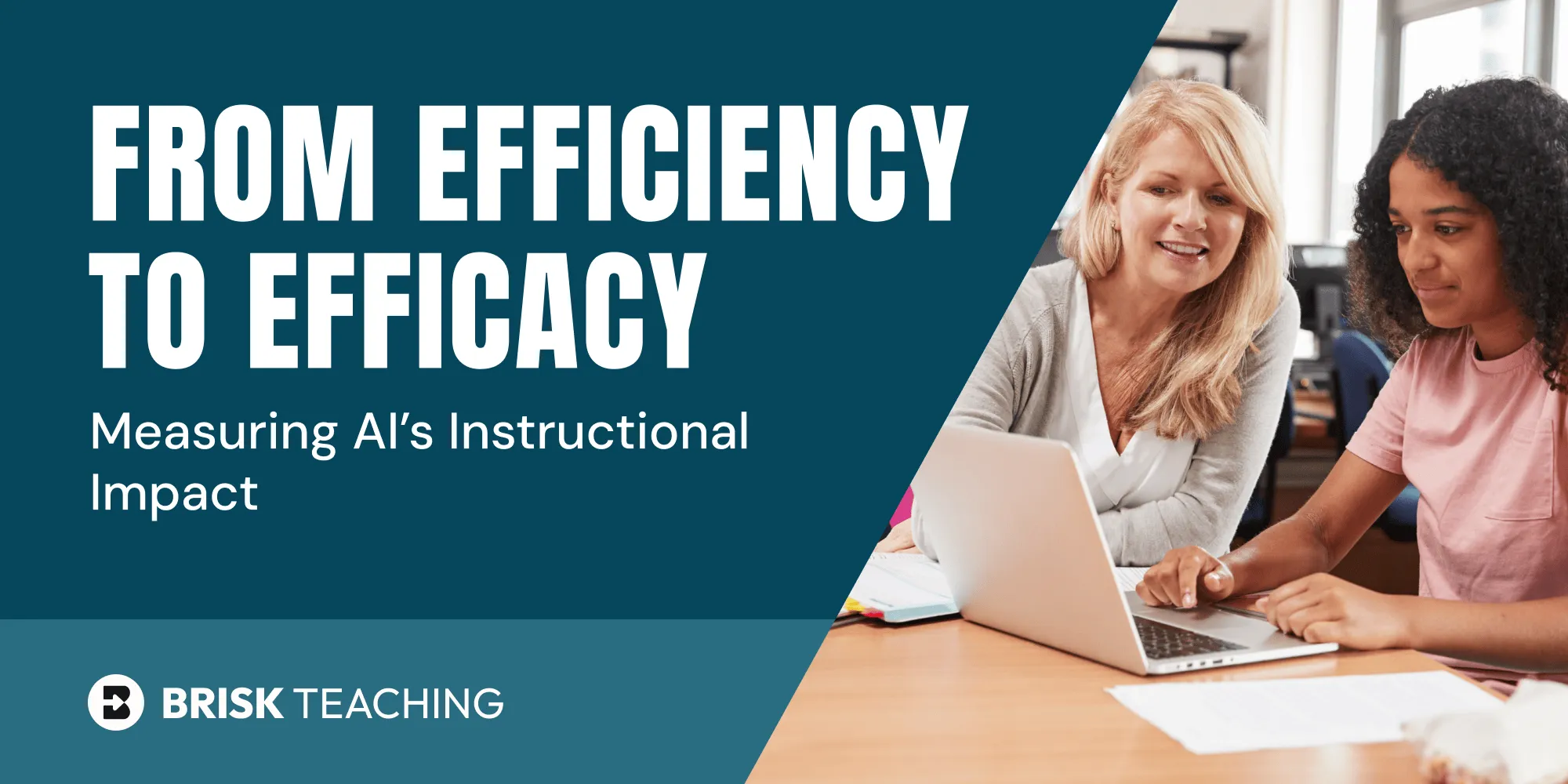
Brisk in New White Paper on AI's Instructional Impact

Brisk founder Arman Jaffer shares his key takeaways from Whiteboard Advisors’ new white paper on measuring the instructional impact of AI in the classroom.

AI is in the midst of a massive hype cycle. You know. I know it. Any person you stop on the street knows it. That doesn’t mean AI is all hype — far from it. It just means that, especially in a field like education, we shouldn’t treat every use of AI as equally valuable.

As with any tool, technology, or technique, our ability to scale the benefits of AI will hinge on how effectively we quantify AI-supported practices in the classroom. To that end, we recently commissioned a white paper from Whiteboard Advisors, “From Efficiency to Efficacy: Measuring AI’s Instructional Impact,” that explores a new way to approach this measurement.

The white paper details the need for a well-defined framework for connecting AI use to the learning science principles that research tells us drive student outcomes. It highlights the newest metric that school and district leaders will see in their Brisk dashboards this year, Quality Instructional Moments, as a strong example of how educators can draw these connections.

AI helps teachers do more of what they know works

There are decades upon decades of peer-reviewed research on the kinds of instructional practices that promote student achievement. The biggest obstacle to effective teaching isn’t knowing what to do, but finding the bandwidth to do it. As the white paper states:

We know that students learn better when they receive frequent, specific feedback rather than waiting weeks for a test grade. We know that students learn more when they’re working at the edge of their ability, challenged but not overwhelmed. And we know that the practices most likely to move students — responsive instruction, meaningful relationships, timely feedback and intervention — are also the ones most likely to get crowded out by everything else educators are asked to do.

Minimizing this “crowding out” is where AI has the greatest potential in education. AI isn’t a replacement for great teaching; it’s the infrastructure that makes it possible to implement proven practices with greater frequency, fidelity, and consistency.

Moving from higher productivity to increased teaching capacity

To reiterate: AI’s true value is not just that it enables teachers to do more, but that it enables them to do more of what really works.

Which is not to say that productivity and efficiency boosts are meaningless. For a long time, Brisk measured our impact in terms of hours saved on tasks like grading, resource writing, and administrative work. We all want to save time wherever we can — no harm in that. But as school and district leaders repeatedly asked, “How does Brisk actually support student learning?”, we realized we needed to take a more comprehensive view of what happens in the classroom.

What really matters is what teachers do with the time they save. When they reinvest the time in implementing proven instructional practices — differentiating instruction for every student, using data to drive decisions, intentional planning — that’s when student outcomes tend to improve.

Using Quality Instructional Moments as a leading indicator of learning

You might be wondering, “How do you track if and when any of this is happening?” It’s a good question.

Traditional success metrics like standardized test scores and graduation rates paint part of the picture, but they lag years behind the instructional actions that shaped them. In an effort to provide leaders with a leading indicator of effective instruction, we landed on Quality Instructional Moments.

As we define it, an instructional moment is a discrete, observable student interaction that:

  1. Is grounded in learning science;
  2. A teacher wouldn’t have been able to facilitate on a regular basis without the increased capacity carved out by AI.

Think: A teacher uses Brisk to provide every student with personalized, rubric-aligned feedback on the same day students turn in their essays. Or, a teacher uses Brisk to generate multiple versions of an activity to ensure each student’s assignments are challenging enough to promote growth but scaffolded enough to remain achievable.

These are the kinds of instructional moments that drive results. They’re also the kinds of moments that school and district leaders can now track in Brisk. (We get that every district has different priorities, so districts are able to customize how they measure instructional moments in Brisk based on their unique pedagogical approach.)

Get the full story

Whiteboard Advisors’ white paper does a great job of unpacking all the considerations that go into tracking AI’s impact in the classroom. It covers the entire spectrum of research-backed instructional practices that ground instructional moments, the five questions every district leader should ask when evaluating AI solutions, and a whole lot more.

It’s a quick and, for those of us who are interested in these things, incredibly compelling read. I’d encourage you to check it out.

– Arman Jaffer, Founder, Brisk Teaching

Library shelves filled with books
July 27, 2026
Tips for Teachers

60 Get-to-Know-You Questions for Students (For Every Grade)

60 get-to-know-you questions for students, organized by category and grade — plus, easy ways to use them for icebreakers, morning warm-ups, and first-day connection.

The first week of the school year sets the tone for the months of learning that follow. The fastest way to establish a classroom environment in which students feel comfortable talking, laughing, and taking productive risks together is to provide regular opportunities for students to build meaningful connections with each other.

A good set of get-to-know-you questions can do a lot of the heavy lifting here. These questions lower the temperature for nervous students, give quieter kids an easy on-ramp into discussions, and show you what kind of personalities you have in the room before you even start your first lesson.

Below are 60 get-to-know-you questions for students, sorted into categories you can pull from all year — not just on day one. (Skim to the grade-specific notes near the end for tips for getting the most out of these questions in your classroom.)

How to Use Get-to-Know-You Questions

While these questions are invaluable during the first week of school, they’re just as powerful in many other contexts throughout the year. In addition to using them as first-day icebreakers, always keep a few on hand for:

  • Morning (or class period) warm-ups: Pose one question a day (or every Monday) to get everyone’s juices flowing.
  • Exit tickets: Use a reflection question to keep students engaged during the final few minutes of class.
  • Digital or remote learning: Drop a question into a poll, a shared doc, or a discussion board so students can answer without the pressure of the spotlight. If you want a quick set of interactive questions tailored to your grade and subject, you can generate them with Brisk Boost, a student-facing, AI-supported workspace that puts you in control of what’s shared.

Regardless of when you’re using these get-to-know-you questions, make sure you keep these best practices in mind:

  • Keep it low stakes: Let students pass if a question doesn’t land for them, and answer the questions yourself so the sharing feels mutual.
  • Specify a format: Pick a response format that aligns with the energy in your classroom on the day, whether it’s a turn-and-talk with a partner, a quick go-around, a written response, or a digital poll.
  • Return to high-impact questions: Asking a question in September and then again in January is a great way to show students how much has changed over the course of a few months.

Icebreaker & First-Day Questions

These icebreaker questions for students invite short, low-stakes answers. Pair these with a few active icebreaker games to get everyone moving.

  1. What are you hoping this year will be like?
  2. What’s one word your friends would use to describe you?
  3. If we were going to pick a mascot for our class, what should it be?
  4. What’s something you’re looking forward to this year?
  5. What makes a classroom feel like a good place to be?
  6. What’s a fun fact about you that surprises people?
  7. What fictional world would you like to live in?
  8. What’s the farthest you’ve ever traveled from home?
  9. If you could switch places with anyone for a day, who would it be?
  10. What makes you feel welcome in a new group?

Fun & Favorites Questions

Easy, low-pressure questions are perfect for any time you need a quick warm-up.

  1. What’s something you’re really good at that most people don’t know about?
  2. If you had to eat only one meal for the rest of your life, what would it be?
  3. What’s the best movie or show you’ve watched recently?
  4. What song do you have on repeat right now?
  5. What’s your favorite way to spend a Saturday?
  6. If you could instantly master any skill, what would it be and why?
  7. What’s a book, game, or hobby you could talk about forever?
  8. What’s your go-to snack?
  9. What’s the best gift you’ve ever received?
  10. If you had a whole day with no plans, what would you do?

This-or-That & Would-You-Rather Questions

These this-or-that-questions for students promote whole-class participation. For a more active experience, let students respond with a hand gesture or by walking to one side of the room or the other.

  1. Summer or winter?
  2. Sweet or salty?
  3. Early bird or night owl?
  4. Books or movies?
  5. Mountains or beaches?
  6. Would you rather be able to fly or be invisible?
  7. Would you rather never have homework or never have a test again?
  8. Would you rather explore space or the deep ocean?
  9. Would you rather always be 10 minutes late or 20 minutes early?
  10. Would you rather have a rewind button or a pause button for your life?

Getting Comfortable Questions

A step past the icebreakers, these questions help students share a little more about themselves once the classroom has been established as a welcoming environment.

  1. Who’s someone you look up to, and why?
  2. What’s something you’ve worked hard to get better at?
  3. What’s a tradition your family or friends have?
  4. When do you do your best thinking?
  5. What’s a mistake that taught you something?
  6. What’s something that always makes you laugh?
  7. Where’s your favorite place to be?
  8. What’s a small thing that makes any day better?
  9. What have you been curious about lately?
  10. What’s something you’d love to spend more time doing?

Questions About Learning & School

These are the kinds of questions to ask students when you want insights you can incorporate directly into your teaching — how students learn, what helps them, and what gets in their way.

  1. What’s a subject or topic you genuinely enjoy?
  2. How do you like to work best: alone, in pairs, or in a group?
  3. What helps you focus when things get noisy or busy?
  4. What’s something a teacher has done that really helped you?
  5. When you’re stuck, what do you usually do first?
  6. What does a good day at school look like for you?
  7. What’s something you wish teachers understood about you?
  8. How do you like to get feedback on your work?
  9. What’s a goal you have for this year?
  10. What’s one thing that would make this class better for you?

Social-Emotional Learning Questions

Save these questions for later in the year, as they require a certain level of trust and familiarity among students.

  1. What does being a good friend mean to you?
  2. When was a time you felt really proud of yourself?
  3. How can you tell when someone’s having a hard day?
  4. What helps you calm down when you’re frustrated?
  5. What’s something kind someone did for you that you still remember?
  6. Who do you go to when you need help?
  7. What are you grateful for right now?
  8. What’s something you’d like to get better at as a classmate?
  9. What makes you feel respected?
  10. What inspires you?

Picking the Right Questions for Your Grade

  • Elementary school: Start with favorites and this-or-that questions. As you incorporate more complex questions, provide your answer first as a way to model what a complete response looks like. Movement voting — e.g., walking to the “sweet” side of the room or the “salty” side of the room — can help keep younger learners engaged.
  • Middle school: Make sure students are comfortable by using low-spotlight formats like written responses, anonymous polls, or partner shares before jumping into whole-class go-arounds. (Pro tip: Students at this age love debating would-you-rather questions.)
  • High school: Lean into the learning styles and SEL questions. Older students can handle real reflection, and they notice when you incorporate what they share into your teaching. Frame the conversations as “help me teach you well,” not just “share your feelings.”

Frequently Asked Questions

What makes for a good get-to-know-you question for students?

Early on in the school year, the best questions are specific, low stakes, and easy to answer in a sentence — favorites, would-you-rather choices, and light “tell me about yourself” prompts. Save deeper reflection questions for once you’ve built a positive classroom dynamic.

How do you use get-to-know-you questions in the classroom?

Use them as first-day icebreakers, daily warm-ups, exit tickets, or digital polls. Give students a clear format (partner talk, go-around, written response), let them pass, and answer each question yourself.

What questions can I ask to get to know my students better as learners?

Ask about what they enjoy learning, what helps them focus, and what they wish teachers understood. The answers will give you insights you can teach with, not just fun facts.

When should I use get-to-know-you questions?

The first week of school is the most obvious opportunity, but they’re just as useful after long breaks, when a new student joins your class, or any time you want to reset class energy.

Start the Year by Connecting with Your Students

You don’t need to step into the classroom on the first day of school and ask 60 get-to-know-you questions. In fact, you really shouldn’t — that might scare students a little.

Instead, pick five of your favorites for the first day, keep a few in your back pocket for slow moments, and work your way toward the deeper questions as trust develops. The questions may be simple, but the payoff can be huge: A class that knows each other, trusts you, and is ready to learn together.

Want to generate your own get-to-know-you questions in seconds? Use Brisk's Create Anything tool to generate a list of get-to-know-you questions tailored to your classroom needs in seconds. Free to use for teachers — get started with Brisk today.

Library shelves filled with books
July 20, 2026

30 Fun First-Day-of-School Activities [2026 Edition]

Kick off the year with 30 first day of school activities for elementary, middle, and high school — icebreakers, games, and get-to-know-you ideas, each with a Brisk prompt to get you started.

Set the Tone for the New School Year

While these activities are perfect for back-to-school season, they’re just as powerful anytime you want to build connection, spark curiosity, or shift the energy in your classroom. Whether you’re kicking things off with a new group, regrouping mid-semester, or hitting reset after a tough week, these ideas help you reconnect, recharge, and refocus — no matter the date on the calendar.

Students thrive when they feel safe, valued, and inspired. And that kind of classroom doesn’t just happen. It’s built in the small, intentional moments — where students get to reflect, laugh, lead, and learn with each other. That’s what these activities are designed for.

From creative icebreakers and curiosity sparks to reflection prompts and student-led challenges, this collection helps you create a space where students feel like they belong — and where learning feels meaningful, not mandatory.

Each activity includes a Brisk prompt to help you plan faster, personalize with ease, and meet every learner where they are. Here’s how to use them:

  1. Open Brisk in your Chrome browser.

  2. Click “Create Anything.”

  3. Copy and paste the prompt from this post.

  4. Customize it if needed, then generate your activity, resource, or discussion.

Whether you’re trying something new tomorrow or saving it for a future refresh, this list is here when you need it. 


Because what you do today sets the stage for what comes next.

Get-to-Know-You Games

Break the ice without the awkwardness.
These activities are designed to help students feel seen without the spotlight being too bright. Whether it’s laughing over shared quirks or finding out who else puts hot sauce on everything, these ideas ease students into the room while helping you start learning who they are. Low pressure, high connection.

1. Find Someone Who... with a Twist
Each student receives a bingo-style sheet — but instead of generic traits, include quirky prompts like “loves pineapple on pizza” or “can make a weird animal noise.”

  • Why it works: Students discover fun facts and unexpected common ground. 
  • Brisk prompt: Generate a playful “Find Someone Who” board with 25 unique, humorous, and culturally inclusive prompts for [insert grade level] students.

2. Would You Rather? Movement Game
Read off questions like “Would you rather teleport or time travel?” and students move to a side of the room to show their answer.

  • Why it works: Builds comfort, encourages participation, and gets students moving.
  • Brisk prompt: Create a list of 20 fun “Would You Rather” questions for [insert grade level] students.

3. Emoji Introductions
Students pick 3 emojis that represent them and explain why. Can be shared verbally, drawn, or written.

  • Why it works: Invites self-expression in a digital-native language.
  • Brisk prompt: Generate a prompt asking students to introduce themselves using only emojis and a brief explanation for [insert grade level] students. 

4. Personality Playlist
Each student picks a song that represents their energy or personality. Play short clips and have classmates guess who picked what.

  • Why it works: Fosters self-awareness and community through music.
  • Brisk prompt: Generate a student-friendly prompt: “If your personality were a song, what would it be and why?”

5. Memory Match: Name + Fun Fact Edition
Pair students to share a fact, then remix into a memory game: “This is Max — he once ate a cricket!”
 

  • Why it works: Makes names and stories stick through fun repetition.
  • Brisk prompt: Create a guide for a memory-style name game with student facts for [insert grade level] students.

6. Icebreaker Skits
Students act out mini scenes that represent a favorite hobby, habit, or summer moment.

  • Why it works: Adds movement, fun, and laughter to self-intros.
  •  Brisk prompt: Generate a list of silly skit prompts that students can act out in pairs or groups of three for [insert grade level] students.

Community + Belonging

Build a classroom culture where everyone matters.

From day one, students are looking for signs that this is a space where they belong. These activities help co-create that space — one where every voice is valued, and students help shape the culture they’re part of. You’re not just setting expectations — you’re setting the tone for trust, respect, and ownership.

7. Community Vision Board
Create a shared collage (paper or digital) of images and words that represent your ideal classroom culture.

  • Why it works: Visualizes collective values and sparks creativity.
  • Brisk prompt: Generate a classroom vision board activity where students co-create a vision for their ideal classroom environment.

8. Chain of Kindness
Each student writes a kind message for a classmate and links their message on a paper chain that grows daily.

  • Why it works: Fosters trust, kindness, and visibility.
  •  Brisk prompt: Generate sentence starters for student-to-student affirmations.

9. “We Are…” Identity Wall
Students each finish the phrase “We are…” with a word or phrase that reflects their background, values, or hopes.

  • Why it works: Emphasizes collective identity and diversity.
  • Brisk prompt: Create a reflective writing prompt that invites students to complete the phrase “We are…”

10. Culture Curators
Groups create mini exhibits (posters, slides, or videos) about their cultures, traditions, or favorite foods.

  • Why it works: Promotes cultural awareness and student agency.
  • Brisk prompt: Generate a template for a “Culture Curator” student presentation.

11. Respect Roundtable
Students write down what respect looks like, sounds like, and feels like — then turn it into class agreements.

  •  Why it works: Turns abstract values into real behaviors.
  •  Brisk prompt: Generate prompts that help students define respectful behavior in a classroom for [insert grade level] students.

12. Compliment Constellations
Each student draws their name at the center of a star and classmates write one-word compliments on rays radiating out.

  • Why it works: Builds a visible map of positive traits and inclusion. 
  • Brisk prompt: Generate a guide for creating visual “Compliment Constellations” for [insert grade level] students.

Looking for more ways to foster classroom community? Check out 75 Ways to Build Classroom Community  

Creativity & Expression

Let students show who they are—beyond the surface.
Your students aren’t just learners — they’re storytellers, artists, problem-solvers, and creators. These activities give them space to express their full selves while sparking imagination and joy. Bonus: you’ll quickly learn how they think, what excites them, and which learners light up when given creative freedom.

13. Design a Class Mascot
In teams, students invent a character that reflects their shared values and vibe.

  • Why it works: Promotes collaboration, humor, and belonging. 
  • Brisk prompt: Generate a prompt asking students to create and pitch a class mascot.

14. “Me in a Bag” (Remixed)
Instead of bringing in items, students draw or digitally collage five objects that represent them.

  • Why it works: Makes the activity more inclusive and creative.
  • Brisk prompt: Create a visual storytelling prompt: “Design a digital ‘Me Bag’ that shares five things about you” for [insert grade level] students.

15. Dream Classroom Design
Students sketch or model a dream classroom — complete with features that support fun, focus, and learning.

  •  Why it works: Combines imagination with critical thinking.
  •  Brisk prompt: Generate a STEM-based design prompt for reimagining the perfect learning environment through a [insert grade level] student lens.

16. One-Word Wall
Each student selects a word that reflects their mindset or intention for the year.

  • Why it works: Promotes introspection and builds a shared visual culture.
  •  Brisk prompt: Generate a reflection prompt to help students choose a meaningful “One Word” for the year.

17. Personal Coat of Arms
Design shields that highlight students’ values, strengths, and dreams.

  •  Why it works: Supports identity-building and artistic expression.
  •  Brisk prompt: Create a Coat of Arms template with guiding categories like “values,” “strength,” and “passion.”

18. Identity Maps
Students build webs showing different layers of who they are—family, interests, languages, and more.

  • Why it works: Builds empathy and celebrates multidimensional identity.
  • Brisk prompt: Generate identity map guiding questions that explore culture, community, and individuality.

Reflection & Leadership

Give students the mic — then get out of the way.
The first day isn’t just about learning names — it’s a chance to hear students’ hopes, experiences, and ideas for the kind of classroom they want to build. These activities foster student voice, agency, and leadership, helping students feel not just included, but essential to how the year unfolds.

19. Student TED Talks
2-minute talks on topics students love, know, or wonder about.

  • Why it works: Builds voice, courage, and confidence.
  • Brisk prompt: Generate a student-friendly planning guide for a short TED Talk for [insert grade level] students.

20. “Dear Future Me” Letters
Students write letters to themselves to open at the end of the year.

  • Why it works: Encourages goal-setting and emotional reflection.
  •  Brisk prompt: Create a guided “Dear Future Me” letter-writing template for [insert grade level] students. 

21. Student-Led Icebreaker Stations
Small groups design and lead their own quick games.

  • Why it works: Builds leadership and autonomy from day one.
  • Brisk prompt: Generate a list of creative icebreaker ideas students could choose from to lead.

22. Class Norms Design Sprint
Teams draft and pitch classroom norms, then vote on which to adopt.

  • Why it works: Makes expectations feel collaborative and democratic.
  • Brisk prompt: Generate a lesson guide for co-creating classroom norms through student pitches.

23. Hope & Wonder Walk

Invite students to anonymously share their hopes and questions for the year ahead—what they’re excited for, curious about, or unsure of. Then, walk through the responses as a class to spot shared themes and offer encouragement.

  • Why it works: This activity builds emotional safety and connection by helping students see they’re not alone in their thoughts.
  • Brisk prompt: Generate sentence starters like: “This year, I hope to…” or “One thing I wonder about is…” for 6th grade students. 

24. Timeline of Me
Students map key moments in their lives to reflect on growth and goals.

  • Why it works: Brings awareness to identity and builds connection.
  • Brisk prompt: Create a timeline activity that helps students map meaningful moments in their lives—highlighting personal growth, challenges overcome, and goals for the future. Include sentence stems like “A moment that shaped me was…” and “One goal I’m working toward is…”

Curiosity & Exploration

Start with wonder. Stay curious together.

What if the first day of school wasn’t just about routines—but about questions? These activities ignite student curiosity and open the door to discovery, showing learners that school is a place where their ideas matter and exploration is encouraged. Lead with wonder, and you’ll build momentum that lasts all year.

25. “What Do You Wonder?” Wall
Students write big, bold questions on sticky notes or digital boards.

  • Why it works: Builds a culture of curiosity and inquiry.
  • Brisk prompt: Generate a list of sample “I wonder…” starters across subject areas.

26. Me in Numbers Infographic
Students create an infographic using personal data: age, pets, screen time, books read, etc.

  • Why it works: Combines data literacy and self-expression.
  • Brisk prompt: Generate a prompt for a “Me in Numbers” data storytelling activity.

27. Book Tasting Café
Transform your classroom into a cozy café where students sample genres and share “flavor notes.”

  • Why it works: Makes book choice feel fun and social. 
  • Brisk prompt: Generate a genre menu and reading reflection prompts for a book tasting for [insert grade level] students. 

28. Curiosity Sparks
Use mystery items, images, or facts to spark discussion and theories.

  • Why it works: Activates wonder and group problem-solving. 
  • Brisk prompt: Create a set of curiosity-driven mini-mysteries to use on day one for [insert grade level] students. 

29. Silly Debates
Is cereal a soup? Should socks match? Students take sides and defend with logic.

  • Why it works: Teaches respectful argumentation with a twist.
  • Brisk prompt: Generate 10 lighthearted debate topics that are perfect for warm-up thinking for [insert grade level] students. 

30. Invent an Icebreaker
Challenge students to invent, test, and refine their own icebreaker activity.

  • Why it works: Puts creativity and student leadership at the center.
  • Brisk prompt: Create a challenge prompt for students to design and lead their own original icebreaker for [insert grade level] students. 

What You Build Today Shapes What’s Next

The best classrooms aren’t built in a day — but they are built in moments like these. When students feel connected, challenged, and inspired, everything else gets easier.

This list isn’t about checking a box or filling time — it’s about creating a space where students feel like they matter, and where learning actually feels worth it.

And with Brisk, you’re not just getting through the day. You’re planning with purpose, responding to real needs, and building toward something bigger — your next move, your next idea, your next level.

Whatever comes next, we’ve got you.

Explore all Brisk Teaching Tools here.

Library shelves filled with books
8
min
Tips for Teachers

Managing Teacher Workload During Busy Seasons

Discover practical teacher workload management strategies for busy seasons. Explore time-saving tips for teachers, smarter grading, classroom productivity, and how Brisk’s AI tools support educators without adding stress.

Every teacher knows that certain points in the year feel busier than others. Whether it is grading stacks of essays, prepping report cards, or handling an influx of parent communication, the workload can feel like it doubles overnight. The good news is that there are ways to make these crunch times more manageable.

The key is remembering that you do not need to do it all on your own. With a few smart strategies and the right tools, you can lighten the load and keep your focus where it belongs: on teaching and connecting with students.

Why Workload Spikes at Certain Points in the Year

Busy seasons are a universal part of teaching. End-of-unit assessments, grading projects, preparing progress reports, and organizing seasonal events all add up quickly. Add in parent emails, holiday programs, or standardized testing, and it is no wonder teachers feel stretched thin.

These spikes take time and energy, which is why it helps to have systems in place before they hit. By thinking ahead and leaning on tools designed for teachers, you can make these busy stretches smoother and less stressful.

Smarter Grading and Assessment Strategies

One of the fastest ways to ease your workload is by rethinking grading. Not every assignment needs to be marked in detail. Prioritizing meaningful assessments over sheer quantity keeps the focus on learning rather than paperwork.

Rubrics are another lifesaver. Clear rubrics make grading faster and more consistent, and they also help students understand expectations upfront. Incorporating peer and self-assessments is another way to share the responsibility, while still building accountability and reflection skills in students.

Brisk can take grading efficiency even further. With Brisk, you can instantly generate standards-aligned assessments, progress reports, or even draft parent communication. This cuts down hours of prep and gives you more time for what matters most: supporting students during the school day, instead of spending your evenings catching up on schoolwork.

Planning Ahead With AI Support

The best way to handle busy seasons is to stay a step ahead. Proactive planning lowers stress and helps you feel in control when the workload ramps up.

Brisk Next makes this easier by recommending exactly what you need based on your grade level, standards, and class insights. Maybe it is an inquiry activity, a ready-to-use slide deck, or a quick exit ticket. Instead of scrambling at the last minute, you can walk into class knowing you have resources ready to go.

From there, you can build Bundles. A Bundle can include a lesson, activity, assessment, and even an exit ticket, grouped together in seconds. Bundles can be shared directly with students in a way that works best for you: view-only, editable, or as interactive Boost Activities. Having everything packaged neatly saves time and ensures that both you and your students stay on track.

Managing Feedback at Scale Without Losing Personalization

Feedback is one of the most important ways we help students grow, but it can also feel endless during busy stretches. The challenge is finding a way to keep feedback personal without spending hours writing comments.

Brisk’s feedback tools help solve this problem. Using Glow & Grow suggestions, you can provide students with feedback that is quick to generate and easy to customize. The best part is that you can adjust Brisk’s suggestions to sound like you, keeping the personal touch while cutting the time it takes to respond.

Protecting Teacher Well-Being During Crunch Times

No matter how efficient your systems are, teaching is still a demanding job. That is why it is essential to take care of yourself during peak workload seasons.

Time-blocking can help you stay focused, while setting small daily goals makes big tasks feel more manageable. Prioritizing what truly matters is another game changer. Sometimes done is better than perfect, especially when the to-do list is overflowing.

It's also important to set boundaries — whether that means not answering emails after a certain hour or giving yourself permission to leave grading for tomorrow, protecting your energy allows you to show up for students without burning out.

Key Takeaways

Busy seasons are part of the teaching cycle, but they do not have to feel overwhelming. By making small shifts in how you approach grading, planning, and feedback, you can reclaim time and keep the focus on student learning.

Brisk can help by generating assessments, drafting progress reports, creating parent communication, and more. With Brisk, you can step into busy seasons knowing you have a partner that lightens the load, giving you more time for what matters most: your students.

Ready to lighten your workload and make busy seasons less stressful? Try Brisk and see how much time you can save.

`

READY TO BRING BRISK TO YOUR DISTRICT?

See how 20,000+ districts adopted AI with full compliance and teacher buy-in from day one.